Two Oscar-winning actresses do a delicate dance around a dicey subject built on tabloid fodder

May December
Starring Natalie Portman & Julianne Moore
Directed by Todd Haynes
Rated R
In limited release Friday, Nov. 17; on Netflix Dec. 1
A Hollywood actress preps for a provocative, ripped-from-the-headlines role in this deliciously dark exploration of sexual manipulation, forbidden love, deep-dish obsession and the porous boundary between entertainment and reality. Taking its title from the shorthand phrase for a relationship with a wide age gap between partners, May December pairs two formidable Oscar-winning actresses in a delicate dance around a dicey subject: a scandalous liaison and the sexual exploitation of a child.
Natalie Portman stars as Elizabeth, a well-known TV actress who comes to the small Southern town of Savannah, Ga., to spend some time with the real woman she’ll be playing for “reel” in a movie about a decades-old chapter from her disreputable past. Julianne Moore is Gracie, a character closely based on Mary Kay Letourneau, the infamous schoolteacher who was sentenced to seven years in prison in the ‘90s for inappropriate sexual relations with one of her students, a 12-year-old boy that she pleaded guilty to raping when he was a sixth grader.

Like Letourneau, Gracie and her student/lover later married and started having children. He’s 36 years old now as we meet him as the movie opens, a dad with twins about to graduate from high school and another—born while Gracie was in the hoosekow—enrolled in college. Clearly Joe (in a solid, heart-wrenching performance by Charles Melton) is carrying the emotional baggage of a lost youth, an emotionally stunted man-child thrust into adulthood too soon. And unlike the Monarch butterflies he raises as a hobby, Joe can’t emerge from his confining, life-defining cocoon of fate with Gracie. There’s no way he can leave his past behind, spread his wings and just fly away from it all.
As Elizabeth researches her role, she tries to get inside Gracie’s head, to understand what makes her tick. Gracie, herself lost in her own cocooned concocted fantasy of a wholly consensual, misunderstood relationship, resents the intrusion of show biz, shining the glare of its spotlight into her life. And Joe is caught in the middle, where eventually a line is crossed and Elizabeth discovers that she and Gracie may not be that different, after all.
Director Haynes, a lauded filmmaker whose previous work includes Carol, Mildred Pearce, Dark Water and biopics on Bob Dylan and Cher, walks this precariously tense familial tightrope (there’s even a bar band doing a ragged rendition of Leon Russell’s song 1972 hit “Tight Rope”) with dollops of subversive humor, analogies for predators and prey, and scathing swipes at America’s apparently insatiable appetite for true-crime programming, boldly biting the Netflix hand that feeds his project. A scene in a dress shop, in which fitting-room mirrors resemble the myriad reflections in a carnival funhouse, suggests that fabrication and real experience have become nearly indistinguishable from each other, conveniently merged for our carnivorous consumerism, our entertainment and amusement.
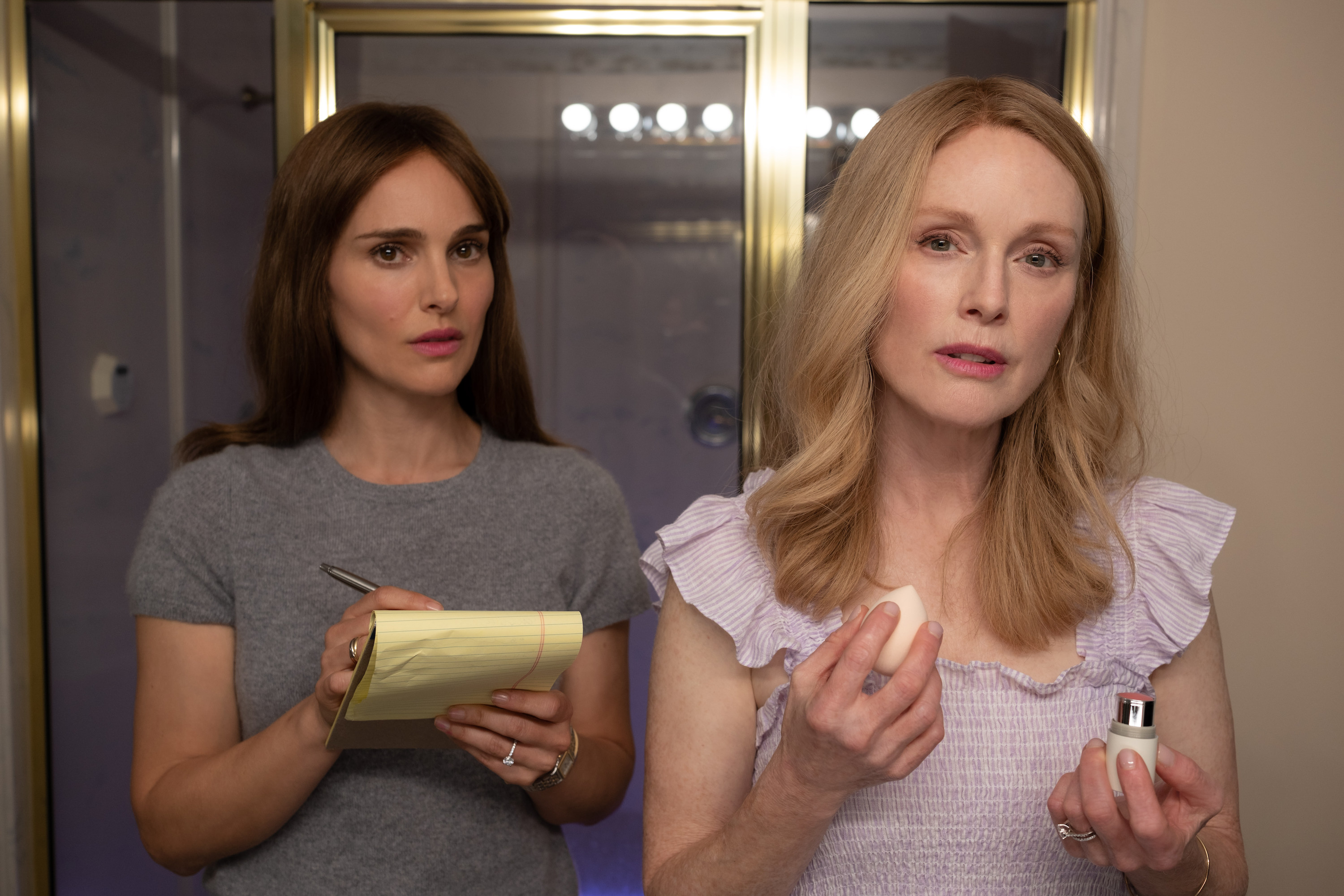
Even though Moore tends to chew the scenery here and there, taking her performance over the top into meaty melodrama and campy cheese, she does convey the skewed reality of a woman who did the crime and did the time, but now spends her days refusing to confront any of it or the damage it caused. Portman is the audience’s surrogate, looking into a situation and trying to understand it, then being pulled deep into it.
Together, they pull you into this tawdry tale based on taboo fodder, elevating it in the process to something much more profound, and more unflinchingly honest.
—Neil Pond
 The Media Tourist