Ferociously entertaining reboot shines with dazzling effects, action and emotion
Kingdom of the Planet of the Apes
Starring Owen Teague, Freyda Allan & Kevin Durand
Directed by Wes Ball
Rated PG-13
In theaters Friday, May 10
In the newest installment of the durable film franchise about a world in which apes and humans coexist, a young chimpanzee squares off with a fearsome bonobo leader as all civilization hangs precariously in the balance. It’s a rip-roaring dystopian survival tale, a heroic journey, a parable about caring for our planet and an emotionally resonant tale about families, friends and the future.
But Curious George Goes to the Zoo, it isn’t. There’s some seriously muscular monkeyshine going on in this depiction of what happens when our young protagonist chimpanzee, Noa, sets out on a journey to find his clan, which has been subjugated into slavery by a cruel alpha-ape tyrant who calls himself Proximus Caesar. (All you Latin scholars will know that proximus means “next” or “nearest,” which is this monstrous monkey’s only relation to the late, great benevolent ape leader Caesar, who died at the end of the previous movie, 2017’s War for the Planet of the Apes.) And Noa soon finds out just how the new Caesar is totally, despotically different from the old Caesar.
The new movie—the ninth in the canon—plunks us again down on Earth hundreds of years from now when apes have supplanted humans. We learn that the cause was a mutated virus with a world-changing side effect: It led apes to become fluent in speech (we know they know at least one common curse word!) and civilized, and dethroned humans into bands of feral, mute scavenging pests. The apes call humans echoes, suggesting their distant, faint resemblance to mankind of yore.
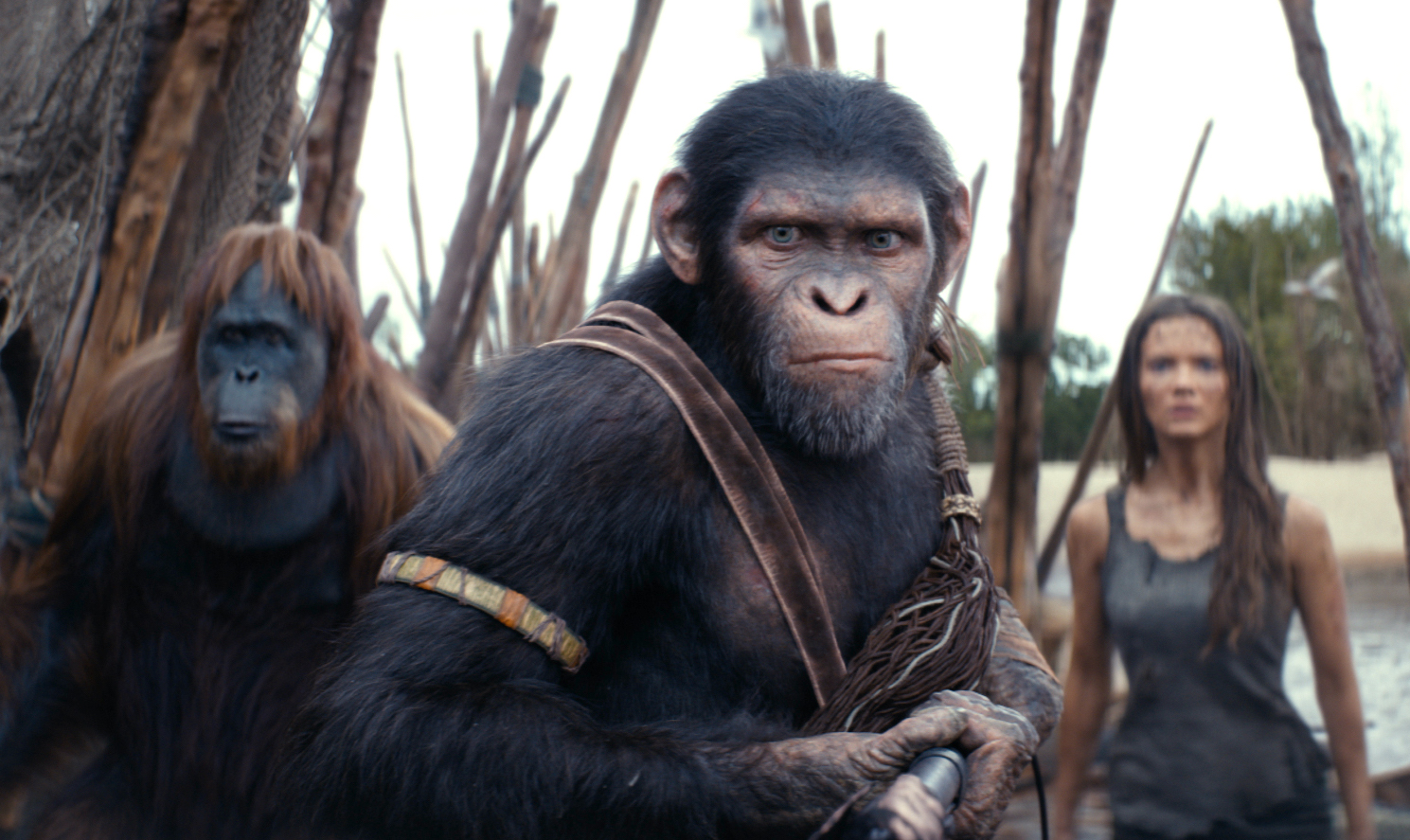
As you might suppose, most of the characters here are apes, played and voiced by actors underneath deep layers of motion-capture effects and CGI. Owen Teague is Noa, Kevin Durand is Proxiumus, and Peter Macon is Raga, a sagacious old orangutan. There’s also a host of talent behind the performances of Noa’s ape clan, Caesar’s merciless foot soldiers, and hundreds of supporting simians. There are only a couple of non-monkeys in the mix—William H. Macy is a human now ill-advisedly serving as a lackey for Proximus, and The Witcher’s Freyda Allan plays Mae, an uneasy female echo who becomes an ally of Noa and Raga—but with an agenda of her own that is revealed later.

It’s an ape-tastic epic, action-packed and full of feels that will touch your (human) heart, tapping back into the sci-fi soul of the original Planet of the Apes in 1968. (There’s a scene with apes on horseback, snatching up men and women with nets, that will definitely give you Charlton Heston vibes.) The tech is nothing short of amazing, showing just how much SFX has evolved and progressed—to make ape characters look, move and behave like apes, instead of human actors in monkey suits and prosthetics. With fully emotive CGI faces and bodies, these apes feel like they’re on the vanguard of the next movie-effects breakthrough, the same way Avatar set a new motion-capture standard more than a decade ago.
A couple of vertiginous “climbing” sequences, with the apes swinging like trapeze artists from mountainous peaks and scaling a sheer rock coastal cliff, will really get your blood pumping. The ape-on-ape fighting scenes have a fierce intensity that “human” actors can’t realistically match, with teeth-baring, chest-thumping, body-slamming brawls that might leave you feeling a bit bruised yourself.

In addition to allusions to politics, Roman history and power run amok, there are other touchstones. Monstrously menacing apes snarl like mini Kongs, ruling a brutish “kingdom” that resembles Col. Kurtz’s compound in Apocalypse Now. Even little Curious George gets a wink-wink shoutout, in a children’s book found by the apes. Some of the apes-on-horseback scenes, clopping along with conversational banter, reminded me of Butch Cassidy and the Sunday Kid. The abandoned shells of human civilization—from rusted ship hulls to hollowed-out shopping malls and observatories overtaken by ivy—are stark suggestions about where humanity might end up someday, marked by decayed relics of long-forgotten science, advancement and history.
This ferociously entertaining franchise reboot (from director Wes Ball, who also directed The Maze Runner trilogy) lets us revisit a planet still evolving, a place where apes and humans still haven’t fully worked things out. Will they ever, or will one or the other always get the upper hand? In a closing scene as humans and apes both look above, gazing at the same stars in the same night sky, we’re left to wonder what they’re thinking—and wait, perhaps, for the next return to the Planet of the Apes.
—Neil Pond
 The Media Tourist