Biopic about German minister who openly opposed Hitler reverberates anew today

Bonhoeffer
Starring Jonas Dassler, August Diehl and Flula Borg
Directed by Todd Komarnicki
Rated PG-13
In theaters Friday, Nov. 22
It’s impossible to miss the parallels to today’s fractured politics in the new biopic about the German theologian who stridently opposed the Nazi takeover of his country. The film’s warnings about fascism, dictatorship, authoritarianism, Christian nationalism and antisemitism are at the heart of the story, then, as now.
Dietrich Bonhoeffer was a pastor and author whose “radical” interpretations of Christianity became theological building blocks for generations to come. But his outspokenness about Hitler—and his association with a failed attempt on Dur Fuhrer’s life—sealed his fate.
There have been almost 10 movies already about Bonhoeffer, and this one mostly soft-pedals through its story about the firebrand man of the cloth who infiltrated the Nazis as a spy, became implicated in an assassination attempt, and spent the last days of his life as a prisoner of war. Bonhoeffer believed that his faith obligated him to take decisive action against Hitler and his genocidal movement against Jews, in the same way that he’d feel obligated to stop a madman driver intentionally trying to kill other motorists on the road. There’s a lot of “action” around the movie’s edges, but onscreen it’s largely a lot of talking—about what’s happening, what happened, what might happen, and what should happen as Germany slides into the dark abyss of the Third Reich. I wish the filmmakers had taken a cue from Elvis for “A Little Less Conversation” (and “a little more action, please.”)
It’s a modest production with no recognizable names attached, at least for American audiences. Jonas Dassler, who plays Bonhoeffer as an adult, is a young German actor likely a bit better known in Deutschland, and maybe—maybe—you’ll recognize another German actor, August Diehl, from his role in Inglourious Basterds, as the Gestapo officer who horns himself into a tavern guessing game. Germany’s Fuela Borg was Javelin in The Suicide Squad, had a small role in one of the Pitch Perfect movies and appeared in an episode of TV’s Ghosts. Irish actor Muiris Crowley, who plays a sneering Nazi, popped up (as the “Third Saxon noble”) in a couple of episodes of Vikings.
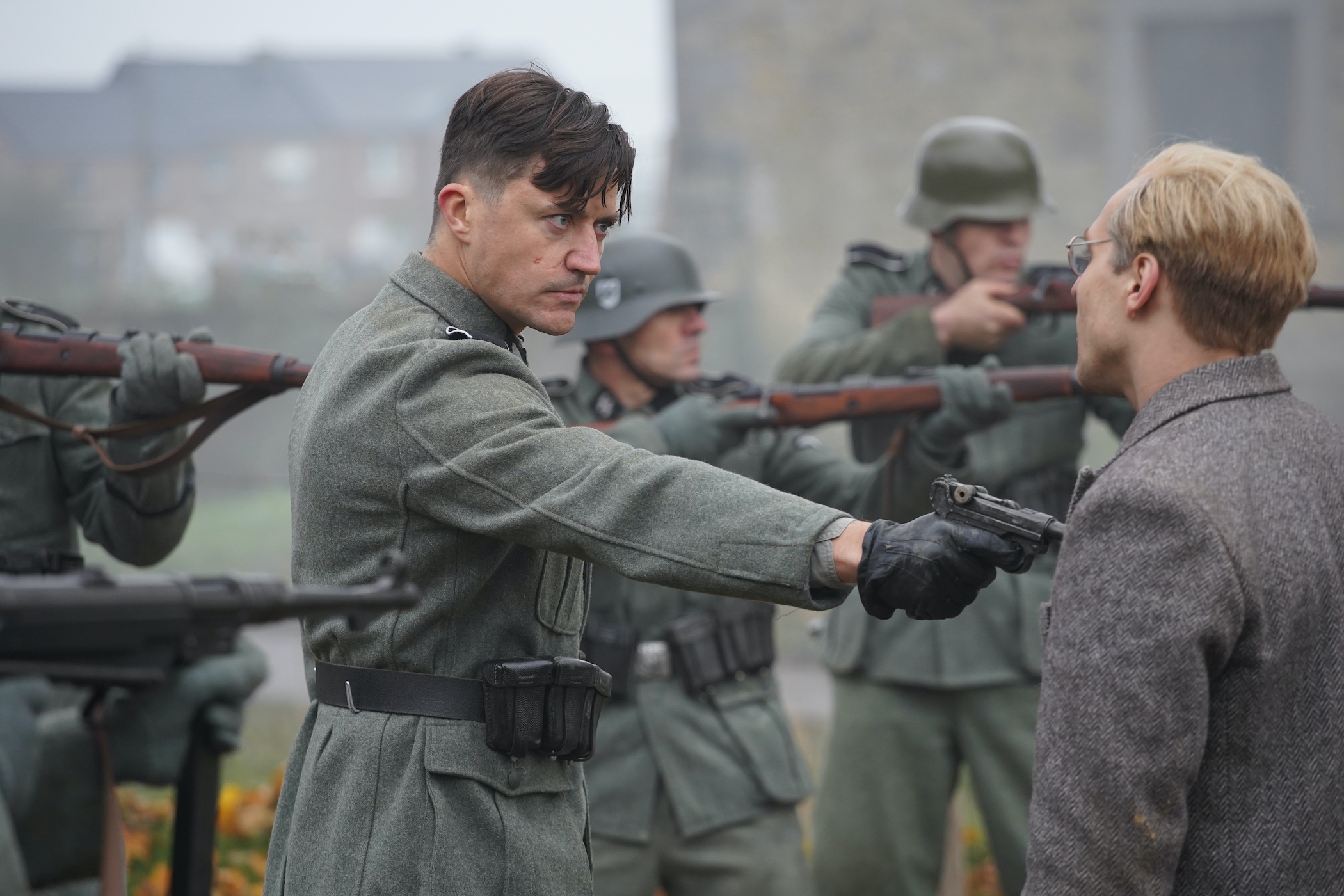
The film shows Bonhoffer as a young lad frolicking in lederhosen, spending time in seminary, getting exposure to Black church services, jazz music and stinging American racism, and finally enduring his incarceration (where he serves communion to his fellow inmates—12 of them—in a scene obviously modeled on The Last Supper.) Winston Churchill (Tim Hudson) and Louis Armstrong (John Akunmu) get cameos. But I kept thinking the movie’s roving eye, hop-skipping across time and place and people, should settle down and sharpen its focus.
But it’s certainly a movie for thinkers, as well as doers, and it offers a lot to think about.
You might recall that a certain 2024 presidential candidate—now the president-elect—made no secret of his admiration for dictators and Hitler’s military prowess, and was supported by white nationalist extremists waving Nazi swastikas. Well, you don’t have to squint to see the movie’s connective tissue between past and present. (Not to mention the film’s pointed reference to Hitler replacing Holy Bibles in German churches with his own version, along with a copy of Mein Kompf—shades of the so-called Trump Bible, which contained copies of the Constitution, the Declaration of Independence, the Bill of Rights…and a snippet of Lee Greenwood’s song “God Bless the U.S.A.”) The movie’s an echo from the past with a resounding relevance today, about a man with bedrock beliefs remembered for taking on Nazi Germany, for confronting the menace and calling out its evil—and warning about the dangers of dragging the church into a political fray, kowtowing to government and getting trampled by jackboots. His life, and his words, ring true anew.
—Neil Pond
 The Media Tourist