Author Archives: Neil Pond

Best Seat in the House

Drumming with Charlie Daniels, a memorable slice of pizza with Lynyrd Skynyrd’s Artemis Pyle, and going gonzo for Southern rock
Ain’t it good to be alive and be in Tennessee!

That’s something Charlie Daniels used to bellow out on stage, typically when he was playing back on his midstate home turf.

In the late 1970s, he was the big kahuna of the growing band-centric genre of Southern rock, which included such diverse groups as Lynyrd Skynyrd, the Marshall Tucker Band, Wet Willie and the Allman Brothers. Charlie had paid his dues as in the 1960s as a Nashville session guitarist (he played with Bob Dylan, Ringo Starr, Pete Seeger and Flatt & Scruggs) and touring road dog. He produced an album by The Youngbloods.

In the early 1970s, he’d had enough of all that and wanted to helm his own group. The Charlie Daniels Band finally hit the airwaves with “Uneasy Rider” in 1973. I remember him performing that song solo, on Ralph Emery’s early-morning weekday TV show, when I was a sophomore in high school. I remember thinking, wow, he looks like he’s not used to being up this early.

Starting the next year, Charlie would throw a big annual homecoming bash, the Volunteer Jam, in the Nashville area. He’d invite all his Southern rock friends to share the stage, along with special surprise guests from the wider musical world—James Brown, Ted Nugent, George Thorogood, Crystal Gayle, Roy Acuff, Alabama, Carl Perkins, Little Richard, Stevie Ray Vaughn, Don Henley after he’d gone solo from the Eagles. It was the big all-star concert event of the year, with a proudly Southern-fried spin.

In my role as a journalist, I crossed paths with Charlie several times over the years. And his music was a formative part of my teenage years, which happened to be the era in with Southern Rock was on the ascending arc of its curve, and South-rooted FM rock was at its zenith…especially in the South. I played in a band during high school—drums—and would put down the sticks and pick up a pawnshop fiddle to play a screech-y version of “The South’s Gonna Do It,” the CDB’s breakout hit from 1974. (Fortunately, in those dark ages of technology, no home video exists of me playing the fiddle.)

A few years later, I got to know one of Charlie’s two drummers, Freddy Edwards, when I was dispatched to interview and photograph him for the newspaper The Portland (Tenn.) Leader, for which I was working during college breaks. Freddy and his wife had bought a house locally, less than a mile from where I grew up, and we got to be friends. I photographed him for the piece in his basement, playing his drums. It looked a lot like the basement in my house, where I’d learned to play on my kit.

And in an interview that would presage my movie-reviewing career by some three decades, we talked about a wide range of things—including the movie Freddy and Colleen had just seen, Day of the Dolphin, starring George C. Scott. I don’t remember much else about the interview, but I do remember how impressed Freddy was with the story about “intelligent” research dolphins who are kidnapped in a diabolical ploy to use for a political assassination.

Freddy invited me one day to come along with him to a CDB rehearsal, at Charlie’s place in Mount Juliet, Tenn. Why, of course! To give the pretense of something professional, I brought along my camera and snapped some pics of Charlie and the band running through songs for the album, Million Mile Reflections, they were getting ready to record in the studio. Freddy asked me if I wanted to sit down behind his drums and play a bit while the band loosened up and jammed—on a tune that turned out to be the albums’ opening cut, a song called “Passing Lane.” To this day, whenever I hear that song, I hear the groove that I had locked into that morning in the rehearsal house on Charlie’s place.

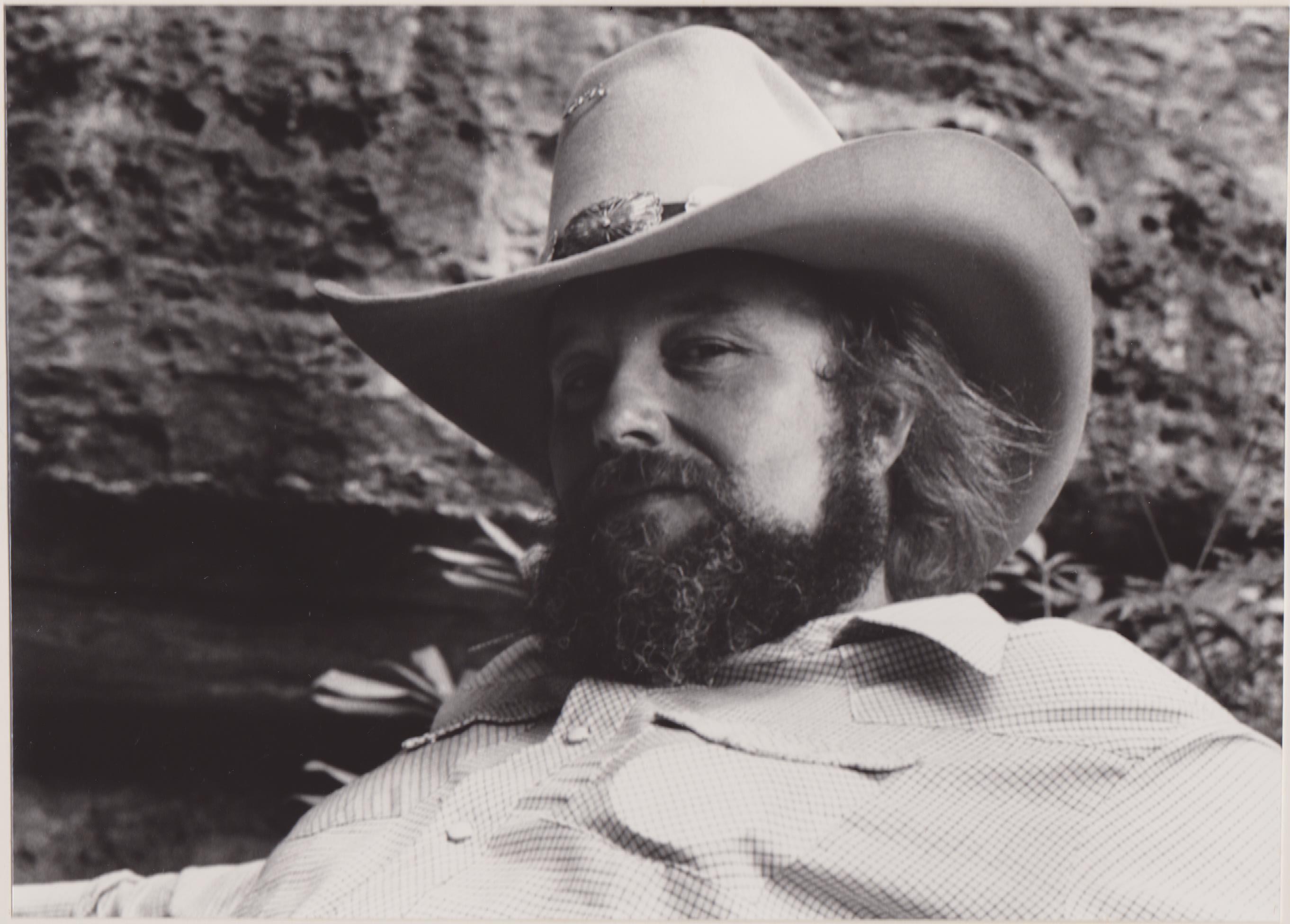
A few more years rolled by. I interviewed and photographed Charlie for a magazine cover story after he won a CMA Award for “The Devil Went Down to Georgia.” It was my first job out of college, and I met him at the south Nashville home of his manager, Joe Sullivan, the former DJ who founded Sound Seventy Productions. I took some portraits of Charlie leaning back in a swing in Sullivan’s backyard, against a wall of sheared rocks, because it had a kind of Mount Rushmore feel. Charlie was himself a mountain of a man, a big guy. And if Southern rock had a Mount Rushmore, he would have certainly been on it.

“I’m just a country boy who plays the guitar and the fiddle,” Charlie told me, spitting a mouthful of tobacco juice with an emphatic splat into a pop bottle. “That’s all I am. I ain’t no better than anyone else. I don’t look at myself as being separated from the rest of the human race just because I sold a few records.”

He went on to sell a few more records, and I went to several Volunteer Jam events, marathon kaleidoscopes of eclectic performances, all revolving for that one night around Charlie Daniels. One piece I wrote on the Jam in the early ’80s described the performers cycling on and off stage like precision figurines in a massive Swiss clock of Southern rock, musical moving parts all clicking and ticking in sync with the night’s schedule. But you never knew who’d be coming up next. Appropriately enough, the Jams always closed in a late-night jam session, with everyone who’d performed that evening invited to return to the stage and join in.

As a fledgling music journalist, I’d been reading a lot of Rolling Stone, trying to soak up some of the mojo about how the big boys covered big musical stories. One of the RS “correspondents” was Hunter S. Thompson, whose counter-cultural “gonzo journalism” was a free-wheeling mixture of surrealism built around his own outrageous experiences. In Thompson’s world, a writer did than simply report a story—he became part of the story, shaping and sizing it by his presence and participation. I wasn’t gonzo enough to throw myself into Thompson’s dizzying swirl of whiskey, weed, cocaine and acid, but it did give me an idea.

I called Charlie’s publicist, Paula Szeigis, and pitched my proposal for covering the upcoming Volunteer Jam XIII, set that summer at the outdoor Starwood Amphitheater. Charlie knows I’m a drummer, I reminded Paula. What if I played drums during the Jam’s closing jam session, and wrote about it, for coverage? That seemed like something Hunter S. Thompson might have done if he were covering a Charlie Daniels event for Rolling Stone. It seemed gonzo tailor-made for me.

Paula seemed to like the idea, and said she’d run it by Charlie. A couple of weeks later, I got the confirmation call. I’d be drumming at the Volunteer Jam.

At the event, I picked up my laminate and milled around backstage with all the other musicians—Stevie Ray Vaughn was there, so was William Lee Golden of the Oak Ridge Boys. Over there is the L.A. rock band Great White, and is that Amy Grant’s husband, Gary Chapman? Yep, it is!  

But the VIPs of the evening were the members of Lynyrd Skynyrd, making their first appearance with Johnny Van Zandt as then new front man. He was the little brother of Ronnie, who died in the tragic airplane crash ten years earlier; the crash killed a total of six band members and crew, including guitarist Steve Gaines and his backup vocalist sister, Cassie. That night’s Volunteer Jam was a reunion of the surviving members, who’d decided to pull all their loose ends back together after the setback and re-form for a tribute tour.

It would be the final time they’d share the stage with Allen Collins, who appeared in a wheelchair, waving to the crowd. But his guitar-playing days were over. I think a lot of the crowd at Starwood thought Collins was incapicated because of injuries after the plane crash, but actually, he’d been paralyzed in a 1986 car accident when his new black Thunderbird flipped on a Florida highway, killing his girlfriend passenger. He would never play guitar again, and he died three years later.

There was Ed King, the former Strawberry Alarm Clock member who’d joined Skynyrd in 1972. And there was bass player Leon Wilkeson and drummer Artemis Pyle (more about him later), the former U.S. Marine and aviator who’d replaced the band’s original drummer, Bob Burns, in 1974. And there was Gary Rossington, one of the band’s founding members, and piano player Billy Powell, who started as a Skynyrd roadie but became a part of the group after the band heard him noodling around on a keyboard.

With Rossington’s death March 5, the band’s “classic” lineup was all gone—Ronnie Van Zant, Gaines, Wilkeson, Powell, Burns and King. I’ve been thinking about how almost all the Skynyrd band members I watched that night are no longer with us, and three of them had perished a full decade earlier. It had been a rough road for Lynyrd Skynyrd. And Southern rock, as a genre, would soon be past its heyday, a retro relic of another place and time.  

I’ve been thinking about the times I heard Lynyrd Skynyrd, the times I saw Lynyrd Skynyrd, and about the time I reviewed their sophomore album, Second Helping, for my high school newspaper. Believe it or not, I slagged Bob Burns’ drumming. (He left the band in 1974 after a mental breakdown.)  And I’ve been thinking about a night in 1989 in Elliston Place, Nashville’s West End music district, when I sat down at a table in The End, the little rock club across the street from the Exit In, and had some pizza with Artemis Pyle.

I was playing drums in a little Beatles cover band, Day Tripperz, and we making a return appearance at the club. There were maybe 20 or so people there; it was a weeknight. I couldn’t see very clearly; it was dim and dark. But I could make out the silhouette of one guy, with long dark hair, and he seemed a little bit older than the otherwise college-age crowd. Then a delivery guy from Obie’s Pizza, across the parking lot, came into the club and yelled, “Artemis! Pizza for Artemis.”

I’d never heard the name Artemis until I started reading album credits and music features and came across Artemis Pyle. Could this be that Artemis, the one who drummed for Lynyrd Skynyrd?

Indeed, it was.

Our band was on a break, so I went over and introduced myself. He had friendly eyes and a big, fuzzy beard that seemed to meld with his long hair to completely obscure his face, and he asked me to pull up a chair. He was likeable and talkative. We bantered with a bit of drummer small talk, and then he told me about surviving the plane crash, and how he wanted to write a book, called “The Best Seat in the House,” about his perspective as Skynyrd’s stickman, getting to see everything—on stage and in the audience—from his seat behind his double-bass rig on the drum riser. Artemis didn’t sing; he just drummed…and watched. But the title had a double meaning. If he hadn’t been where he was sitting on that ill-fated Conair CV-240, when it plowed into the Mississippi swamp, if he’d been in another seat, situated somewhere else in the plane, he might not have made it. As it was, Artemis was the only survivor capable of crawling from the wrecked fuselage and trekking into the night looking for help, covered with mud and blood.

Best seat in the house, for sure.

At the Volunteer Jam event, I didn’t know when I’d play on stage, with whom, or what songs. So I just hung out, me and my laminated backstage pass, waiting for my cue and watching the musical flow—and the frenzy when Lynyrd Skynyrd took the stage, plowing into the opening bars of “Workin’ For MCA.”

When my “spot” finally came, at the evening’s big closing jam, I was instructed to come up on stage and stand behind one of the two risers on the backline; there were two drummers playing to keep the beat going and avoid any interruption when a sub would come aboard. One of the drummers, on the other riser, was Artemis. The risers were about three feet high, and they had a couple of little steps. A stagehand was standing beside me, behind the platform, and when one song finished, he reached up and put his hands into the rear of the drummer’s pants waistband and gave a tug—time to “switch out.”

The newly de-throned drummer hopped down, handed me his sticks and I climbed up. And before I could say “Yikes!” the 15 or 16 musicians on stage launched into a rocking version of “That Good Ol’ Mountain Dew.” Charlie was leading and calling the shots, throwing in fiddle breaks. Our two-drummer rhythm section was churning. And most of the Lynyrd Skynyrd band members—and various other musicians—were scattered about, picking and playing and trying to get all their chords in the right spots.

I could see the stage stretched out in front of me, with the edge about 40 or 50 feet away. The audience was a churning sea of faces on the other side, disappearing up the hillside into the night. The sound is different, on a big stage like that, from what you’d hear in the audience. I could barely hear when Charlie turned away from the stage and told the musicians what song we’d be doing next, and then we were launched into a peppy version of “Will the Circle Be Unbroken.”

I’d never played that, or the other song, either. But luckily, growing up steeped in music, I was familiar with them. I just locked in with Artemis, and away we went.

And then I got the tug; my time was up, and there was yet another drummer waiting to take my spot for the big finale, the closing jam number.

I didn’t get any pictures; it’s hard to photograph and drum at the same time. And all my Nashville press colleagues—from the Tennessean, from the Banner, from Billboard, from the Associated Press—had left early, to beat the traffic, along with most of the publicists who were there. I haven’t, to this day, come across anyone who witnessed me playing drums on the stage with Charlie Daniels and Lynyrd Skynyrd.

But I did.

And for a few minutes, I knew what Charlie Daniels meant, about it being good to be alive, and be in Tennessee—I was alive, in Tennessee, playing drums at an event I’d previously only experienced as a spectator. I was alive, even as the specter of death loomed in the gloomy recesses of Southern rock’s musical soundscape, waiting to pluck more victims. My heartbeat had synched with my drum beat, and I knew exactly what Artemis Pyle would later be talking about, off West End Avenue, over slices of Obie’s Pizza.

I, too, felt like I had the best seat in the house, and in a lot of ways, I always have.

—Neil Pond, March 2023
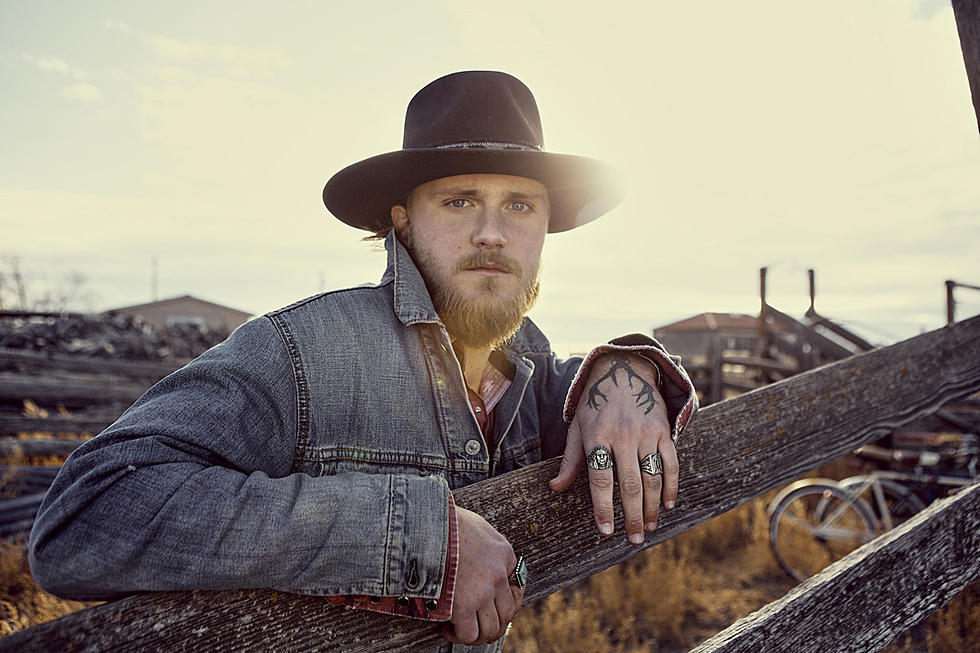
Not Afraid of Much

“Fearless” singer Jackson Dean on seeing ghosts, recording at the Ryman & what really gives him heebie jeebies

Jackson Dean’s new single is kinda scary. It details things that frighten a lot of people, and one thing that should scare everybody.

“Fearless (the Echo),” originally a track on his 2022 debut album, Greenbroke, gets a new kick of renewed energy this week on March 17 as the first release from Dean’s forthcoming full live album, recorded at the Ryman.

And recording at country music’s Mother Church was a dream come true, says the Maryland native now living in east Nashville. Dean, 22, vividly remembers visiting the Ryman for the first time as a teenager.

“I had just turned 15,” he tells me from his East Nashville home. “I had already [recorded] a little acoustic record, and my dad said, ‘Hey, you want to go [to Nashville] and check it out?’”

Dean sat with his mom and dad in the nosebleed balcony of country music’s venerated music hall, watching Jamey Johnson perform on the stage below, joined by his special guest, 27-time Grammy-winner Alison Krauss.

“They were singing ‘Dreaming My Dreams with You,’” a 1970s classic recorded by Waylon Jennings, Emmylou Harris, Crystal Gayle, Marianne Faithful and Jewel, among others. “And I fell in love with the place, with the Ryman,” Dean says. That’s why it was such a thrill for him to come back, seven years later, to record his songs in front a Ryman audience—one that had come to see him.

“I had [‘Dreaming My Dreams with You’] on my mind during the soundcheck,” he says. “It was a big bucket-list moment, a helluva mile marker for where I am now and where we’re headed.”

If you’ve heard the big ballad “Fearless,” get ready for a slightly different live version of it and other songs from Dean’s debut album, Greenbroke, released a year ago. The Ryman album has new players (including Dean’s road band), some supplemental instrumentation (lap steel and dobro) and an unbridled onstage live-show energy that he says “you can’t recreate” in the studio.

“ ‘Fearless’ is a bit fast,” he says. “That’s what happens when your adrenaline starts going faster than you can keep it down. All the [live] songs are a bit more aggressive, for sure.”

It’s understandable that Dean might be surging with super-charged adrenaline. He’s been hitting it hard on the road, opening shows for Blake Sheldon and Carly Pierce, and he’ll be on the bill at several major state fairs and festivals this summer, including Stagecoach, Country Thunder and the Iowa State Fair. Fans as well as critics have been wowed by his earthy, masculine baritone, which has drawn impressively lofty comparisons to Chris Stapleton, Waylon Jennings and Travis Tritt.  

And everyone wonders, where does a 20-something get a voice like that, one that sounds like it’s already lived a life beyond its years?

“I can tell you where that came from,” he says. “From my daddy. He was a stonemason for hire; still is. I’ve been working for my old man since I was about 10, and being on job sites, being expected to carry yourself like a man, it shapes you. You learn to walk and talk.”

You also learn, he says, to be fearless, like in his song—except when it comes to someone you love. “Dudes are dudes, and we ain’t scared of shit,” he says. “But the song is about being fearful of something happening to someone; loving them so much, you’re scared of losing them, or fucking things up. My dad told me and my brothers and sisters once, ‘I’ve been scared to death since the day you all started popping out of your mom.’ I can’t really imagine anything more powerful than the love of a dad for his kids.”

In “Fearless (the Echo),” cowritten by Dean with Jonathan Sherwood and Luke Dick, he starts the song by noting that he’s unafraid of risky behaviors like jumping off bridges, risking a fall from a narrow ledge, or even encountering ghosts. Maybe it’s because he’s done all those things.

He claims to have seen a ghost near his childhood home in Maryland, where years before, the bodies of several murdered missing girls had been found in the deep woods. “I swear to God,” he says. “My mom had gone to school with one of the girls, and she showed me her picture.” And that day, alone in the woods, “I saw her, that girl in the picture, walking through groups of trees. She passed behind one, behind another, and then she was gone. It sent a shiver down my spine. I’ve believed in ghosts ever since then.”

As for jumping off bridges and leaping from ledges, he’s done that too, into streams and swimming holes of the Potomoc River, near his childhood home between Baltimore and Washington, D.C. “There are some crazy cliffs on the Potomic, man,” he says. “I didn’t have a lot of friends growing up, so it was work, the woods and then music. Just like the song says, there’s not much that scares me.”

But there’s one thing that does make him somewhat slightly uncomfortable.

“I definitely don’t like spiders,” he says.

—By Neil Pond

The Entertainment Forecast

March 10 – March 16

Miley takes a ‘Vacation,’ Ted Lasso returns & ‘Bachelor’ women spill the beans

Jason Sudeikis (right) returns to the award-winning series ‘Ted Lasso,’ with co-star Nick Mohammed (left).

FRIDAY, March 10
The New York Times Presents: Sin Eater
Hard-hitting documentary looks at the work (and crimes) of Hollywood’s most notorious dirty-tricks “fixer” and private investigator, Anthony Pellicano (10 p.m., FX).

Miley Cyrus—Endless Summer Vacation (Backyard Sessions)
Coinciding with this week’s release of her eighth album, this performance special features the former Disney star (right) showcasing her new music in the intimate setting of, yes, her backyard (1 p.m., Disney+).

SATURDAY, March 11
Blood & Money
Real stories about real people and real investigations of greed and murder, including the Menendez brothers and billionaire Robert Durst, plus notorious grifters and con artists, in this new series from Law & Order mega-producer Dick Wolf (Oxygen).

SUNDAY, March 12
Shock Docs: Alien Abduction
Learn about a 1975 incident that became an international media sensation, involving a logging crew in Arizona, a UFO, a flash of bright light…and the baffling disappearance of one of the loggers—almost like, well, he was taken away by space aliens! (9 p.m., Travel Channel).

MONDAY, March 13
Street Outlaws: The Fastest in America
Teams of racers from across America compete to win $250,000 in this gritty reality series. OK, as long as they stay off my street! (8 p.m., Discovery).

The Good Lawyer
Kennedy McMann from TV’s Nancy Drew series stars as an ambitious young attorney in this pilot-episode spinoff from the hit series The Good Doctor (10 p.m., ABC).

So many ‘Bachelor’ women, so many secrets to tell!

TUESDAY, March 14
The Bachelor: Women Tell All
Girls talk, as Elvis Costello reminded us, and in this episode, all this season’s “contestants” get together to spill the behind-the-scenes beans (8 p.m., ABC).

Ted Lasso
Season three of the hit, award-winning comedy series launches tonight, as transplanted soccer coach Ted Lasso (Jason Sudekis) wrestles with team dilemmas and personal issues back home. With Juno Temple, Nick Mohammed, Anthony Head, Brett Goldstein and Hannah Waddingham (Apple TV+).

READ ALL ABOUT IT

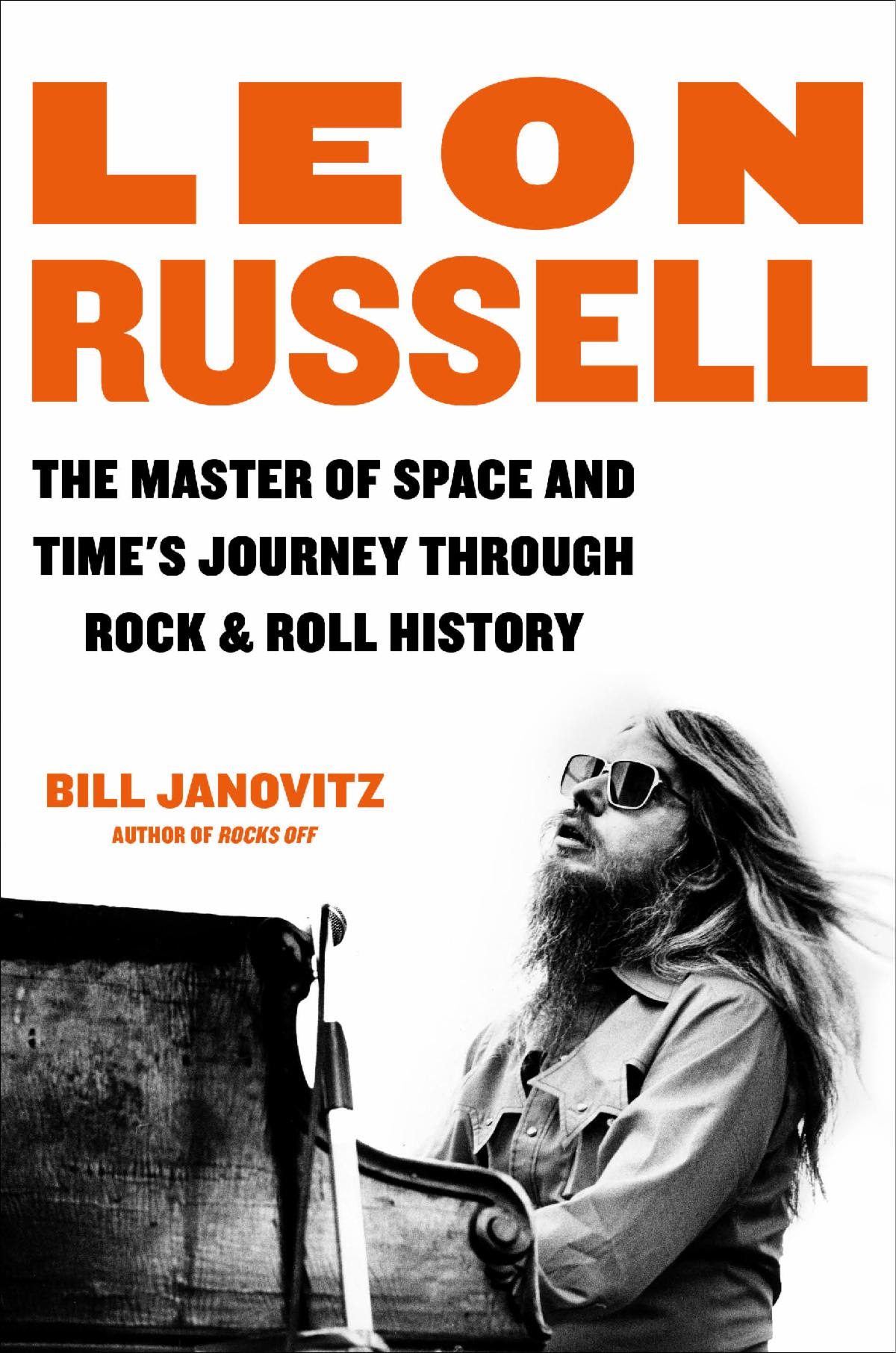
One of the most revered music-makers of the 20th century is told in Bill Janovitz’s Leon Russell: The Master of Space and Time’s Journey Through Rock & Roll History (Hachette), which chronicles the enigmatic, genre-spanning Rock and Roll Hall of Famer whose hits include “Tight Rope,” “Lady Blue” and “A Song for You.”

THURSDAY, March 16
Shadow and Bone
The young-adult fantasy continues, expanding its characters and its sci-fi mythology reach (Netflix).

Grown & Gospel
New docuseries follows the career paths of five childhood friends searching for a future in gospel music and navigating the murky business waters of Detroit (9 p.m., WeTV).

Queens Court
Actress Holly Robinson Peete and husband Rodney host this new series matchmaking rich and famous single Hollywood women with would-be suitors (Peacock).

NOW HEAR THIS

Some of today’s top country stars get rolling with The Rolling Stones in Stoned Cold Country (BMG), which shows the influence of the iconic British rockers on modern country music. Artists on the new CD include Brooks & Dunn, Ashley McBride, Maren Morris, Elle King, Eric Church and Laney Wilson, on tunes including “Honky Tonk Women,” “Dead Flowers,” “Tumbling Dice” and “Angie.”

Songs of Surrender (Island/Interscope) features 40 seminal songs of the Irish rockers U2. Re-recorded anew and ranging across the band’s entire catalog, the four-disc set includes “With or Without You,” “One,” “Beautiful Day,” “Sunday Bloody Sunday,” “Where the Streets Have No Name,” “Pride (in the Name of Love)” and many more.

FRIDAY, March 17
Power Book II: Ghost
Season three returns tonight, with new twists and turns as the characters deal with new complications in their relationships and their business. Starring Mary J. Blige, Michael Rainey Jr., Shane Johnson and Cliff Smith (8 p.m., Starz).

Bono & The Edge: A Sort of Homecoming with David Letterman
The former late-night host travels to Dublin in this new music documentary to hang out with the U2 musicians in their hometown, learn about their friendship of nearly 50 years—and join them for a concert performance unlike any they’ve done before (Disney+).

BRING IT HOME

Tom Hanks stars in the heart-tugging A Man Called Otto (Sony Pictures Home Entertainment), an adaptation of a Swedish film, as a crotchety senior citizen whose life takes a brighter turn with the arrival of some new neighbors. Just call him Forrest Grump.

Willie’s Secret Weapon

Almost everything superstar Willie Nelson has recorded over the past decade has been in collaboration with producer Buddy Cannon

Willie Nelson has a Buddy.

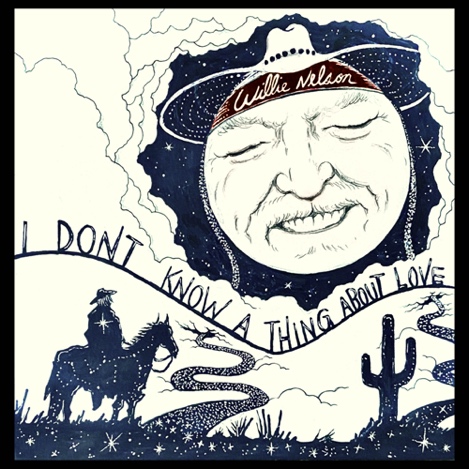
Not a buddy, but The Buddy. He’s the Nashville uber-producer who’s been producing Nelson since 2003. Most recently, they collaborated on I Don’t Know a Thing About Love, Willie’s latest album, a new collection of songs written by the late, great Nashville tunesmith Harlan Howard.

The album contains Willie’s all-new cover versions of Howard’s “I’ve Got a Tiger by the Tail” (a hit for Buck Owens), “Busted” (recorded by Johnny Cash, Ray Charles and a later it for John Conlee), “She Called Me Baby” (Carl Smith, Charlie Louvin, Charlie Rich), “Streets of Baltimore” (Gram Parsons, Bobby Bare), “Too Many Rivers” (Brenda Lee, Johnny Rodriguez, Ray Price, Eddie Arnold, Ernest Tubb), “Excuse Me, I Think I’ve Got a Heartache” (Buck Owens, The Mavericks, Dwight Yoakam), and the Ricky Van Shelton hit “Life Turned Her That Way.”

“I sent Willie a list of about 30 Harlan songs,” recalls Cannon of the project’s genesis. “I said, ‘Why don’t we choose from this?’ And Willie said, ‘Hell, let’s just cut the first ten!’ I don’t think we ended up doing exactly that but, I mean, what a goldmine of songs.”

Willie chose to name the project—the title of another Harlan Howard classic—when all the tracks had been finished.

“I think he just really liked that song,” says Cannon of “I Don’t Know a Thing About Love,” which was a No. 1 chart-topper for Conway Twitty in 1984.

Cannon’s musical path first intersected with Willie back in the 1980s, when Cannon was producing another act, Mel Tillis.

“The first time I met him, I was working with Mel [for a 1984 album] on a track called ‘Texas on a Saturday Night’,” says Cannon. “Mel thought it would be good to have Willie sing on it, and Willie said he would. So, he came into town one night and we went over to the old Music Mill on 18th [Avenue] and spent about two hours working on that song.”   

Cannon and Nelson eventually became buddies and true working collaborators years later, when Cannon was producing a new album for superstar Kenny Chesney, and the “No Hat, No Shoes, No Problem” singer also invited Willie to join him on a cut of the old pop standard “That Lucky Old Son.” Nelson liked Cannon’s production on the track so much, he asked Cannon on the spot to work with him on a record.

“He said, ‘Let’s go find some songs and make an album’,” says Cannon. “That’s how it kinda started.”

To date, Cannon has produced just shy of 20 albums for Nelson, and they’ve cowritten dozens of songs. The new I Don’t Know a Thing About Love is Willie’s salute to a songwriter regarded as one of the top tunesmiths of all time, the one who described a great country song as “three chords and the truth.”

Earlier this month, Nelson’s 2022 album A Beautiful Time received the Grammy for Best Country Album, and he won the Grammy for Best Country Solo Performance for “Live Forever,” a track from his tribute last year to singer-songwriter Billy Joe Shaver. Yeah, Cannon produced both of those, too. 

Nelson, a musical icon by any measure, began his career in his native Texas in the mid 1950s. He later relocated to Nashville in 1960s, where he struggled to crack into the musical community, eventually establishing himself as a fledgling songwriter. In the 1970s, he became a torch bearer for country’s “outlaw movement,” a musical ethos of iconoclastic artists who insisted on creative freedoms beyond the strictures of Nashville’s Music Row. Today, he’s a bona fide superstar, with 25 No. 1 hits, more than 200 albums and enough awards—including 12 Grammys—to fill a Texas dance hall.

And on the cusp of turning 90 in April, he’s still going strong. Cannon recalls a recent trip to visit Willie at his getaway home in Maui, where he watched him work out with a boxing speedbag. Only Willie wasn’t punching, he was kickboxing.

“It was higher than my head, and he was kicking that thing,” Cannon recalls. “He’s very agile.”

Killen says the vibe at the sessions for the new album were relaxed and in synch with Willie’s musically laid-back personality—and suffused with a portent of his almost-shamanistic creativity, just like always. “There’s an aura around him,” Killen says. “Every time I’m around him in the studio, I get excited because, you know, something magical is about to happen.”

Nelson’s iconic, idiosyncratic singing style and jazz-influenced phrasing have become musical trademarks, and his guitar playing is a thing completely his own. “You never know what it’s going to sound like, his singing or his playing,” says Cannon. “Even he doesn’t know what it’s going to come out like.” And forget about asking him to do another take of a guitar part, or a vocal phrase, the way he did it previously. “He sees absolutely no point in playing or singing the same thing twice. It’s different every time.”

He adds that Nelson has never been one to over-prepare, over-sweeten or overcook when it comes to making music. Nelson and Cannon’s collaborations show how “you can under-produce instead of over-produce, and it will be just as effective,” says Cannon. “A lot of Willie’s recordings have no background harmonies on them, and you don’t even notice it.”

One of Nelson’s albums long before he started working with Cannon was Willie Nelson & Family, the 1971 LP that established his eclectic, ever-widening circle of musicians, associates, friends and blood kin as a unique, like-minded clan…a family.

And for the past ten years or so, producer Buddy Cannon has felt like he’s part of that family, too.

“I get the Willie Nelson and family thing now,” Killen says. “People mean something to him. I think I’ve somewhat become a part of that.” 

What’s next for Cannon, and for Willie? The producer says their next studio collaboration will tap into Nelson’s wide-ranging tastes in all kinds of music. And they’ve already started working on it.

“We’re cutting a bunch of Willie’s old stuff with bluegrass musicians,” says Cannon, who’s mum on other details about the project.

But he notes that the bluegrass project is in keeping with Willie’s unpretentious, musically ecumenical embrace of all kinds of styles and formats, from country to pop standards, jazz and blues.

“He doesn’t think about genres,” says Cannon. “As far as he’s concerned, it’s just songs, and he’s just a singer.”

Neil Pond

Third Man Records Marks 14 Years in Nashville

Jack White’s indie boutique label continues to push the envelope for the “experience” of music

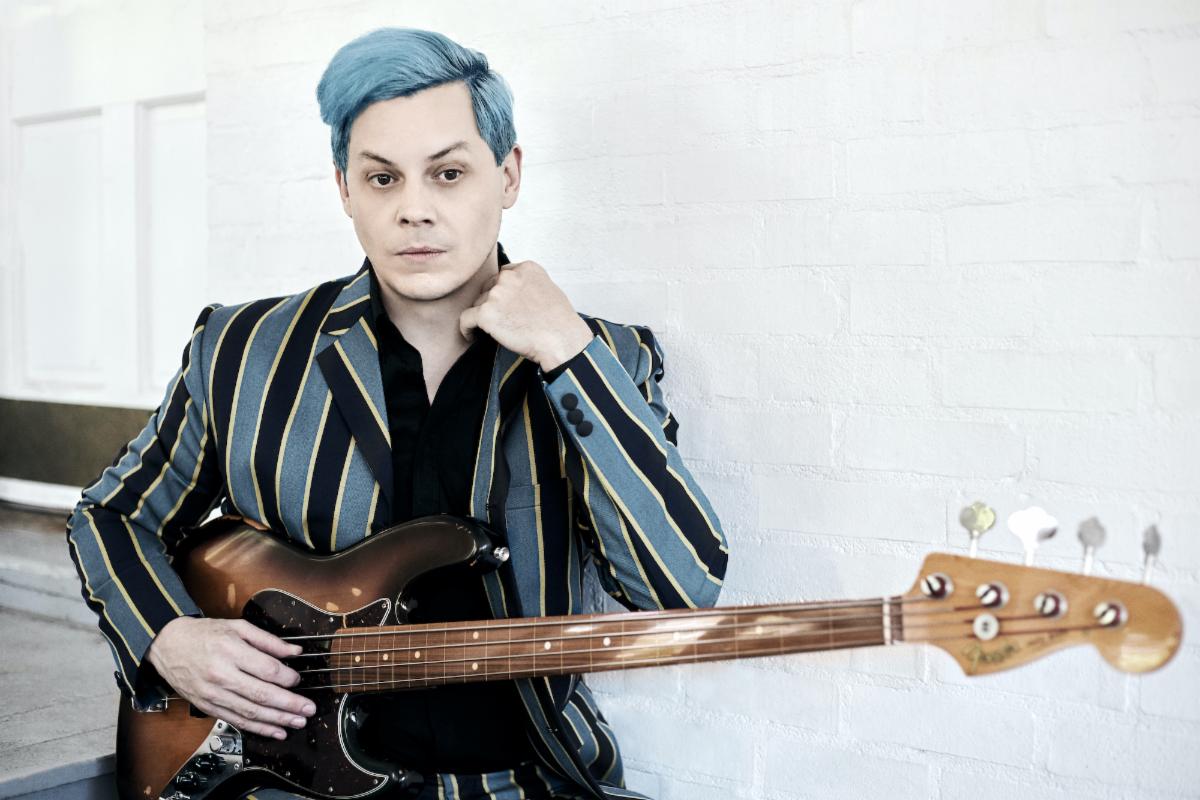
The former White Stripes front man opened up Nashville’s Third Man in March 2009.

Ben Swank might not be singing “Happy Birthday” this week, but he’ll be thinking it as Third Man Records marks its 14th year in Nashville.

“It feels like, wow, that went by so fast,” says Swank, who was instrumental in opening the Nashville branch of Third Man in 2009—and he’s been a Nashvillian ever since.

Some nine years earlier, Grammy-winning Detroit rocker Jack White had co-founded the independent, vinyl-centric record label with Swank and Ben Blackwell, his Michigan business partners. “It happens fast when you head down the middle of it.”

From its eclectic headquarters on 7th Ave. South, Third Man has grounded itself in the local music community, pushing the boundaries of what a record company can do and be. It releases records, sure, but it’s much more—a retail store, live-music venue, photo studio, distribution center, publishing company and arthouse cinema. Where else in Nashville can you see a collection of vintage music-machine curiosities, then catch a set by a visiting Scottish indie sensation? It’s the only record company in Nashville where an act can perform, record live and then have vinyl records made—on the spot—in just a matter of hours.

Fans can not only see and hear music, purchase it and be entertained by it, but can experience it in one of Nashville’s coolest, most unique settings, where music isn’t so much a commodity as an organic, ongoing creative process.

“Jack’s philosophy on a lot of things is to find new ways for fans to engage,” says Swank, whose describes his role and responsibilities as Third Man’s consiglieri.

Since its opening, hundreds of artists have plugged in to Third Man in Nashville. There’ve been singer-songwriters, garage bands and punk rockers, but also superstars. U2, Pearl Jam, Conan O’Brien and comedians Chris Rock and Aziz Ansari have performed and recorded there. So has White’s former White Stripes duo partner and ex-wife, Meg. Country’s Margo Price was a Third Man breakout with her critically acclaimed 2016 debut album Midwest Farmer’s Daughter.   

When I connected with him a couple of weeks ago, the consiglieri talked about becoming a Nashvillian, how he hooked up with White, and the big opening night, 14 years ago, that kicked everything off and set the tone for everything that would follow.

How did you meet Jack White?

We met when we were in our early 20s in Toldeo, where I’m from. One of his bands was playing on a bill with some friends of mine. My band played in Detroit [White’s hometown] a lot. We started swapping shows; he produced my band’s first big record. We just kind of became, the way music can bring people together. But more than that, I always thought Jack was an intelligent, natural-born almost bohemian type person, and I’ve always found myself more interested in people like that. I just think we identified with each other a little more than some others in the world. But certainly, music was the first thing that kind of made us friends.

White had already moved to Nashville, in 2005, after producing Loretta Lynn on Van Lear Rose, her much-hailed comeback album, on which the former White Stripes front man also sang and played guitar. Impressed by the Music City vibe, he decided to open a Nashville branch of Third Man, expanding beyond the company’s original footprint in Detroit and its later setup in London. Swank, working in the London location at the time, and Blackwell, White’s nephew, were tapped to relocate and set up the new operation.  

What were your first impressions of Nashville?

I didn’t know anything about Nashville, and then, here I was. My very first night they took me down to Broadway, and I thought, ‘Oh, boy, well, this isn’t me.’ But I put in some time, and almost immediately I started seeing that this is the perfect place for us. I wanted to be in a smaller town, and I was kind of tired of living in a sort of hectic-ness [in London]. Nashville had everything we needed for Third Man; URP, United Pressing Service, who started working with us [making acetates and records] almost immediately, was right down the road from us; [and] there’s so much printing [done] here. It felt very close to what we were trying to do, at start of the onset of the trend of small businesses and farm-to-table restaurants. We wanted to say, “Come in, you can record, take your photos, do all of it in-house, and your records will be made here in Nashville,” A one-stop shop.”

Third Man launched in Nashville on March 11, 2009, with a top-secret grand opening known only to the 100 guests who’d been invited. White debuted his new band, The Dead Weather, which played their very first show in Third Man’s new venue space, the Blue Room.

What do you remember about opening night?

Lots of industry people came to see the debut of Dead Weather. We had already pressed Dead Weather’s first seven-inch [vinyl 45], which was available at the show. All the sleeves were hand-signed by the band. Everyone got an individual piece of photo strip of the band, and each one had a different picture in every frame. I think it immediately set the pace for what we were trying to do. We took everyone’s phones away; they had to immerse themselves in this party, this experience. It was amazing to see people’s minds blown by this new thing that was happening.

Third Man continued to add to the experience of music. In 2013, it introduced the Third Man Record Booth, where fans—or anyone else—could step inside a small space and make an “instant record.” Soon, artists also flocked to the booth; Neil Young recorded a whole album in it; Weezer, Weird Al and Richard Thompson also plugged in to its unique aural ambience.

What other new things did you bring to Third Man after the opening?

We’ve expanded our retail store four times. We bought the building next door to us and combined both into one larger structure. So, we now have distribution in-house now, as well as what we call “soft” merchandising manufacturing—T-shirts, etc. And we added the photo studio, where we hand-develop film and make prints in-house. Our Blue Room is now open for shows five nights a week. We’re a bar that’s open on a near-daily basis. We have 800 releases under our belt at this point, I have a family now and I’m almost 50. It’s fun to look back. We started out as a very small team, and we’ve built a very specific kind of world and culture here.

Especially at first, locals expressed some skepticism about the location chosen for Third Man in Nashville—just across the street from the city’s homeless shelter, a couple of blocks from the Greyhound station, in an industrial zone where businesses mostly buttoned up and shut down after dark.

There were comments about Third Man setting up shop in a spot that some people considered dicey, or even a little dangerous.

It doesn’t bother us. We still hear about that; apparently, it’s a concern for some folks. I think it says a lot more about [them] than us, to be honest. Just because we’re next door to the mission, I don’t think it means anything necessarily bad about the neighborhood. It’s always felt like home to us, and that’s what Jack [wanted]. Since we come from a more sort of industrialized city, it never seemed out of place to us.

What have been some of the highlights and things you’re proudest of?

We have a world record—the fastest record ever made, which we did in front of a live audience; recorded it, pressed it, did the artwork. That was a big thing.

[In 2004, White recorded a pair of new songs in front of a live audience, then took the direct-to-acetate disc to United Record Processing, printed vinyl singles and brought them back to Third Man, immediately, to sell to fans. Elapsed time: just under four hours.]

We put a record in space, Carl Sagan. [Third Man’s 2016 vinyl release of the Cosmos host talking was set to music by composer John Boswell; a gold-plated vinyl copy spun on a turntable, specially designed to function in the deep freeze of high altitudes, attached to a high-altitude balloon that ascended to 94,000 feet]. It sold a lot of copies for us.

We brought countless bands through our doors that hadn’t played in Nashville before or wouldn’t have played here otherwise. We have the only venue in the world where you can play a live show in front of an audience and record direct to acetate, live to a master in real time. The audience can watch that process as it happens, and then buy those albums. That’s something that only exists in Nashville, because of us.

We screen films; we have 16mm projectors and we try to show films that are out of distribution. We do massive poetry events and art shows. We really try to just be part of the culture overall. [Third Man’s publishing imprint has released an array of diverse titles of poetry, fiction and children’s books, including White’s own “We’re Going to Be Friends.”]

There’s been so much over the years. But I think the thing I’m most proud of is really being a part of this community, less about being the “first ones” about anything. More about being a part of what’s special about Nashville, and bringing our own stamp to that, in a very specific Third Man way.

—by Neil Pond

The Entertainment Forecast

March 3 – March 10, 2023

Snoopy returns, Mel Brooks’ new ‘History’ project & guess who’s coming to dinner?

Gigi Hadid and Tan France are looking for the next stars in fashion designing.

FRIDAY, March 3
The Snoopy Show
The world’s most iconic cartoon beagle returns for season three—with even more happy-dancing, fighter-ace plane flying and adventures with his birdie buddy, Woodstock (Apple TV+). 

Next in Fashion
Tan France and Gigi Hadid host season two of the high-stakes design competition series, in which talented designers complete for $200,000 and the chance to share their work with the world (Netflix).

SATURDAY, March 4
Black Girl Missing
Inspired by true stories of missing women of color, this original movie stars Garcelle Beauvais and spotlights the disparities of Black women by the media and authorities. It’s part of network’s ongoing “Stop Violence Against Women” campaign.

SUNDAY, March 5
Be My Guest
Dancer Misty Copeland, actors Stanley Tucci and Laura Linney, and singer-songwriter Norah Jones are among on host Ina Garten’s drop-in list for the new season of her series about sharing fabulous food, sparkling conversation and lots of laughs (11:30 a.m., Food Network).

The Rise and Fall of HQ Trivia
Find out the story behind the explosive rise, and the abrupt decline in fortune, of the 2017 trivia-game app that was supposed to herald the beginning of a new era of television—but didn’t (9 p.m., CNN).

MONDAY, March 6
History of the World Part II
It’s been four decades since Mel Brooks’ seminal, sidesplitting comedy opus, and now there’s finally a sequel. The celebrity-packed sketch-comedy series stars Brooks, Nick Kroll, Wanda Sykes and Ike Barinholtz, with appearances by Zazie Beetz, Quinta Brunson, Danny DeVito, David Duchovny, Hannah Einbinder, Johnny Knoxville and just about everyone else who ever tickled a funnybone (Hulu).

Rain Dogs
Dark comedy series about a single British mum, her young daughter and an upper-class gay man—a dysfunctional “family” on the fringes of society attempting to go straight in a crooked world (10 p.m., HBO).

TUESDAY, March 7
Unseen
Two women form an unlikely alliance when a gas station clerk receives a call from a nearly blind woman who’s fleeing her murderous ex. Can the gas gal guide the sight-impaired former spouse to safety? (VOD).

READ ALL ABOUT IT

Bounce around through women’s basketball history and learn how it was shaped in Hoop Muses: An Insider’s Guide to Pop Culture and the (Women’s) Game (Twelve Books) by Emmy-winning journalist Kate Fagan, who brings a colorfully illustrated, time-traveling hipness to this under-recognized story of female hoopsters.

BRING IT HOME

Now on Blu-ray and DVD, the critically hailed Women Talking—based on a real incident—features an ensemble cast (Jessie Buckley, Rooney Mara, Claire Foy and Frances McDormand) in an inspiring tale of Mennonite wives and daughters who make a fateful decision after years of abuse by men in their community. (Universal Pictures Home Entertainment)

WEDNESDAY, March 6
The Challenge: World Championship
This first-ever global “Challenge” event will feature veterans of the “extreme” elimination series competing in a new series of complex, sometimes grueling games (Paramount+).

Farmer Wants a Wife
Grammy-winning country hitmaker Jennifer Nettles (above, who starred in the hit TV series The Righteous Gemstones) helps wrangle romance in the heartland in this new dating series, already a smash in other countries but making its USA debut tonight (9 p.m., Fox). https://mail.google.com/mail/u/0/#inbox?projector=1

THURSDAY, March 9
School Spirits
In this new streaming series aimed at the YA market, a teen girl (Peyton List) stuck in the afterlife goes on an investigative journey to find out what happened to put her there—while adjusting to high school in the hereafter (Paramount+). https://mail.google.com/mail/u/0/#inbox?projector=1

Tagged

Crafty Criminals

Jason Statham does the dirty work in Guy Richie’s action-comedy ‘Operation Fortune’

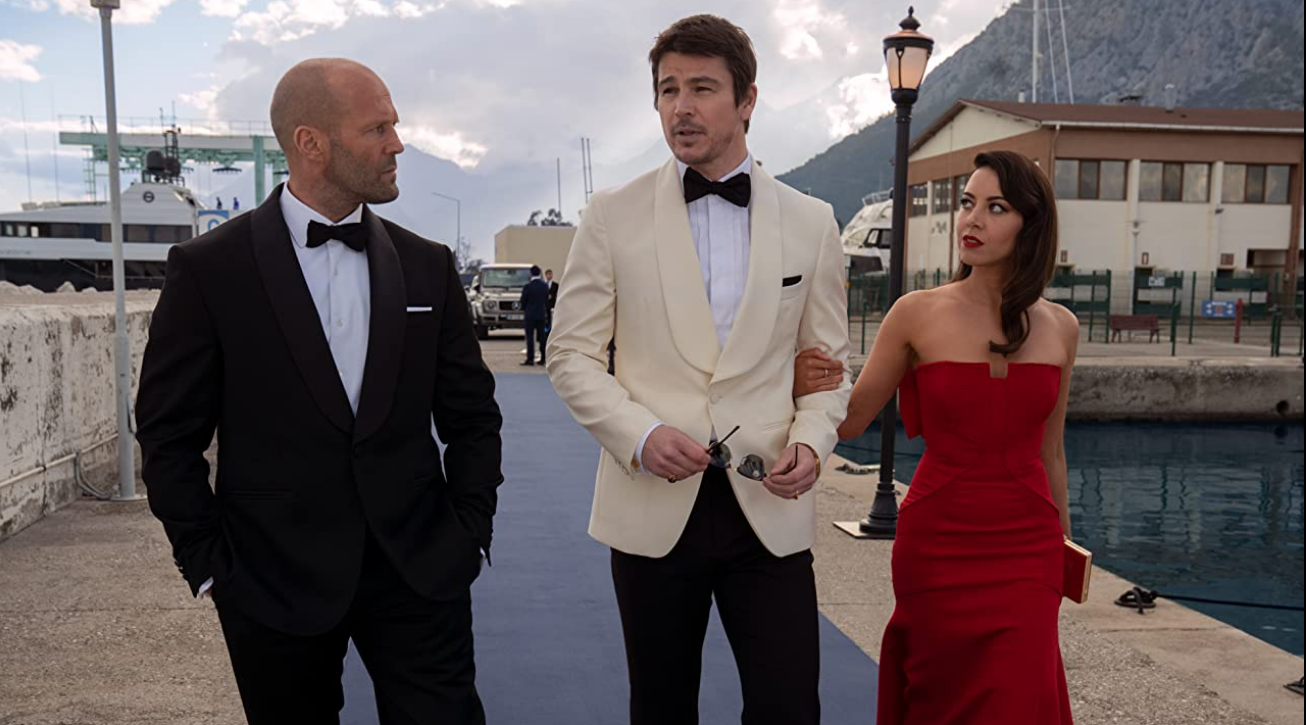
Jason Statham, Josh Hartnett and Aubrey Plaze in ‘Operation Fortune,’ a movie that delayed a full year…but not for the reasons you might think.

Operation Fortune: Ruse de Guerre
Starring Jason Statham, Hugh Grant, Aubrey Plaza, Carey Elwes and Josh Hartnett
R
Directed by Guy Richie
How to Watch: In theaters Friday, March 3

A high-stakes, slam-bang spy caper, director Guy Richie’s latest flick again shows off his fondness for crafty criminals, fast-moving action and wisecracking British gents.

In Operation Fortune: Ruse de Guerre, a super-agent and his team recruit a Hollywood star to help them on a far-ranging mission to track down a heisted something-or-other. If they don’t get it, someone else will—and that would be bad news for, well, everybody else.

What they’re after, as they follow a $10-billion-dollar money trail, involves special agent Orson Fortune (Jason Statham) breaking bones, busting heads and blasting bad guys all over the place, from the French Riviera to Turkey and Quatar.

And it also involves a sexy-smart computer sleuth (Aubrey Plaza), a munitions and muscle man (British rapper Bugsy Malone), a government secret-ops liaison (Carey Elwes), a celebrity-obsessed billionaire (Hugh Grant) and his Hollywood movie-star crush (Josh Hartnett).

The film’s subtitle, Ruse de Guerre, is French for the “deception of war,” and deception is the name of Operation Fortune’s international cat-and-mouse game.

The movie’s been “in the can,” finished and ready to go for more than a full year. Reportedly, its release was postponed not by the COVID 19 pandemic, but for its depictions of Ukrainian gangsters.

Director Richie is known for his British gangster films Snatch and Lock, Stock and Two Smoking Barrels; the Sherlock Holmes franchise with Robert Downey Jr.; The Man From U.N.C.L.E, the big-screen remake of TV’s 1960 spy series; Disney’s Aladdin; and the medieval epic King Arthur: Legend of the Sword. He likes his popcorn movies to have pop, ka-pow and lots of punches, and this one’s got all of those. It’s fast and nimble, sharp and stylish, with likably roguish, smack-talking characters doing dirty work.

The movie opens with the rhythmic click-click-click of shoes on a well-dressed character as he makes his way down a long, polished hallway, setting the stage for the film’s driving percussive beat of quick edits, dapper elegance, quippy banter and globetrotting, jet-setting travel that rarely pauses to catch its breath.

It’s a reunion for the director with Hugh Grant, who appeared in The Gentlemen, another of Richie’s criminal-caper flicks, and with Statham, with whom Richie collaborated Wrath of Man (plus four other projects). British actor Peter Ferdinando—who plays a disreputable rogue spy competing with Statham’s character for the whatzit—was an earl in King Arthur: The Legend of the Sword.

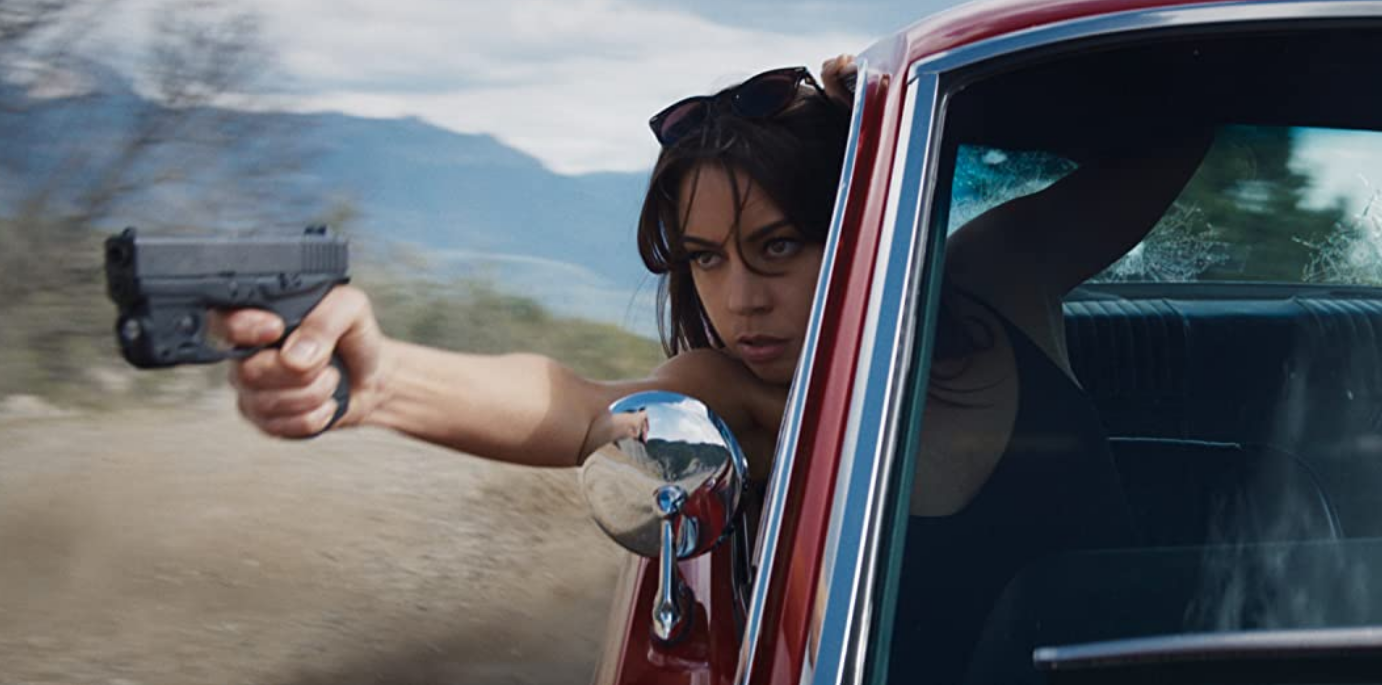
Aubrey Plaza fires away.

Grant, who became a star in British romcoms and costume dramas— like Four Weddings and a Funeral, Sense and Sensibility, Love Actually and Bridget Jones’s Diary—continues to flex his comedic chops. Plaza, best known as the deadpan April Ludgate in Parks and Recreation and more recently on HBO’s season two of The White Lotus, has saucy fun as the team’s cool, confident tech chick. And Hartnett—whose resume includes playing the Wolfman in the TV horror series Penny Dreadful—slips right into the movie’s meta-joke, as a Hollywood action star who now finds himself playing himself in some for-real, life-or-death cloak-and-dagger business.

But the movie is built around Statham, who continues to ride his reputation for intense, tough-guy roles, as established in the Fast & Furious franchise, The Expendables and a slate of other action-thriller films. His schtick ain’t Shakespeare, but he does elevate meaty, muscle-bound macho to a kind of movie art form—one he satirized to great effect alongside Melissa McCarthy in the rollicking comedy Spy. It doesn’t seem like any stretch at all for him here, playing a character whose quiet, coiled collectedness can erupt, when necessary, in a lethal torrent of bruising force, served up with a dry, wry slice of Brit wit.

There’s a car chase with a vintage Mustang; characters come and go between mansions in luxury jets and private yachts; there’s more than one discussion of fine wine. Everyone, even the thugs, looks dashing. The movie drips self-assured style and oozes money, and people take some realistic-looking pummeling in the fight scenes. But the action sequences seem almost like afterthoughts, paling in comparison to jaw-dropping James Bond moments or anything in the Mission: Impossible films. An explosion blowing out the end of a tunnel? A footrace to catch a guy on a motor scooter? A stuntman falling from off a building? Yawn.

Operation Fortune throws a lot at the screen—characters, breezy British repartee, exotic locales, and loads of kabooms and snapped bones. There’s a robbery—that’s also a ruse—that takes place to the tune of B.J. Thomas singing “Raindrops Keep Falling on My Head.” In the end, there’s even a movie within the movie; make sure you stay through the credits. The plot is a knot of detail, a thread to be unspooled, a puzzle box to unpack. “Let’s not make this any messier than it has to be,” someone says at one point. Indeed.

It’s a bit wobbly and untidy but not quite a total mess, from a director clearly back in his comfort zone—his wheelhouse—with a brisk, propulsive, combustive British action-comedy. Operation Fortune won’t win any awards, but if this ruse of a romp sounds like your cup of English tea, well, just sit back and sip and let Guy Ritchie, Jason Statham and crew do their thing.

—Neil Pond

The Mother Church is More Than a Country Club

Nashville’s Ryman Auditorium rocks—and rolls out the red carpet for all kinds of music

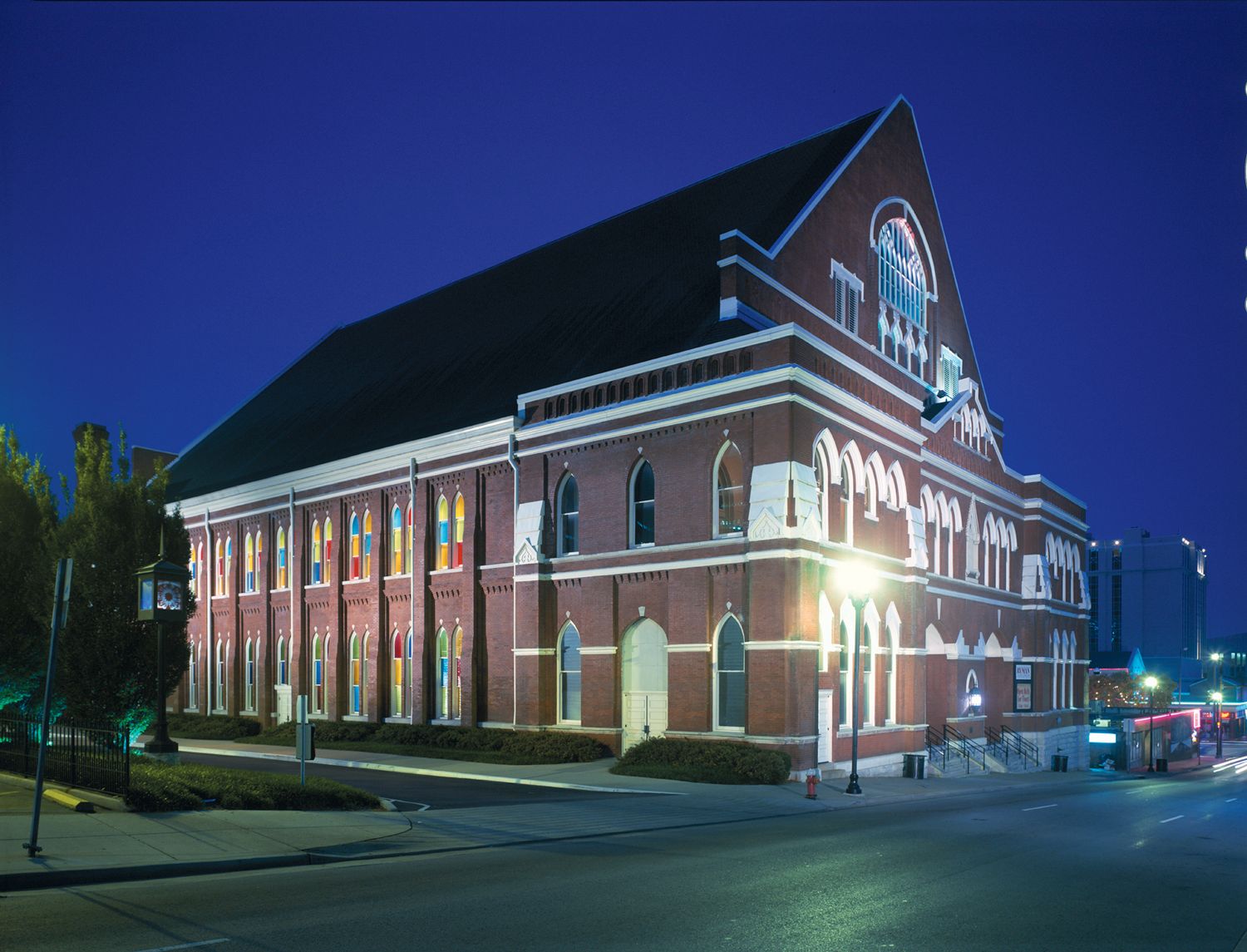
It’s been around since the World War II era, when it was renamed after the death of the steamboat captain, Tom Ryman, who had it built. But before that, it was a church, the Union Gospel Tabernacle. And for decades, appropriately enough, the Ryman Auditorium has been known as country music’s Mother Church, a nod to its house-of-worship roots as well as its unparalleled prominence as a world-class performance spot. The Grand Ole Opry made the venerated venue its home for 31 years, beginning in 1943.

But this iconic temple for Music City royalty has always been a place for more than country music, says general manager Gary Levy, who’s been in his Ryman role for nearly five years. “We just celebrated our 130th birthday, and part of that was to expand on the idea that we’re much beyond the legacy of country music and the Grand Ole Opry.”

Levy points out that from its earliest days, all kinds of showbiz superstars played at the Ryman—including magician Harry Houdini, Italian opera legend Enrico Caruso, composer and conductor John Philip “Stars and Stripes Forever” Sousa, singing cowboy Roy Rogers, comedian W.C. Fields, silver screen goddess Mae West, jazz crooner Nat King Cole, silent film superstar Charlie Chaplin, and Bob Hope.

And the Ryman wasn’t just known for music. It also hosted political rallies, community events, theatrical productions and ballet. It developed a rarified rep one of America’s most venerated performance spots, for acts of any kind. 

“The Carnegie Hall of the South,” says Levy. “Our philosophy here is all are welcome, and we believe that.”

Just this week, the Ryman received its 14th Pollstar Award, an honor voted by the trade industry publication, as the Theater of the Year.

The Grand Ole Opry still comes home “to roost,” for a series of shows during the winter, and other country stars showcase there at other times throughout the year. Garth Brooks, Vince Gill and Amy Grant, and Ricky Skaggs are no strangers to the Ryman stage.

And other times, the Ryman presents a wholly eclectic and ecumenical lineup, opening its iconic doors in downtown Nashville to U2 front man Bono, flute-playing rapper/singer Lizzo, the Wu-Tang Clan (which made history in 2019 as the first hip-hop act to play the Mother Church), pop star/actor Harry Styles, and former First Lady Michelle Obama (on her book tour).

On March 1, the Ryman will host “Rock the Ryman,” an annual event featuring Nashville artists like Little Big Town, The War & Treaty, Caitlin Smith and Charlie Worsham, all performing music from Rock & Roll Hall of Fame inductees—and continuing to connect the dots between the venue and the long line of non-country artists who’ve taken to the Ryman stage over the decades.

“People feel like they’ve ‘made it’ when they play the Ryman,” he adds, “no matter how big they [already] are.”

Left: The suit worn by James Brown during his appearance at the Ryman is on display as part of the venue’s exhibits of memorabilia from artists who’ve played there.

Is the Ryman haunted???

Is there a ghost in the house at one Nashville’s most revered musical places?

“Many artists and a lot of staff members truly do believe the building is haunted,” says Gary Levy, the GM of the Ryman. “My guess is that, if any concert venue is going to be haunted, it would be this one.”

And why is that?

Maybe it’s haunted by the ghost of Elvis, whose first and only appearance at the Grand Ole Opry was a bit of a disaster; audiences just didn’t know what to make of him and his hip-shaking, but he knew what to make of them—he vowed to never return. And he didn’t…or maybe he did, and he does. Could that be Presley’s otherworldly specter, lurking in the shadows of the balcony, or around the labyrinth of corners and corridors backstage?

Or maybe it’s the ghost of riverboat captain Thomas Ryman, who founded the building—which eventually became the Opry—as a gospel tabernacle? After he died, and the facility was renamed in his honor, the Ryman began getting away from its “spiritual” roots, hosting a variety of entertainers and events. Perhaps Ryman wasn’t too pleased with all the secular sounds and “risqué” performances. It’s about that time that reports of a strange “apparition” began circulating. 

One of the Opry’s earliest stars during its Ryman years was Hank Williams, who met an untimely death, at age 28 in 1953, after mixing drugs and alcohol. What if the Ryman’s “ghost” is the fabled “I Saw the Light” singer, who perhaps grew so fond of rapturous responses from the Opry crowd, he decided to keep coming back, seeking an encore? Ryman staffers have for years recounted episodes of hearing Hank Sr.’s unworldly voice or his songs in the building—with no explanation or source to be found.

Numerous other Opry entertainers met unfortunate early demises, from accidents, overdoses or even murder—including Patsy Cline (plane crash), Stringbean Akeman (killed during a robbery) and Dottie West (automobile accident…on the way to play Opry, after it moved to its “new” home at Opryland). Maybe they’re just hanging out at a place that they just weren’t ready to depart.

There’s also the legend of the “Grey Man,” believed to be one of the Confederate soldiers who visited the venue after the War Between the States was over; he’s sometimes been “seen” sitting in the balcony, as if waiting for another show to start. Another spooky school of thought concerns “The Lady,” a recurring female apparition specifically believed to be Patsy Cline.

Levy says he’s heard things from some clearly “spooked” Ryman employees. “Sometimes they’ll see something, or someone, when the building is otherwise completely empty,” he says. “Maybe it’s late at night, after a show, and they’ll notice the stage curtain fluctuating, or what they think is someone standing behind it. Or they think they notice in someone in a place where there should be no one.”

While Levy hasn’t seen any of that himself, he won’t go so far as dismissing it. “I have never personally experienced anything,” he says. “But I’m not [going] to discount anything either. There’s a lot of things out there we don’t know about, and I respect the opinions of everyone who believes it might be haunted. Who are we to say if it is, or it isn’t?”

—Neil Pond

Tagged , ,

The Entertainment Forecast

Feb. 24 – March 2

Eugene Levy on the road, cowboys in the saddle & Satan spooks a school

‘Schitt’s Creek’ star Eugene Levy travels the globe in his new series.

FRIDAY, Feb. 24
The Reluctant Traveler
Emmy winner Eugene Levy (Schitt’s Creek) hosts this globetrotting travel series, visiting exotic and beautiful destinations in Costa Rica, Finland, Italy, Japan, South Africa…and even the good ol’ US of A (Apple TV+)

Liason
Espionage, political intrigue, passionate love—Vincent Cassel and Eva Green (left) star in this high-stakes, high-energy thriller about how our pasts have ways of destroying our futures (Apple TV+)

The Consultant
Biting workplace satire series follows a dapper consultant (Christoph Waltz) who comes to the rescue of an emerging tech company after its CEO dies and a hoped-for merger falls through (Prime Video).

Western Night
Saddle up for a trail-mix trio of cowboy flicks, all starring Robert Ryan, the prolific, genre-spanning actor who appeared in dozens of movies and TV shows during the 1940s through the ‘70s, including war dramas, high-seas epics and crime capers. And oh yeah, also Westerns! (TCM).

SATURDAY, Feb. 25
Chaos Reigns: The Films of Lars von Trier
Danish filmmaker von Trier has always been a controversial director, for his exploration of dicey subjects and gritty, fem-centric parables—like Nymphomaniac I and II, a pair of bridged erotic accounts about a woman (Charlotte Gainsbourg) who, well, just can’t get enough sex. It’s notable for its all-star cast and a stylish flair that elevates it to the realm of “art” instead of pornography, with appearances by Shia LaBeouf, Christian Slater, Uma Thurman and Connie Nielsen (Mubi).

12 Desperate Hours
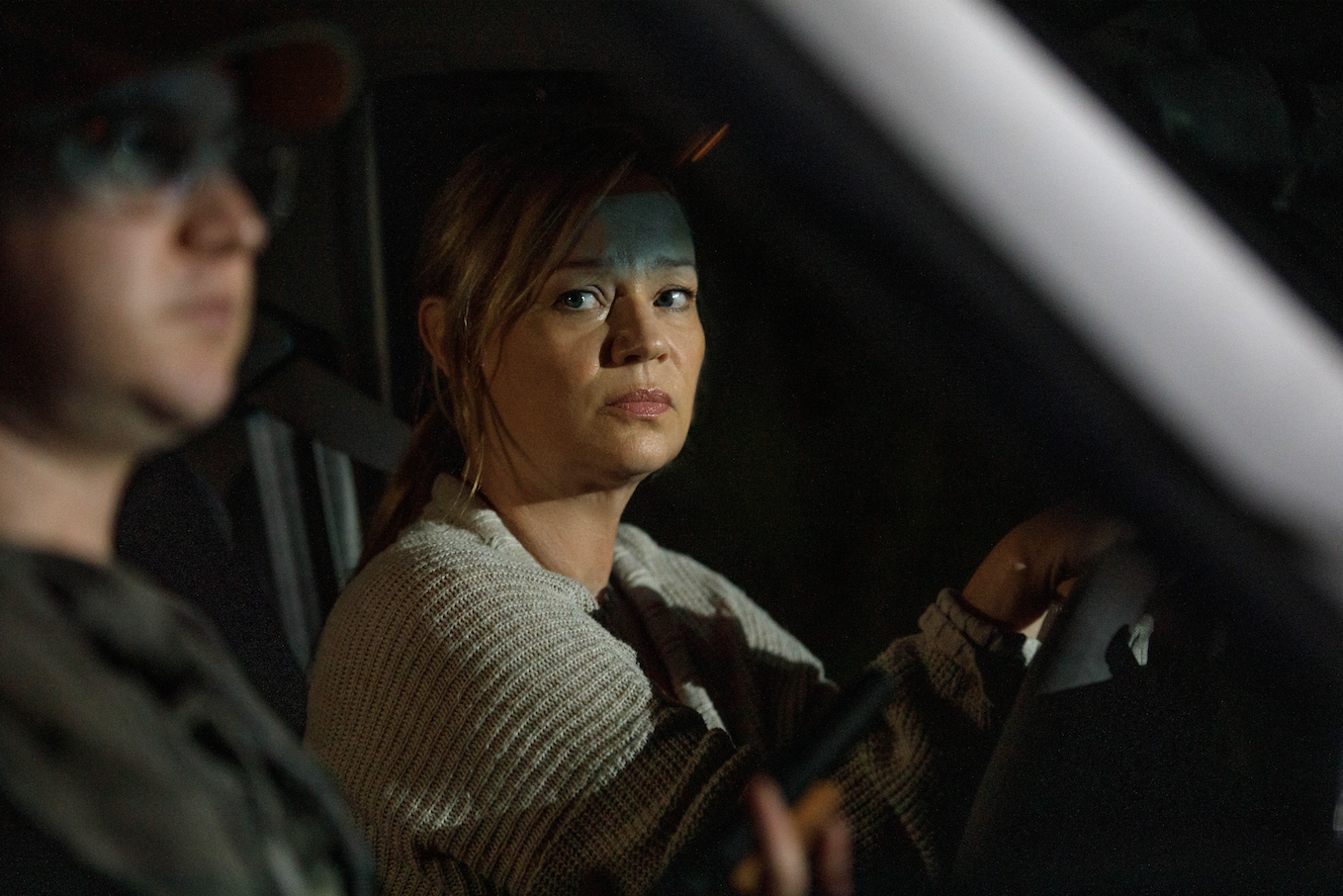
Held hostage by a home intruder, a quick-thinking mother (Samantha Mathis, right) offers to drive him anywhere he wants to go, becoming his unwilling accomplice on a rampage of destruction (8 p.m. Lifetime). 

SUNDAY, Feb. 26
Shock Docs: The Devil’s Academy
Was there really a mass demonic possession at the Miami Space Academy in 1979? This harrowing documentary takes a look at the scarifying chain of events that began hells-a-poppin’ after a student claimed she was possessed by the devil (9 p.m., Travel Channel).

The Circus
Just as the new political season heats up, the Emmy-nominated docuseries returns to pull back the curtain on this extraordinarily fractured and fraught moment for American democracy (8 p.m., Showtime).

TUESDAY, Feb. 28
Black Broadway
This concert special featuring a current generation of Black Broadway stars celebrates iconic stage performances made famous by Black singers, with songs from The Wiz, The Color Purple, Porgy & Bess and more (8 p.m., PBS).

Homestead Rescue
Have a homestead that needs rescuing? Then call Marty Rainey and his kids (above), who thrive on helping people rehab and revive to create more self-sufficient lives, as they do in tonight’s new-season premiere episode, assisting a Wyoming family resurrect a legacy home place (8 p.m., Discovery Channel).

Bring It Home

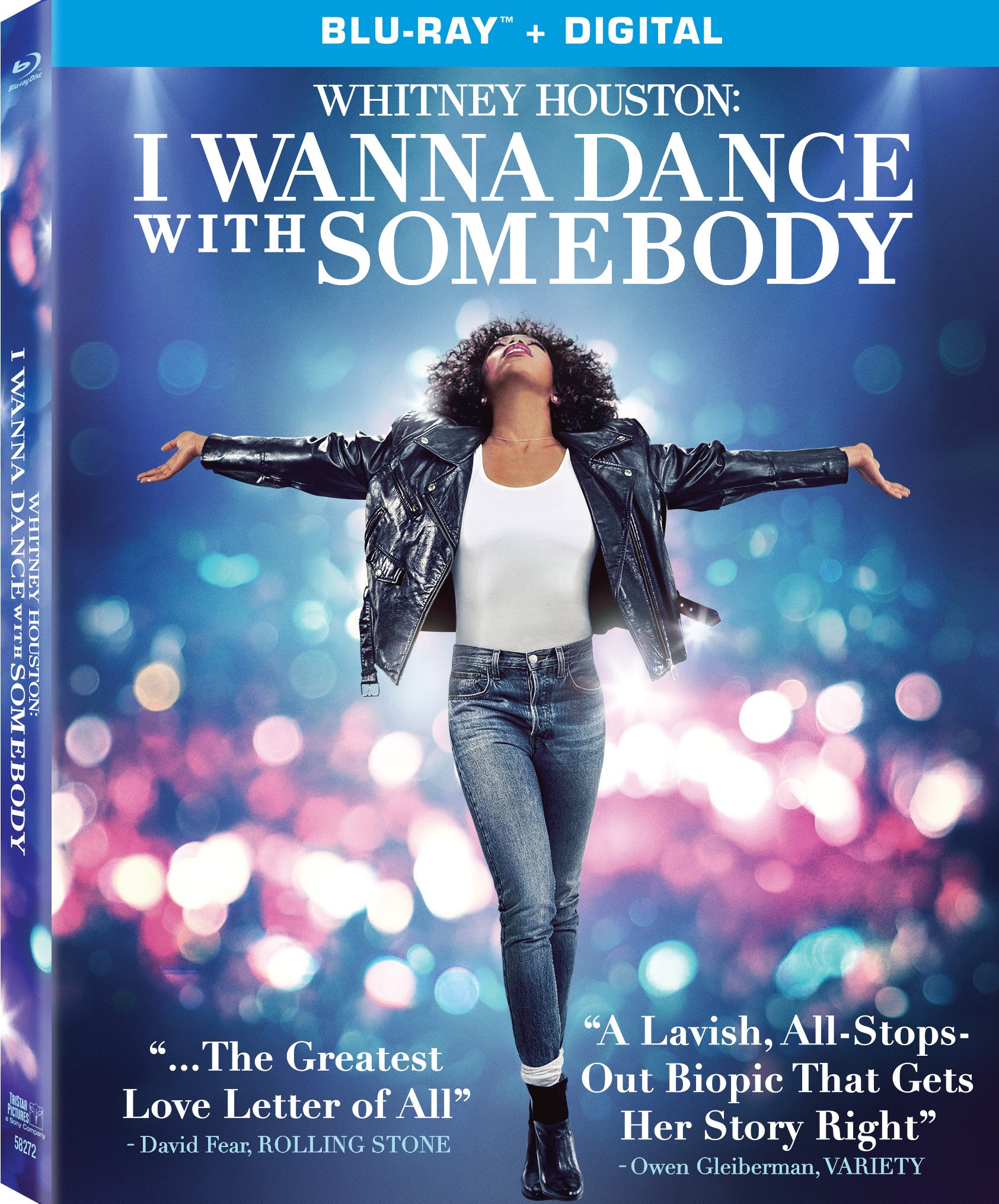
Extras on the home video release of Whitney Houston: I Wanna Dance with Somebody (Sony Pictures Home Entertainment) include a sing-along “jukebox” feature, deleted scenes and featurettes that bring you deeper into the complicated story of the late, great singer and how she became a superstar.

Hollywood’s top palooka goes for extra rounds in The Rocky I-IV Collection (Warner Bros. Home Entertainment), a set of all five feature films in Sylvester Stallone’s epic boxing saga (Rocky, Rocky II, Rocky III and Rocky IV, plus Rocky Vs. Drago). And the knockout punch: They’re all in 4k Ultra HD for the first time (plus standard Blu-rays with commentary).

In Salvatore: Shoemaker of the Stars (Sony Pictures Home Entertainment), director Luca Guadaginino (Bones and All, Call Me By Your Name) turns his lens on the Italian shoemaker who made sure all the stars of Hollywood’s silent era were well-heeled, founding the luxury footware and accessories company that still bears his name. Actor Michael Stuhbarg (currently on Showtime’s His Honor) narrates.

WEDNESDAY, March 1
Star Wars: The Mandalorian
Season three of creator Jon Favreau’s hit sci-fi adventure series, starring Pedro Pascal as a bounty hunter who becomes a protector of Baby Yoda, begins its third season today (Disney+).

Beauty and the Bleach
Documentary looks at the global beauty trend of skin lightening—and how “lighter” skin taps into a wider issue of racist bullying and prejudice against people who aren’t white (9 p.m., Fuse and Fuse+).

THURSDAY, March 2
Omega: Gift and Curse
The Dominican singer-songwriter known as Omega (real name: Antonio Peter De la Rosa) lifts the veil in this new five-part docuseries to give fans an exclusive look at his life and career (WE tv and ALLBLK).

Topic
New series stars Mark Strong as a talented surgeon who opens an “underground” clinic beneath a London tube station to treat those who cannot, or will not, seek more legitimate medical care. But as anyone who’s had to deal with insurance knows, it doesn’t always go smoothly (Topic).

NOW HEAR THIS

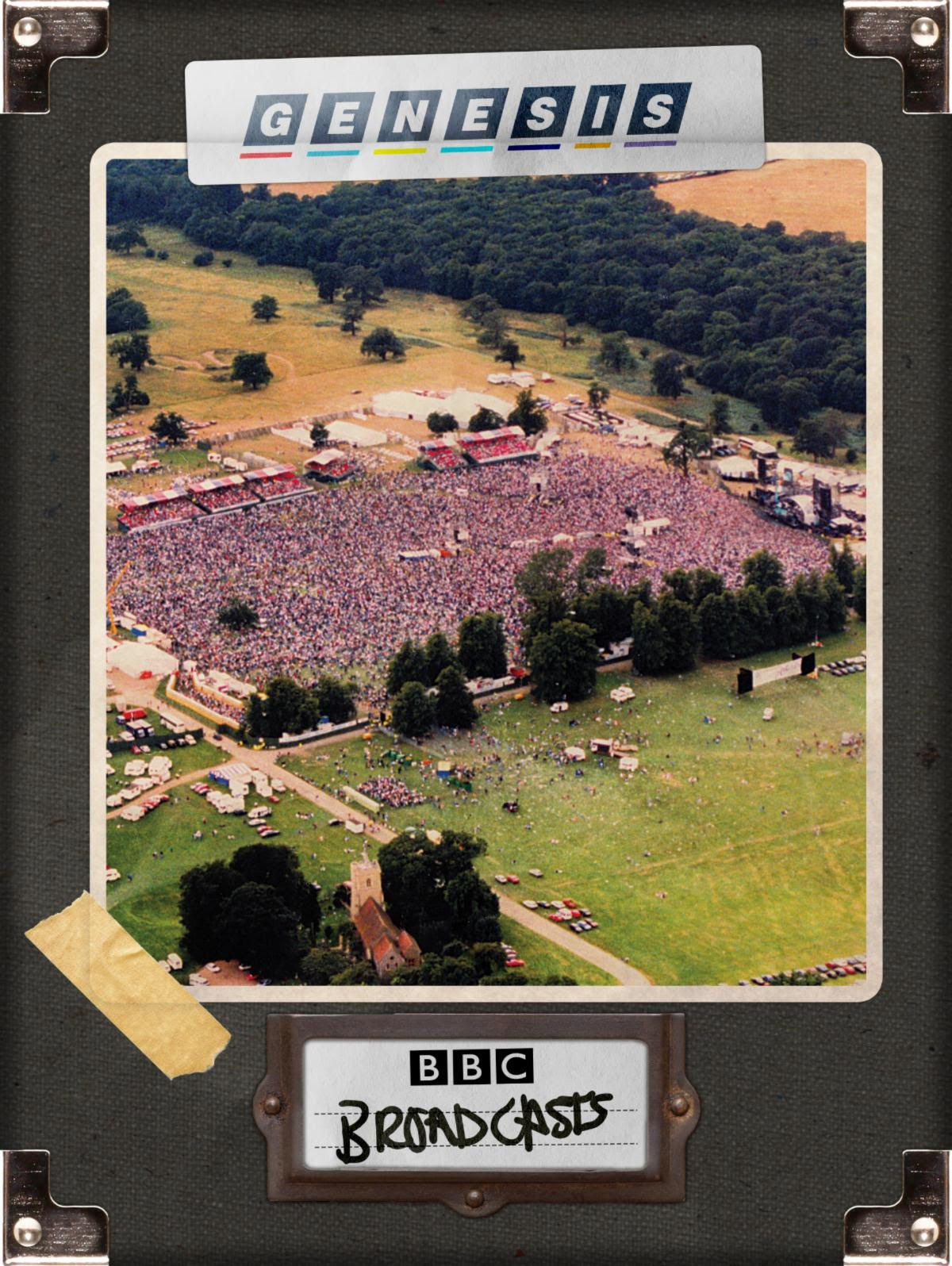
Revisit one of Britain’s most legendary rock bands with Genesis BBC Broadcasts (Rhino), a 5-CD (or 3-LP) collection spanning the group’s music between 1970 and the late 1990s, featuring vocalists Phil Collins, Peter Gabriel and Nick Davis. It features live tracks recorded by the BBC, including an historic set from Wembley Arena in 1987. 

The legendary late Nashville songwriter Harlan Howard once defined country music as “three chords and the truth.” Now the legendary Willie Nelson sings it and brings it in his new album, I Don’t Know a Thing About Love (Sony Music Entertainment), an all-new celebration of Howard’s classic songs, including “Tiger By the Tail,” “Life Turned Her That Way,” “Busted” and “Streets of Baltimore.”

Grin & Bear It

Cast of familiar faces put a ferociously flip, rip-roaring spin on a true incident from the ’80s

Cocaine Bear
Starring Keri Russell, O’Shea Jackson Jr., Margo Martindale and Alden Ehrenreich
Directed by Elizabeth Banks
R

In theaters Friday, Feb. 24

Sometimes, movies have titles that leave you wondering, or might be misleading. Quantum of Solace? Don’t look for it on a map—and what the heck is a Quantum of Solace, anyway? Reservoir Dogs? Watch the whole movie, and you won’t see a single reservoir, or any canines. A Clockwork Orange? No clock, no orange. I screened Armageddon Time last year and liked it, but when it was over, I still felt the title was, well, a tad obscure for a story about a Jewish boy growing up in Queens during the 1980s.

There’s nothing misleading or obscure, however, about Cocaine Bear. It’s 100% on the nose, about a bear that does cocaine—a lot of cocaine.

It’s an outrageously fun—and often quite hilarious—spin on the old “man vs. nature” theme, about people pitted against an apex predator and fighting to keep the body count low. Think Jaws in the Great Smoky Mountains, or Leonardi DiCaprio getting mauled by that grizzly in The Revenant, but, well, a lot more unbridled, unhinged fun than either of those. In this case, the predator is a black bear flying high on blow from a drug smuggler’s crashed airplane.

Black bears—as we learn from some onscreen information from Wikipedia, which opens the film—aren’t generally threats to humans; they’re mostly just looking for something to eat.

But a bear hoovering copious snootfuls of snow? Well, watch out!

And, as you might have heard, it’s based on a stranger-than-life true story from the mid-1980s, when a 175-pound bear did, indeed, come upon a duffle bag filled with cocaine cargo dropped from a smuggler’s airplane in the mountains of east Tennessee. When wildlife agents came across the bear, its stomach gorged with about $15 million worth of nose candy, it was dead. A medical examiner at the time said no creature, not even a large one, would have a chance surviving that much coke. There was no rampage, no attacks on people, just a major, unfortunately fatal OD, a sad end to a majestic creature of the forest.

So, the movie takes a few liberties—well, a lot—with the facts, as movies sometimes do. Actor-director Elizabeth Banks adds to her behind-the-camera resume (which includes directing one of the Pitch Perfect movies, and the 2019 remake of Charlie’s Angels) with this ferociously entertaining action-comedy romp as an ensemble cast of familiar-face characters converges, eventually colliding with the cocaine bear. She finds just the right tone of black (bear) humor, spicing the story with a few severed limbs and goosing it all with some well-timed, funhouse-level gotchas.

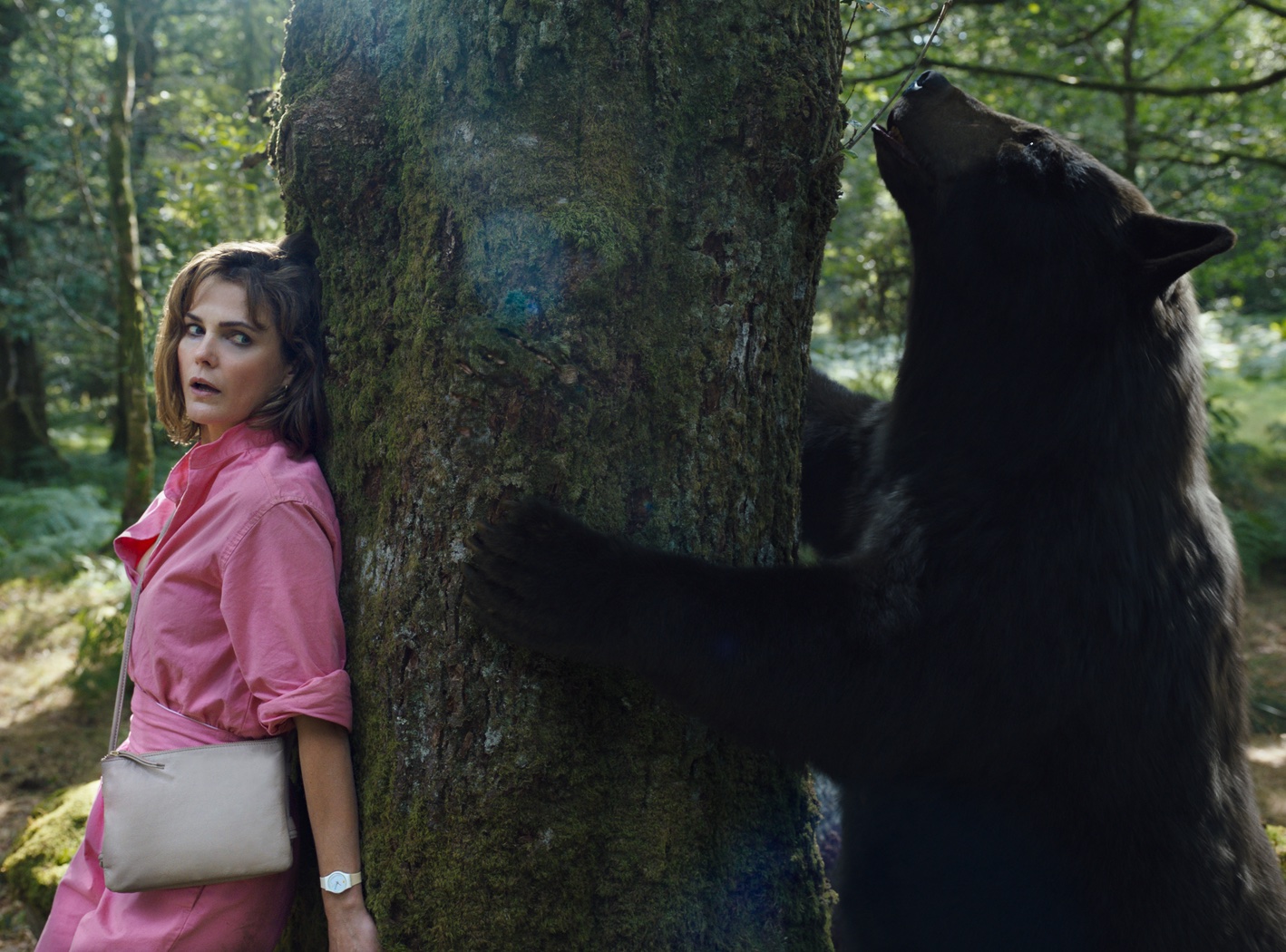
Keri Russell is menaced by a bear coked up on nose candy.

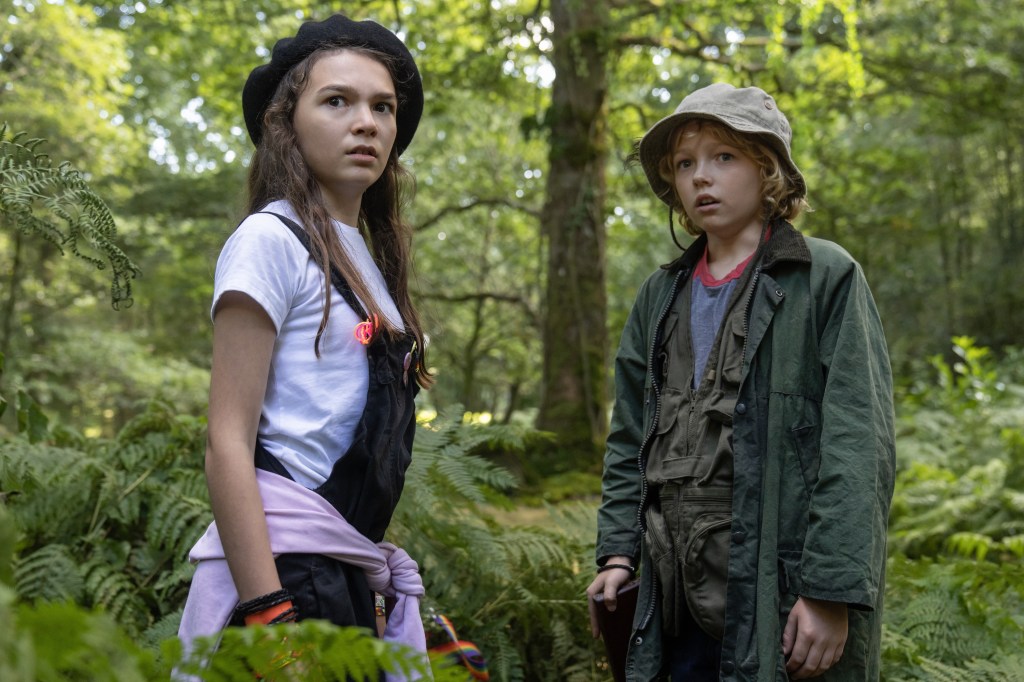
It’s a wild ride as a park ranger (Margo Martindale), wildlife inspector (Jesse Tyler Ferguson) and single mom (Keri Russell) venture into the Great Smoky Mountains National Park to look for a couple of young school-skipping teens (Brooklyn Prince, who made her debut as a wayward kid in the critically hailed The Florida Project, and Christian Convery). Meanwhile, the bear has already attacked a tourist couple (Kristofer Hivju from Game of Thrones and Dutch actress Hannah Hoekstra), while a motley crew of small-time drug-smuggling middlemen (rapper/actor O’Shea Jackson, Alden Ehrenreich—he was young Han Solo in the Star Wars spinoff Solo—and, in one of his final roles before his death last year, Ray Liotta) arrive in the area. They’re hoping to intercept the dropped drugs and scoot before a local cop (Isiah Whitlock Jr.) can sniff out their trail.  

Brooklynn Prince and Henry Christian get more than a tardy slip when they skip school.

You can’t have a movie about a wild, drug-crazed bear without a few bear attacks, can you? The mama bear in Cocaine Bear is completely computer-generated, designed by the same topline effects company that crafted amazing creatures for King Kong, Avatar and Lord of the Rings. But she behaves, well, certainly not like Yogi, Fozzie Bear or Paddington—more like you might expect a big wild animal on toot would really behave, out-of-its mind crazy and desperately craving another snort. (At one point, mama bear does a quick line off a lower leg recently detached from, well, you’ll just have to see it.) There’s blood and guts, but they’re balanced by the well-calibrated, giddily gruesome humor of watching an ensemble of recognizable actors gamely throw themselves into the merry, deep-woods mayhem.

As one of them finds out, pinned underneath an exhausted, zonked-out black bear passed out on top of him, that’s not somewhere you want to be.

Isiah Whitlock Jr. is a cop on the cocaine trail.

Do kids and baby bear cubs get into the stash, too? Yep. Can a cocaine-fueled bear outrun a speeding ambulance? Yes, she can. Is it wise to try to escape a bear—especially one zooming on coke—by climbing high into a tree, or locking a door? Um, no, it is not.

This could very well become a new cult classic, in the vein of some other movies that have successfully found ripe, riotously rich comedic tones in dangerous, deadly situations, like Werewolves Among Us and Snakes on a Plane, turning something frightfully fearful into something else, something fun, flipped-out and funny.

It’s a rip-roaring romp, with lots of rip and lots of roar—and a message from the ‘80s that still resonates today: Keep your stash of cocaine away from the bear!

—Neil Pond