Category Archives: Movie Reviews

Impossible Odds

Tom Cruise returns to his leading role in the action-packed, stunt-tacular seventh installment of his blockbuster big-screen franchise

Mission Impossible: Dead Reckoning—Part One
Starring Tom Cruise, Simon Pegg, Hayley Atwell & Esai Morales
Directed by Christopher McQuarrie
PG-13

In theaters Wednesday, July 12, 2023

What does a runaway train, renegade AI, a four-sided, two-piece doodad and a doomed Russian sub have in common? They’re all part of Tom Cruise’s latest “impossible” mission.

The seventh installment of the blockbuster franchise that began more than 25 years ago finds Cruise’s iconic character, Impossible Missions Force (IMF) agent Ethan Hunt, scrambling all over the place in a race for a four-sided key that could trigger a digital geopolitical doomsday in the wrong hands.

Everybody’s trying to get their paws on that mysterious gizmo, which can unlock access to an all-knowing, all-seeing, super-processing artificial intelligence known as The Entity, “a truth-eating digital parasite” with the dark power of total domination. And everyone, it seems, is also trying to stop Ethan, which certainly adds an additional level of difficultly to his job.

“The world is gonna be coming after you,” Ethan is warned, and it sure does.

It’s a big mission for a big movie on a grand scale—golly-whopping spectacle, breathless action and a threat that’s even bigger, and so much badder, than Big Brother.

The gang’s all here, for Mission: Impossible movie fans who’ve grown up watching the IMF continue the globetrotting spy shenanigans first introduced in the 1960s TV series. Cruise, the consummate movie star, is as dapper and unflappably cool as ever, rallying his loyal team (Ving Rhames and Simon Pegg), confronting a couple of formidable old foes (Esai Morales and Vanessa Kirby) and reuniting with a former ally (Rebecca Ferguson).

New characters include Hayley Atwell (well-known to Marvel movie fans) as a cagey thief with a criminal past, and Pom Klementieff (from Guardians of the Galaxy) plays a French assassin and lets her lethal skills do the talking. We’ll likely see them again in Mission: Impossible—Dead Reckoning Part 2, which is already in the can and due for release next summer.  

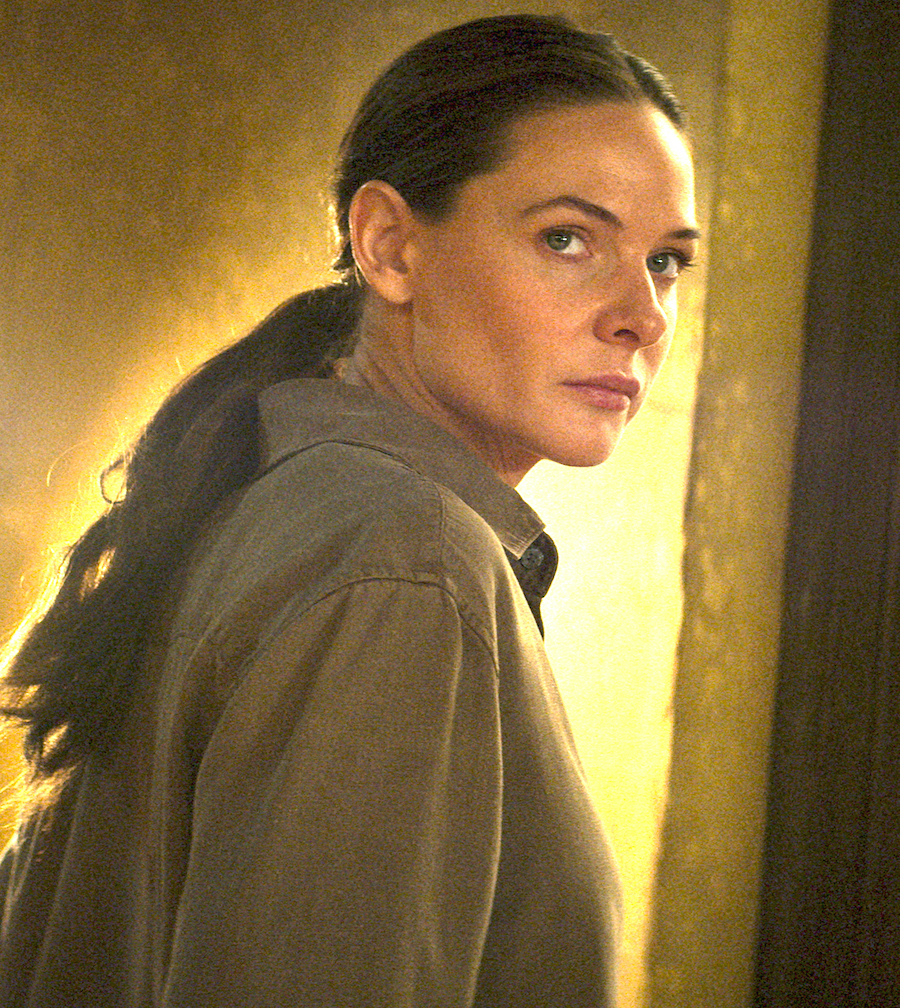
Rebecca Ferguson reprises her role from previous Mission: Impossible flicks.

Director Christopher McQuarrie also returns to the franchise; he’s directed Cruise in several projects, include two previous Mission movies. He certainly knows how to move things along, make it an exciting, exhilarating ride and pepper the menu with some levity and laughs.  

The movie hinges on issues of privacy, deception, manipulation and misinformation in this modern era of digital overload. And it’s also about empathy; Ethan Hunt cares about those closest to him, and even about people he doesn’t know. The Entity, like all tech by design, is amoral and cares about nothing and no one, only about whatever its objective is programmed to be. (You think your laptop or smartphone, or Siri and social media, really care about you? Uh, no. So just imagine if they became your master and overlord.) Ethan and the Entity represent a battle between good and evil on a global stage, with the fate of the planet hanging in the balance.

But the plot is just so much blather and blah-blah, after all, when it comes to Tom Cruise and his Impossible missions—everyone wants to see the stunts, and Dead Reckoning certainly delivers. There’s a wild multi-vehicle chase through the narrow streets of Rome, with Cruise and Atwell handcuffed together (!) in a tiny Fiat, pursued by a monstrous Humvee, Italian cops and America CIA agents. Cruise zooms cross-country on a motorcycle, then shoots himself off a high cliff, out-Bonding James Bond in a jaw-dropping aerial sequence. And an extended bit through the Swiss Alps on that runaway train, well, it’s a nail-biting, death-defying, cliff-hanging choo-choo blast, a topsy-turvy, over-the-top obstacle course of everything but the kitchen sink, including pots, pans, parachutes, a flaming oven and a grand piano.

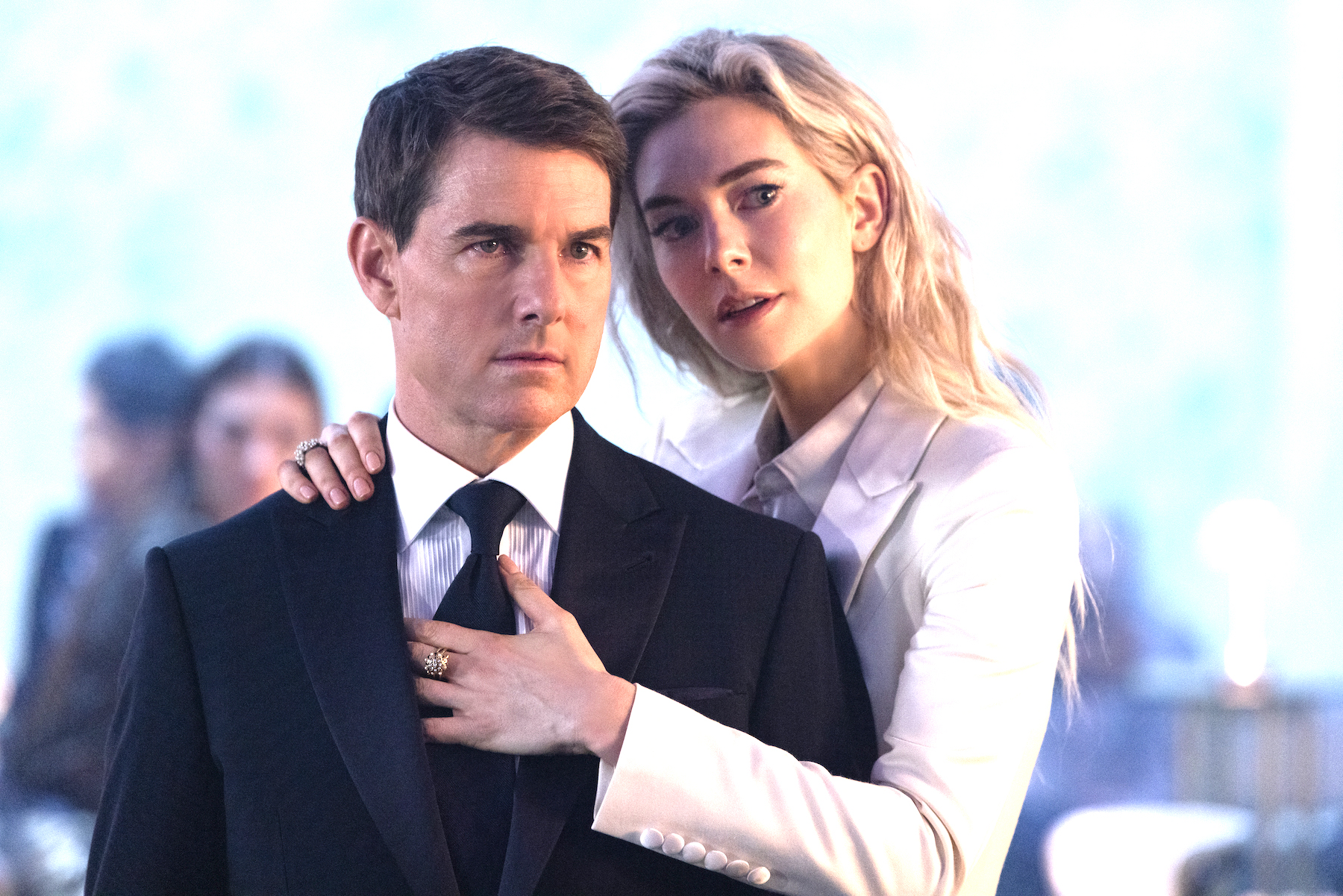
Vanessa Kirby plays a woman with a complicated past that intersected with Ethan Hunt (Tom Cruise) previously.

Everything is made even more exciting by knowing that Cruise performs almost all his own stunts. Wowza—it’s hard to imagine any other star ever even considering the elaborate, bonkers things that he’s made the lifeblood of his movies.

And, of course, there’s high-tech face-swapping, a bit of bruising street-fight physicality, plus a dash of sword fighting, knife slashing and even some sleight of hand magic.

Last year, Cruise’s Top Gun: Maverick became the must-see movie of the summer, signaling that Hollywood was ready to welcome COVID-weary audiences back into theaters. Will he re-do that summer blockbuster magic with Dead Reckoning? Can his movie once again revive a sagging box office, rejuvenate franchise fatigue (sorry, Indiana Jones and the Dial of Destiny, Little Mermaid and Fast X) and remind viewers—who’ve gotten just a little bit too comfortable with at-home streaming—why they should love the big screen?

It’s a bit early to know for sure, but I’m ready to predict: Mission: Accomplished!

—Neil Pond

Forever Young

Harrison Ford returns for one final ‘Raiders’ romp, with an extra dose of movie magic

Indiana Jones and the Dial of Destiny
Starring Harrison Ford, Phoebe Waller-Bridge and Mads Mikkelsen
Directed by James Mangold
PG-13

In theaters Friday, June 30, 2023

More than 40 years ago, we sat on the edge of our seats watching Indiana Jones outrun a big rolling boulder, the bravura opening of Raiders of the Lost Ark that became an iconic representation for a new, blockbuster action-adventure movie template.

There aren’t any giant, bowling-ball booby traps in Dial of Destiny, the fifth film in the Indiana Jones canon, but Indy is still running—all over the globe, still hunting for historical treasure, still afraid of snakes, still dodging bullets and still fighting Nazis.

This time, it’s the late 1960s, some 20 years after the events of Raiders. Neil Armstrong has just walked on the moon, America has won the space race, and there’s a scramble to locate the missing half of a doodad called the Antikythera, a dial-like “computing” device found in wreckage of an ancient sunken ship off the coast of Greece. What’s so special about it? Well, during World War II, Nazisbelieved it could forecast rips in the fabric of time, openings that would allow someone to change the way history unfolds. A dial of destiny, indeed, if only they can find the missing part…

And changing the course of history probably isn’t a good idea, especially when Nazis are involved.

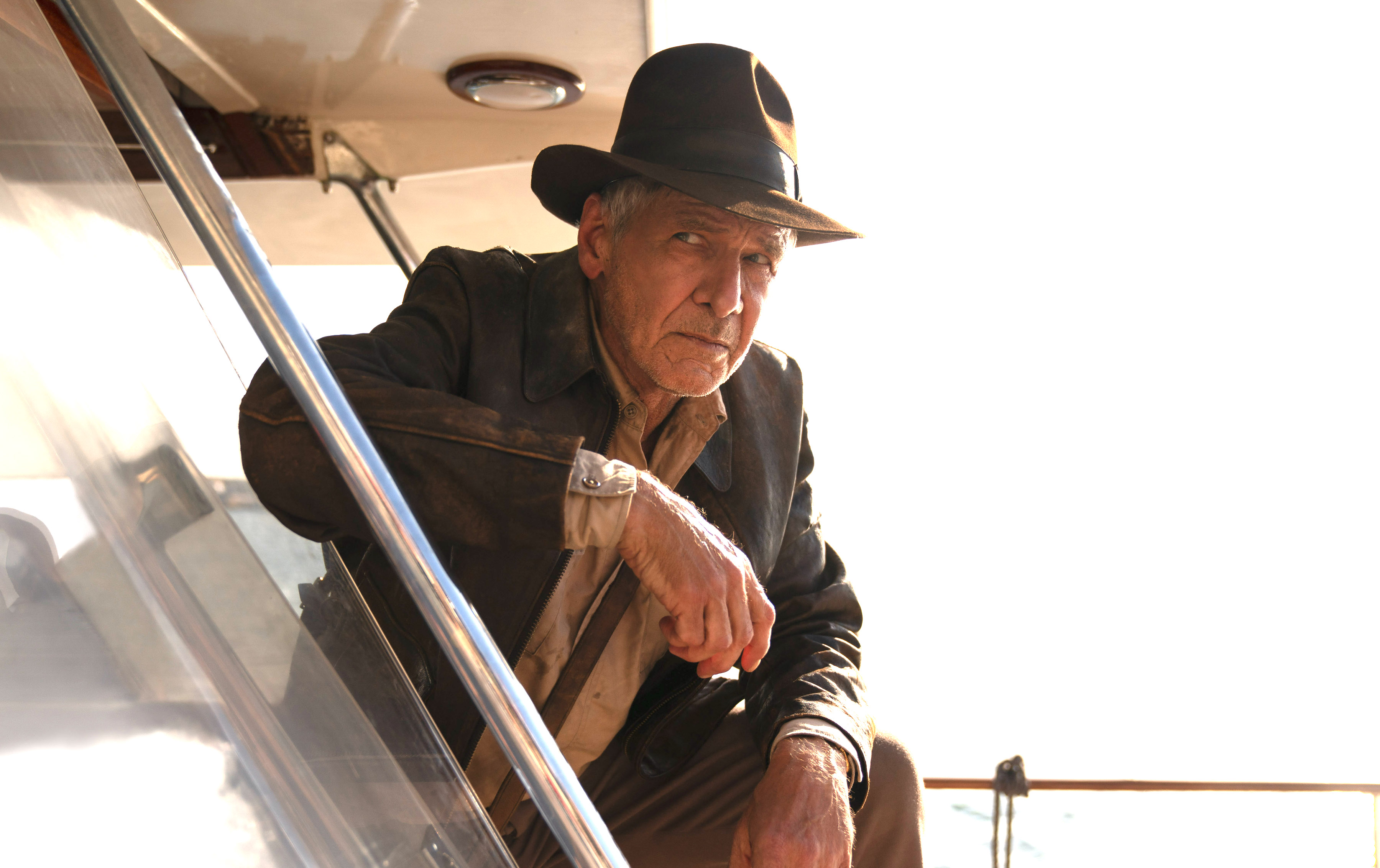
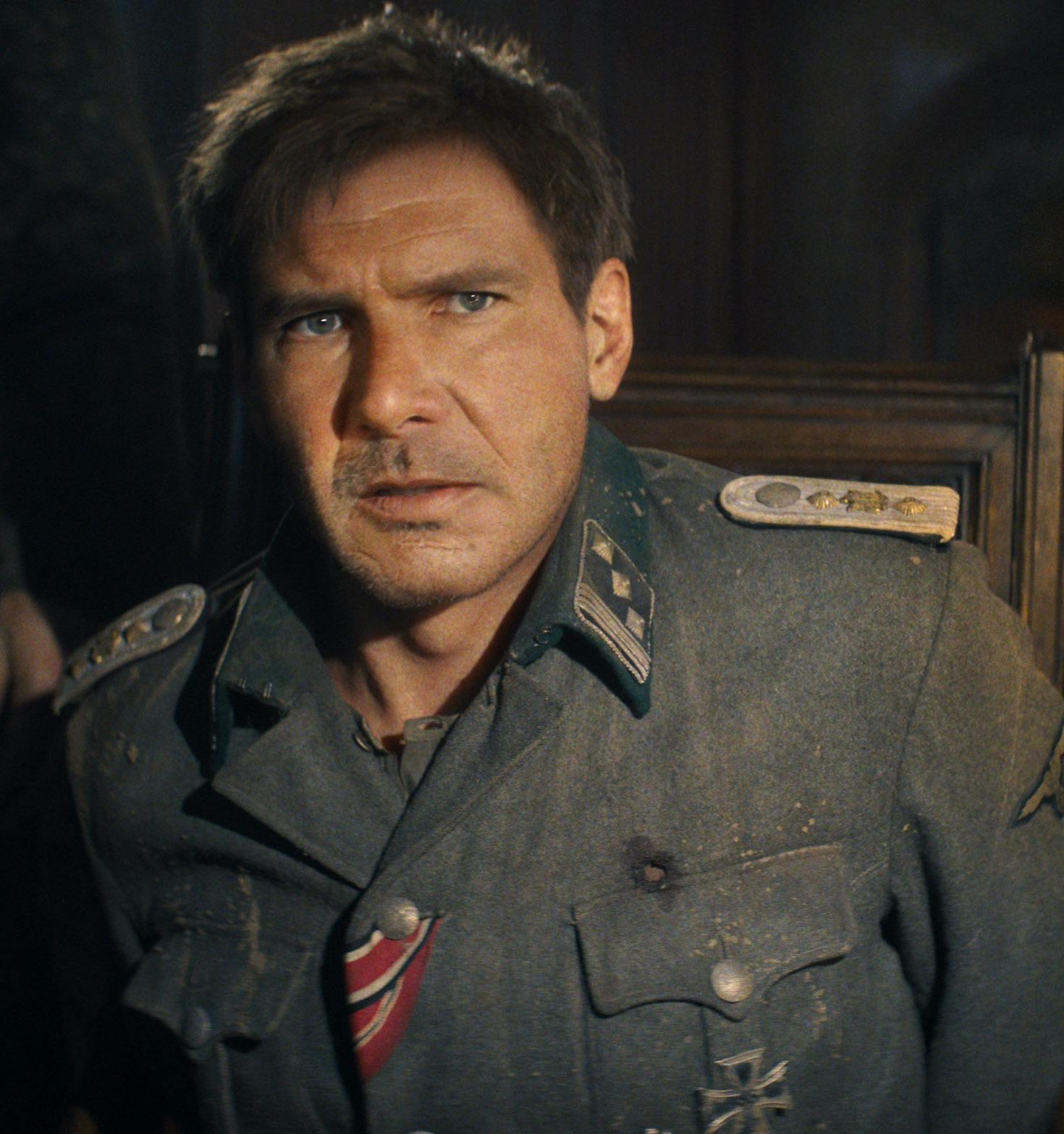
Harrison Ford, just about to turn 81, makes what is intended to be his final appearance as the college professor turned rip-roaring archeologist swashbuckler. He’s helped along in the rip-roar department by some high-tech movie magic that convincingly de-ages his character with “deep-fake” cinematic wizardry, for flashback scenes in which he looks, well, like he looked in Raiders of the Lost Ark. Forget Botox—movie magic is the way to go.

Phoebe Walker-Bridge, of Fleabag TV fame, adds some new spice and sass as Helena Shaw, the now-grown daughter of Indy’s late friend and colleague (Toby Jones).  Mads Mikkelsen proves once again he can be a dandy bad guy; I’m still smarting from remembering what a ballbuster he was with Daniel Craig in Casino Royale more than 15 years ago. Antonio Banderas has a brief role as a Greek undersea diver, one of Indy’s old friends, about as crusty as the barnacles on his boat. There are a couple of other returning characters—major and minor, and one is a real doozie—and a lot of movie callbacks to things that happened in previous adventures.

Phoebe Waller-Bridge plays Helena Shaw.

It’s a full-fledged new Indy adventure, for sure, but also a look-back tribute—a closing-chapter monument to Indiana Jones, and Harrison Ford, as one of moviedom’s most recognizable screen heroes, taking on bad guys in a dusty fedora, with a trusty bullwhip.

This is the first Indy flick not directed by Steven Spielberg or produced by George Lucas. Instead, the reins have been handed over to James Mangold, who has certainly proven he knows he’s doing, with a directorial resume that includes 3:10 to Yuma, Identity, Ford v. Ferrari, Walk the Line and a pair of Wolverine X-Men films. It’s hard to follow Spielberg (duh!), but Mangold keeps the pace moving briskly and with stylish confidence, though often at a frantic pace with nearly nonstop, all-over-the-place action that becomes a chaotic wash of blurry, noisy CGI.

Indy fights on top of a train speeding through the Swiss Alps, gallops at full speed on a hijacked police horse into a New York City subway tunnel, tangles with a nest of icky eels at the bottom of the Aegean Sea, jumps out of airplane, and races through the narrow streets of Morocco on a ramshackle tuk-tuk. Things rarely sit still, and as soon as they do, they’re off and running again.

The movie picks up even more momentum toward the end, when it almost jumps the shark in a loopy battlefield sequence that veers into the realm of nearly comedic impossibility. (At one point, I wondered if Bill and Ted’s time-traveling pay-phone booth might have landed just offscreen, with Abe Lincoln, Billy the Kid and Socrates aboard.) But no matter what the movie throws at him, and at its audience, Ford is gung-ho and all-in, even if Indy admits the years, and the mileage, have taken their toll.

As the Indiana Jones films do, the Dial of Destiny gives “real history” a rowdy, rollicking, what-if spin. Here, it’s a former Nazi scientist who’s been helping America launch its space program (yes, that really happened) and an artifact that truly does exist (and is on display today in museum in Athens). But what if that Nazi wasn’t so former, and what if his intention was to use that hunk of antiquity to go back and have another crack at Dur Fuhrer’s plans to conquer the world?

And what if…well, what if we didn’t have Indiana Jones movies around anymore?

At one point, Indy tells some noisy hippie neighbors to turn down their loud music. The song they’re blaring is The Beatles’ “Magical Mystery Tour,” and it feels like a musical nod to the movie magic that brings Harrison Ford back for one final, blowout romp, letting us relive his younger years, recall his Indiana Jones exploits, reconnect him with a rush of his past adventures, and ultimately bid him a fond, sentimental farewell with a warmly nostalgic salute.

—Neil Pond

Back to the Future

Two lives connect with ancient mystical undertones in this love story that’s so much more than a love story

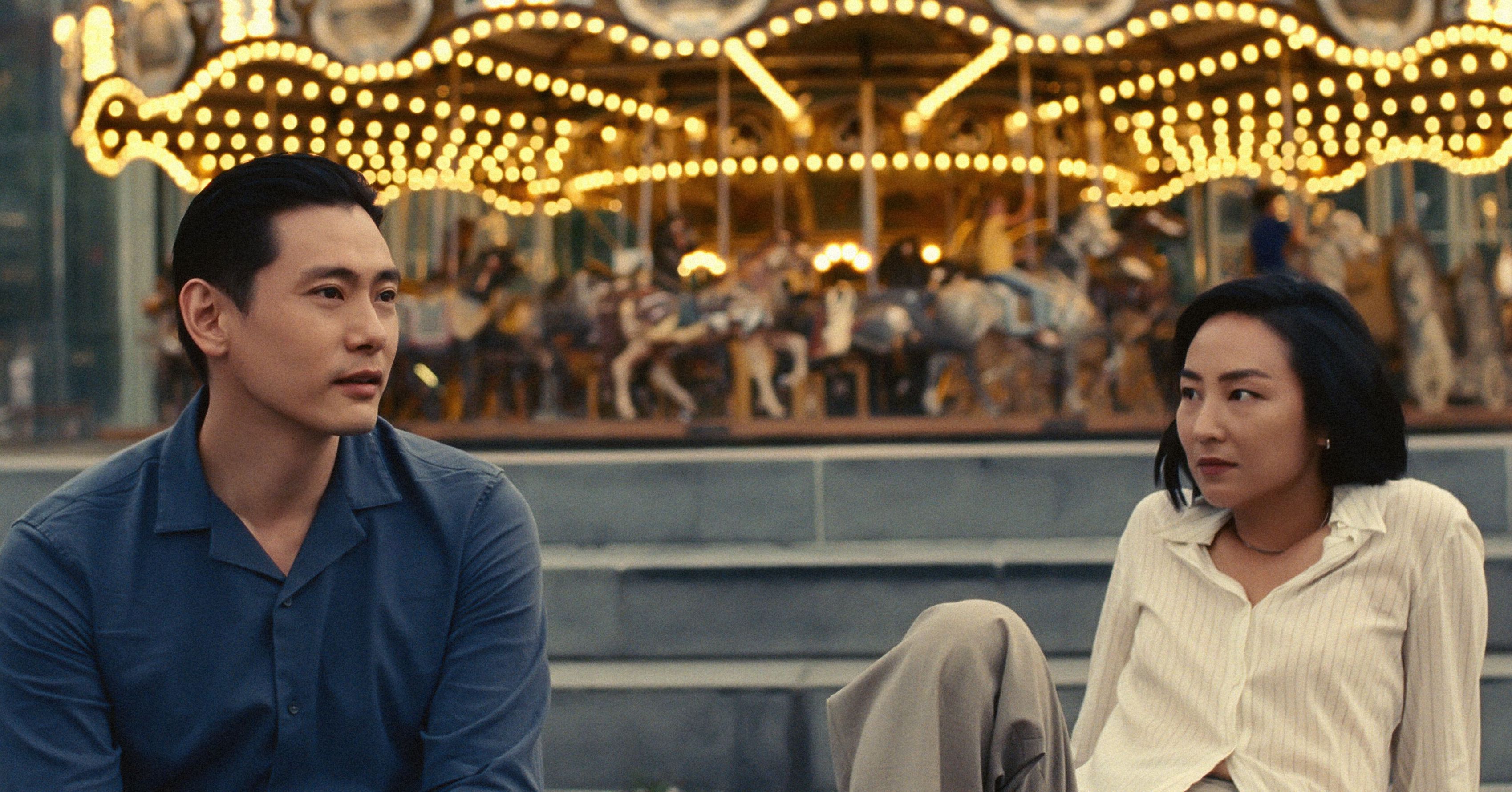
Teo Yoo and Greta Lee play childhood besties who meet again, years later, in ‘Past Lives.’

Past Lives
Starring Greta Lee, Teo Yoo and John Magaro
Directed by Celine Song
Rated PG-13

In wide release Friday, June 23

A little Korean girl and a little Korean boy are schoolmates who grow up together, move apart and finally reunite many, many years later in this tender, emotionally resonant slice of life relationship drama that slices into life choices and the unseen, mystical and mysterious ties that bind.

Moon-Seung-ah leaves Korea with her family and changes her name to Nora, eventually working as a playwright in New York City, fixing her eyes on a Nobel Prize, a Pulitzer, maybe even a Tony. Hae Sung stays behind in Seoul, where he puts in his mandatory time in military service, then settles into adult life as an unlucky-in-love engineer.  

Celine Song, herself a playwright who immigrated as a child with her family from Korea to Toronto, now makes her bracingly confident, immensely impressive debut as a film director in this wonderfully nuanced, decades-spanning saga of connected, intersecting lives and a mojo referred to Korean culture as In-Yun, a force of destiny that brings people together in ways that transcend time, reaching deep even into their previous lives.

The movie is full of soft textures Song uses to help tell the story, subtle visual enhancements to the existential epic—a soggy New York skyline, a glowing silent sunrise, gentle breezes stirring window curtains, reflections in a puddle. It’s as if the characters are, indeed, players in a larger drama, a force of nature writ large in the elemental world around them.  

Greta Lee (from the TV series The Morning Show) is magnificent as grownup Nora, who settles into married life in the East Village life with a writer (John Magaro) she meets at a creative residency retreat. (The marriage, to an American, helped fast-track her immigration card, we learn.) When Hae Sung (Teo Yoo) comes to the Big Apple for a visit, the two Korean “kids” find themselves face-to-face, now as grownups, for the first time in 24 years. And the ol’ In-Yun fires up once again.

This isn’t a yarn of torrid passion, galloping emotion or clashing romantic rivalry. It’s not even really a conventional love story; it’s deeper and more profound than that. There are far more chaste hugs than kisses (of which I counted exactly one). There are no heroes, no villains. But you’ll find your own heart filling, swelling and yearning in this thought-provoking, full-of-feels tale about the choices we make, the choices that make us, what we did, what we didn’t do, and what we might have done. It’s about the yin and yang of everything that ultimately becomes the life we lead, where we end up, who we end up with, and who we turn out to be.

And what is love, anyway? “It’s complicated,” Hae Sung says at one point. It is, indeed.

During one scene, when Nora is workshopping a play she’s written, an actor reads her dialogue for a scene about crossing, passing from one thing into another, like walking over a bridge—or immigrating across an ocean. Some crossings, the actor says, cost more than others; you might get something you desire by making the crossing, but you’ll desire, even more, something you left behind. And “some crossings,” she says, “you pay for your entire life.” It’s certainly no coincidence that Nora and Hae Sung’s stateside reunion brings them underneath the towering Brooklyn Bridge, a large, looming representation of time and distance for them both.

John Magaro plays Nora’s American husband, Arthur.

Nora thinks about what she gained, the price she’s paid, when she moved away and made herself over in a new, Westernized world. She loves her husband, Arthur, who accepts the improbable, epic story of which he’s clearly become a part, but he frets that he might be fated to be on the outside looking in on a relationship that’s deeper than he can fathom. Hae Sung wonders if he will keep intersecting with his childhood friend, and perhaps his true eternal soulmate, in the future.

What does your future hold? Who have you met in the past, in memories that somehow keep coming back to the present? Is coincidence predestined? What price have you paid for the crossings, the changes you’ve made in your life? Who do you love? Past Lives will make you think—and perhaps make you realize that life, in all its rewards and even disappointments, can be so much bigger, and richer, than we can even imagine.

—Neil Pond
Zipping & Zapping

DC’s fleet-footed superhero finally gets his own flick, but another actor nearly steals the show

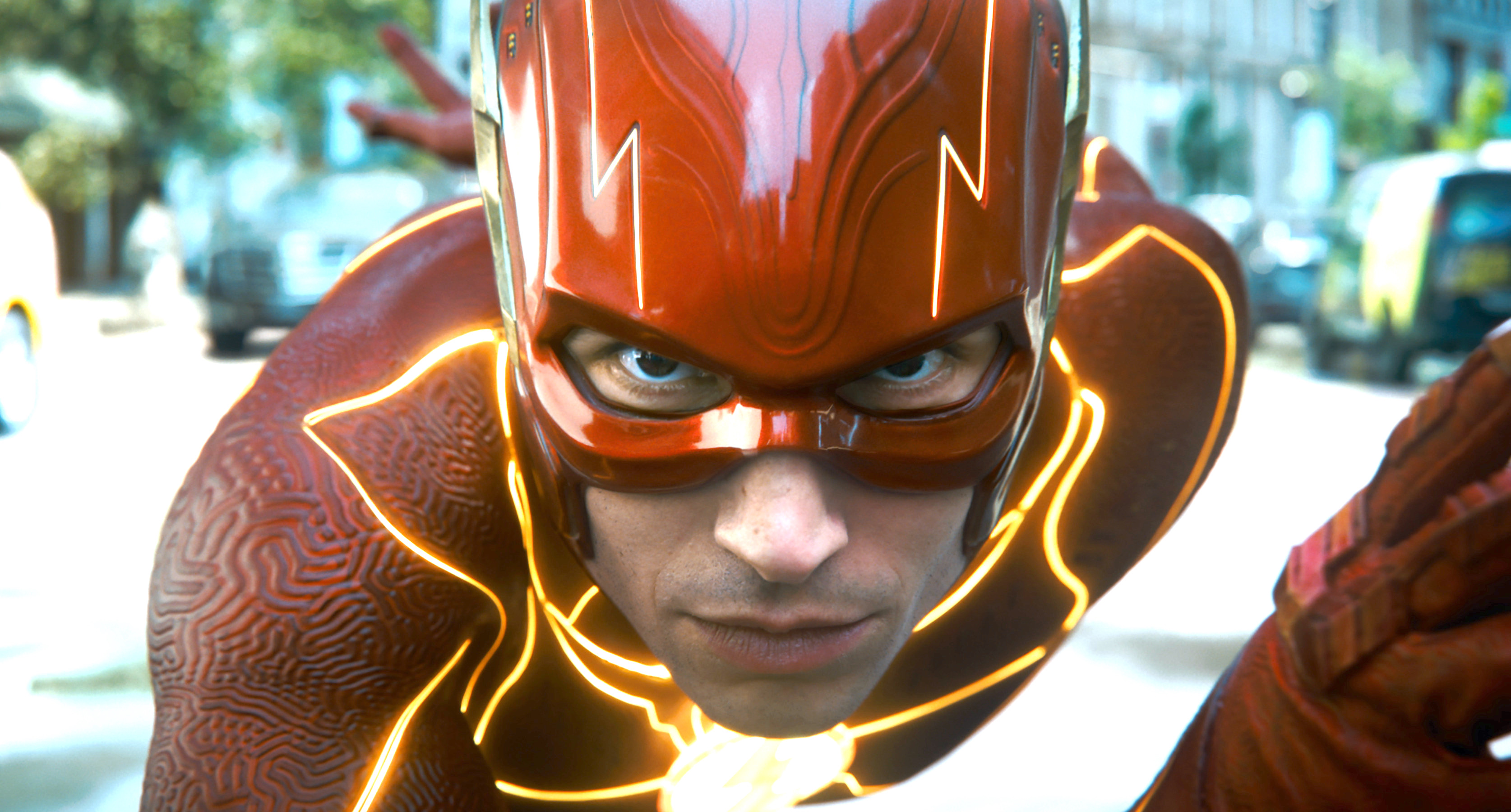
The Flash
Starring Ezra Miller, Michael Keaton, Ben Affleck & Sasha Calle
Directed by Andy Muschietti
PG-13

In theaters Friday, July 16

For a movie about the speediest superhero ever, The Flash took its slow, sweet time getting here.

Discussion about a standalone movie for the popular DC Comics character began in the 1980s but stalled and dead-ended many times over the decades, with various directors, writers and actors becoming attached and then detached. Finally, Ezra Miller (from The Perks of Being a Wallflower) was cast, making ramp-up appearances in a handful of interconnected, big-screen “DC Extended Universe” romps, including The Justice League, Suicide Squad and Batman v Superman: Dawn of Justice.

Now the fleet-footed, red-suited dasher finally gets his own full-blown flick. How fast is the Flash, the alter ego of the guy named Barry Allen? Well, he runs so freaking fast, some crazy, far-out things can happen. And even when he’s not running, he’s moving fast—he can make the molecules in his body vibrate at such unimaginable velocity, they maneuver around other molecules and then rearrange, letting him pass through solid objects. He’s so fast, he’s faster than time; and he finds out that when you outrun the speed of light, time-traveling can be a real head trip.

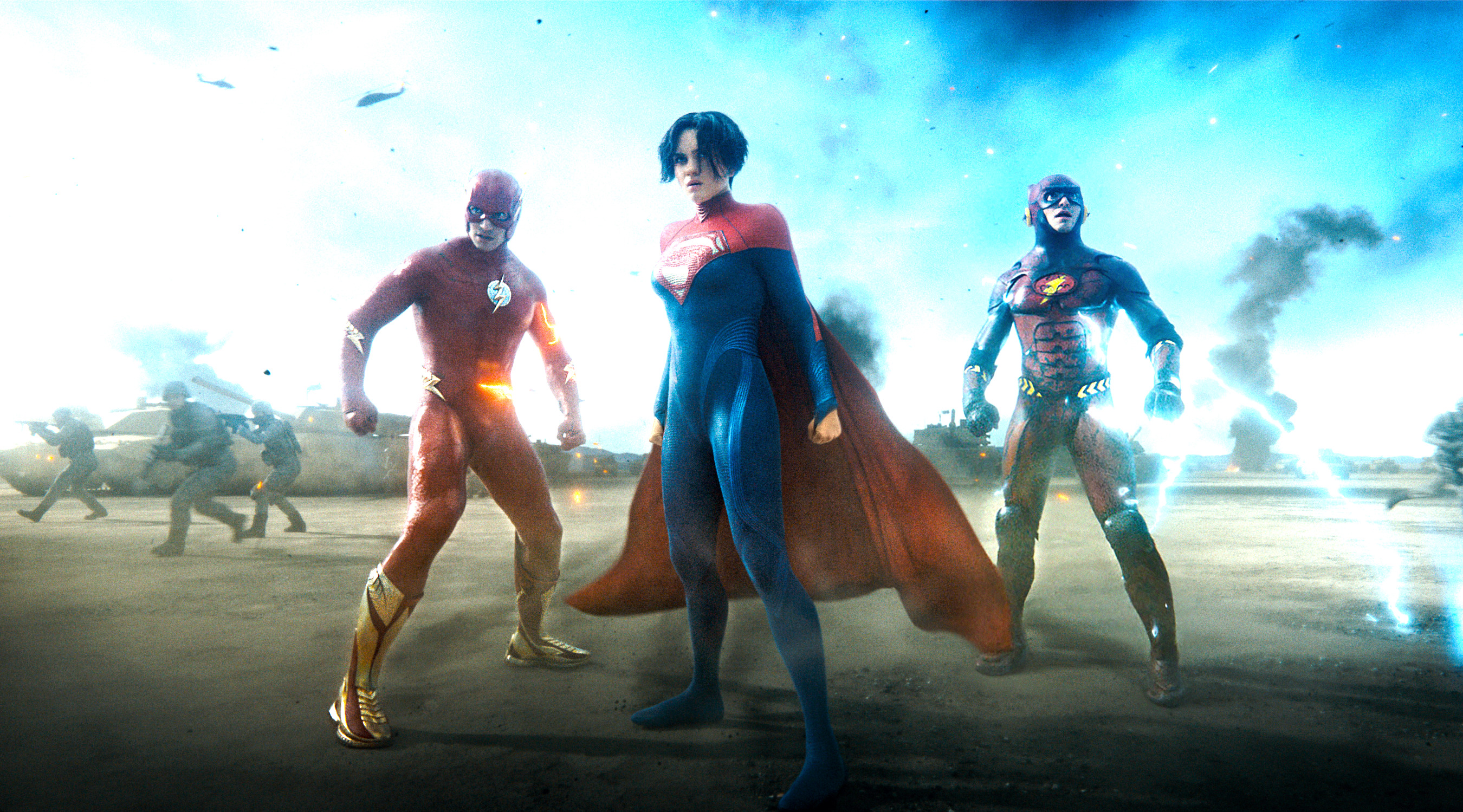
When the Flash goes back in time, it unhinges nearly everything, affecting the present and the future—you know, the old Butterfly Effect. He encounters an alternative version of himself and multiple incarnations of Batman (hello, Michael Keaton, Ben Affleck and another well-known actor whose cameo I won’t spoil). There’s the return of a nasty supervillain bent on humanity’s annihilation; Superman’s cousin (Sasha Calle), Supergirl, gets in on the action; Wonder Woman (Gal Godot) also shows up. And yet another DC superhero splashes around in the after-credits coda. There’s a swirling time-loop metaverse carousel, in which just about everyone in the DC pantheon show ups; who’s your favorite Superman? And Barry is surprised to learn his Butterfly Effect even means that someone other than Michael J. Fox has become Marty McFly in Back to the Future.   

The Flash is a jubilantly overcrowded, hyper-bloated superhero sci-fi carnival ride that gives a flip, fun, wildly inventive spin to the ol’ comicdom nostalgia wheel. It’s got a boatload of superstar cameos, overlapping timelines and a gleefully bombastic smorgasbord blowout of boom-boom-y, bang-bangy CGI spectacle. At the screening I attended, in a jam-packed theater where every seat was occupied, three giddy fanboys directly in front of me were so amped by things they were seeing, I thought they might pee their pants. Heck, they probably did.

There are some genuinely bravo sequences, like the dazzling 15-minute opener in which the Flash zip-zaps around saving babies tumbling out the window in a high-rise hospital catastrophe. (A “baby shower,” get it?) Director Andy Muschetti (whose other films include the psychological horror tale Mama, with Jessica Chastain, and two It scare fests) inventively depicts the mind-warping speed at which Flash can zoom, superheating the air around him with what looks like a kajillion volts of sizzling electricity. There are plenty of knowing nods, in-jokes and callbacks for diehard DC fans. One of the side effects of timeline tweaking and metaverse hopping is how a character (like Michael Shannon’s megalomaniacal General Zod) can be dispatched or destroyed in a previous movie, but fully alive and creating more comic-book havoc in another. (Don’t try to overthink it; it’s a thing.) And I particularly liked a comedic moment when Batman gets tangled in Wonder Woman’s Lasso of Truth.

The plot swirls around twenty-something Barry trying to prevent the death of his mother (a wonderful Maribel Verdú), which happened when he was a child, causing the wrongful incarceration of his father (Ron Livingston, a few miles on down the road from Office Space). It also involves a trip to icy Siberia, where Clark Kent/Superman is supposedly being held prisoner by terrorists. And pasta plays a key role, in a pivotal (recurring) event as well as a scene in which it’s used to explain how time itself is flexible, not linear, and can bend, overlap and interloop, like wiggly spaghetti noodles in bowl.

Ironically in a movie called The Flash, about the Flash, and with Ezra Miller pulling double duty (as two versions of the character), it’s someone else that damn near steals the show. Fans whooped as Michael Keaton dons the Dark Knight’s cloak for the first time since 1992 and swoops in to become an essential part of the story. I must say, it’s supercool to see the Batmobile, the Batplane and the Batcycle roaring into action out of the ol’ Batcave again. And Sasha Collie (who got her start on TV’s The Young and the Restless) gives a fine, fierce—and memorably strong—performance as a broody, totally kick-ass Supergirl.   

There’s also a bit of heart and a pithy mantra about how some problems can’t be solved, even by time-traveling superheroes. “The scars we have make us who we are,” Batman tells the Flash. “Don’t relive your past; live your life.”

Speaking of problems and scars, Ezra Miller has a few, including relatively recent arrests for disorderly conduct and assault. The actor—who identifies as nonbinary and uses gender-neutral pronouns—has also admitted to mental health issues, been charged with harassment and accused of grooming. As good as Miller has been in supporting roles as the Flash, and now with his own movie, there’s been some buzz that DC might not want him—oops, I mean them—for future projects.

So, the Flash might be super speedy, but it might not be fast enough, or go far enough, to outdistance Miller’s troubled past—which might become the one thing that can catch up with a superhero who can outrun just about anything.

FUN FACT: In Steven Spielberg’s Catch Me If You Can, Leonardo DiCaprio’s crafty teenage forger and impersonator cheekily uses the pseudonym of Barry Miller—because if anyone can keep ahead of the FBI agent (Tom Hanks) always hot on his trail, it would be the Flash. 

—Neil Pond

The Summer of Our Discontent

Julia Louis-Dreyfus spins comedy gold in this yarn of New York neurotics

You Hurt My Feelings
Starring Julia Louis-Dreyfus, Tobias Menzies, Michaela Watkins & Arian Moayed
Directed by Nicole Holofcener
Rated R

In theaters Friday, May 26

Neurotic New Yorkers ride out self-doubts, snubs and disappointments in the latest film from Nicole Holofcener, a director weaned on the comedies of Woody Allen.

A native New Yorker herself, Holofcener grew up as the daughter of a set decorator for Allen’s Big Apple-centric films. She appeared as an extra in a couple and eventually became a production assistant and editor for others before going on to make her own, including the critically acclaimed Enough Said and Can You Ever Forgive Me?

It’s no surprise she’s so attuned—like Allen—to what makes a certain sector of New York, and New Yorkers, tick and tock.

You Hurt My Feelings stars Julia Louis-Dreyfus as Beth, a writer whose writing isn’t going so well. Her memoir was a modest success, but she can’t stir up much interest in her latest work, a novel. Her agent tells her it’s tough out there in today’s literary world, with so many “new voices” competing to be heard.

Julia Louis-Dreyfus and Tobias Menzies star as married New York professionals.

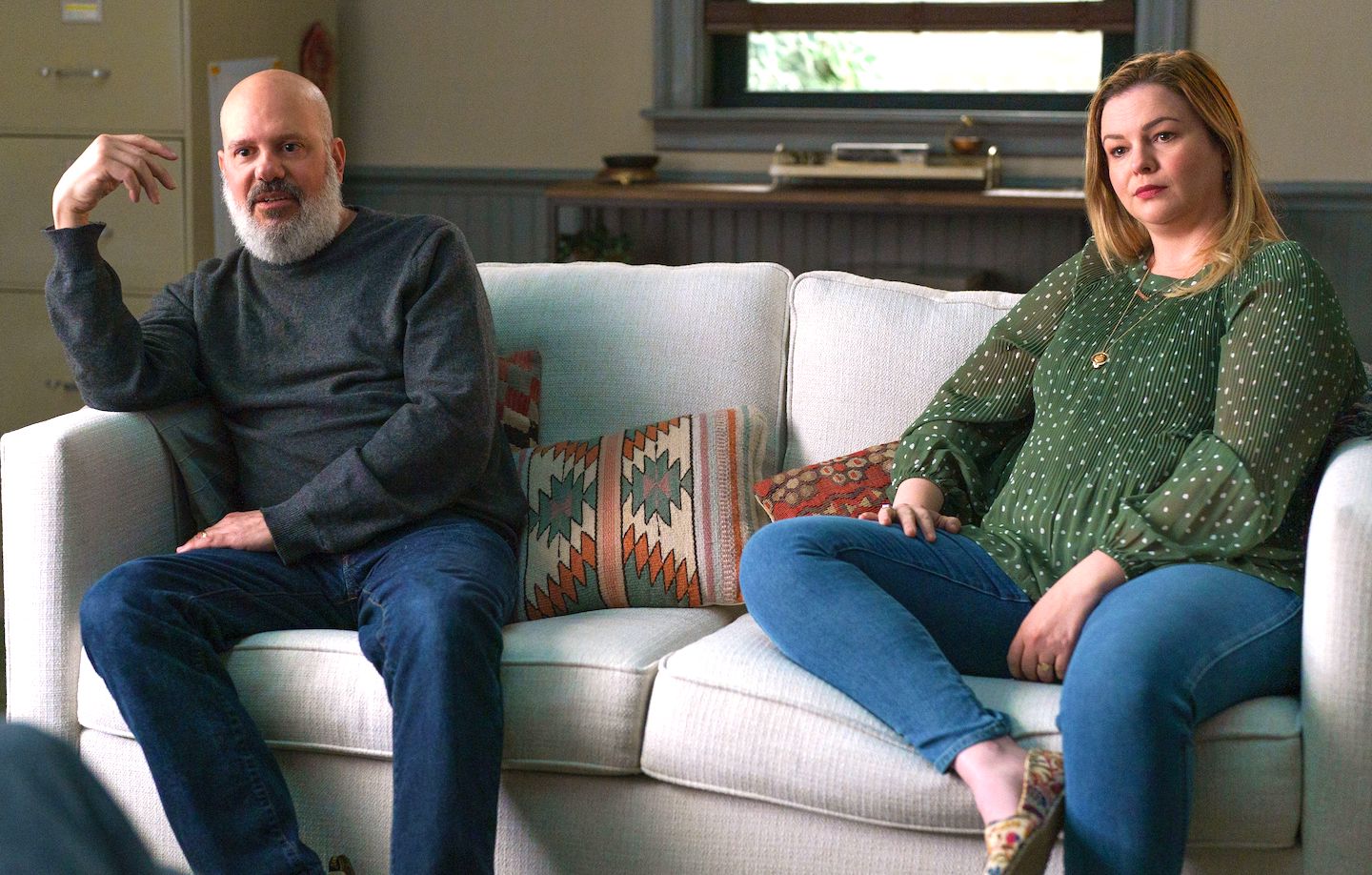
That makes Beth feel like “an old voice,” she dejectedly tells her therapist husband, Don (Tobias Menzies, who played Prince Phillip on Netflix’s The Crown). He’s undergoing a bit of life crisis of his own, fretting about his sagging face and his lost youth, and he’s been getting a bit confused about which of his patients go with what problems. One bickering married duo he’s counseling (the real-life couple of David Cross and Amber Tamblyn) tells him he’s been wasting their time and their money, and they demand a refund. Maybe he’s not the therapist he thought he was.

David Cross and Amber Tamblyn play a bickering married couple.

Beth worries that their grown son (Owen Teague) isn’t fulfilling his potential working in a cannabis store with a bunch of slacker potheads. She doesn’t feel any better about his situation when she’s in the store and it gets robbed.

Meanwhile, Beth’s sister, Sarah (Michaela Watkins), is weary of her job as an interior designer catering to uber-persnickety patrons. Sarah’s husband, Mark (Arian Moayed), is a struggling actor whose self-esteem has just taken a big hit.  

Left: Arian Moayed and Michaela Watkins

All these mini crises intersect and come to a head when Beth overhears a remark made by her hubs to his brother-in-law, Mark, that he doesn’t really think her writing is, well, all that good. Suddenly, Beth’s whole world seems to implode. How could he betray her like that? Was Don lying all those times when he encouraged her as a writer and tried to be supportive? It makes her want to throw up on the sidewalk, but she’s too upset to even do that. Eventually, feelings get hurt all around.

This is the kind of small, grown-up movie that not a lot of studios make anymore—a subtle slice-of-life comedy with a small group of characters that feel like real people, in places that look authentically lived-in, instead of fabricated movie sets. It’s full of little micro details that might seem insignificant, but everything rings true, drawing us closer to the characters and providing connective tissue to their wobbly world—an obscenely overpriced hand-crafted bench, a doctor’s explanation of her new “concierge” fee, a wall of exotic socks, a wastebasket that never seems to get emptied, a blouse donated to the homeless that the donor later decides she wants back. It’s sharp and funny and sweet, and keenly observant about how couples and friends may tell little lies to each other—and themselves—and not even realize it. But they continue to love and live, and life goes on.

All the characters are immensely likeable and relatable. And the cast is tremendous, especially Louis-Dreyfus, the Seinfeld veteran whose finely tuned comedy chops can adapt to almost any situation. (I love how she turns a box of bakery doughnuts into a running gag.) It’s no wonder director Holofcener wanted to work with her again after Enough Said, in which JLD starred alongside James Gandolfini, Toni Collette, Catherine Keener and Ben Falcone. Michaela Watkins was also in that movie, too.

Speaking of Seinfeld, that show also revolved around neurotic, self-centered New Yorkers, and it routinely took little things and made big deals out of them—a puffy shirt, getting lost in a parking garage, waiting for a table at a Chinese restaurant, muffin tops, fusilli. Even though it’s miles away from the crazily calibrated absurdity and goofiness of the TV series, there’s undeniably something Seinfeld-ian about this movie, in which little problems ripple into a wider sea of anxieties, and four central New Yorkers flail and flop around in it all.

Like Seinfeld, and like Woody Allen, You Hurt My Feelings understands how to find the funny in human frailty and foibles, and how to navigate the comically uneven—and sometimes messy—sidewalks of life, all the while with a knowing smile.

—Neil Pond

A Next-Gen Fish Tale

Going ‘under the sea’ with Disney’s latest live-action version of an animated classic

The Little Mermaid
Starring Halle Bailey, Melissa McCarthy, Jonah Hauer-King and Javier Bardem
Directed by Rob Marshall
Rated PG

In theaters Friday, May 26

Disney’s beloved fish-out-of-water tale makes a splashy return in this highly anticipated live-action, all-star remake about a spunky aqua teen who longs to be part of the human world.

Like its 1989 animated predecessor, it’s based loosely on a 19th century Danish fairy tale by Hans Christian Anderson. But mermaids—half human, half fish—were swimming around the far-flung pools of pop culture for centuries before that, and the new movie taps into the ancient fantasy and fascination with these alluring mythical creatures and their addictive siren song, which can supposedly lure sailors to doom and death.

It becomes the latest in Disney’s modern-era march of revisionist cinema since the 1990s, putting live actors alongside hi-tech digital effects for remakes of its “cartoon” movies, including Beauty and the Beast, Aladdin, Cinderella, Alice in Wonderland, Dumbo, 101 Dalmatians, The Lion King and Mulan.

And it also becomes one of the best.

Newcomer Halle Bailey is Ariel, fascinated with what goes on above sea’s surface, a place she is forbidden to go by her hyper-protective father, King Titan (Javier Bardem). But when curiosity gets the best of her and she pokes her head out of the waves for a peek, she ends up rescuing a young prince (Jonah Hauer-King) from drowning during a dramatic nighttime shipwreck, hauling the unconscious seafarer onto a beach and serenading him before disappearing again into the water.

That sets things into high gear, as Prince Eric tries to reconnect with the alluring mystery creature that saved his life and Ariel makes a deal with the conniving sea witch Ursula (Melissa McCarthy) to trade her tailfin for feet. But there’s a catch: Ariel must give up her enchanted siren-song voice and share a kiss of “true love” with Eric within three days, or she’ll be consigned to the depths of the ocean forever.

Melissa McCarthy is Ursula

Comic relief is provided by the flappy, yappy seagull Scuttle (voiced, in a gender switch from the previously animated role, by Awkwafina) and the crab Sebastian (Daveed Diggs), a loyal attendant in the royal court of King Triton. Jacob Tremblay (from Room) is the voice of the little sidekick fish Flounder.

Scuttle the seagull is voiced by Awkwafina

Broadway virtuoso Lin-Manuel Miranda (one of the film’s dozen producers) wrote three new songs and tweaked the lyrics of a couple of others (“Kiss the Girl” and “Poor Unfortunate Souls”) for the new movie, reflecting a commendable next-gen sensitivity to issues of female empowerment and consent. But unless you’re a Little Mermaid superfan, and you’re paying super close attention, you might not even notice—or care that a couple of other tunes in the animated version (“Les Poissons” and “Daughters of Triton”) got the hook.

But you will thrill to the movie’s well-known, iconic soundtrack standouts, given tremendous new zap as underwater, computer-enhanced, razzly-dazzly production numbers—reflecting not only Miranda’s buoyant Broadway roots, but also those of director Rob Marshall, a former theatrical producer and choreographer who went on to make music-filled movies including Chicago, Into the Woods and Mary Poppins Returns. “Under the Sea” is a joyous, calypso-flavored aqua chorus line, with dozens of dancing, prancing sea critters; “Part of Your World” gets new emotionally enhanced wallop and human resonance.

And you’ll be rocked by the stupendous performance by 23-year-old Halle Bailey. The Grammy-nominated pop singer and TV actor (from Grown-ish) gives a star-making movie turn as a splendid Disney princess-to-be who makes you feel the heartfelt tug of her big dreams of discovering what’s out there—and up there. Melissa McCarthy practically steals the show as Ursula, hamming it up with a flourish of florescent octopus tentacles, cackling over her bubbling cauldron of sinister spells and plotting to take over the undersea world. English actor Hauer-King has a bit of resemblance to Ryan Gosling, making me drift away for a couple of fanciful moments thinking about The Little Mermaid going ashore in La La Land. And Javier Bardem, so menacing in No Country for Old Men, looks regally right-on as a bearded, bad-ass, big-kahuna submariner.

Javier Bardem is King Titan

It’s about a couple of young people falling in love, of course—in a risky, forbidden, boundary-crossing inter-species relationship, with disapproving parental figures. Think Romeo and Juliet, tossed in the tide and spritzed with ocean mist. The new Little Mermaid leans into its timely theme of cultural differences and societal riffs, as both merfolk and humans inherently distrust, and even hate what’s on the other side of the thin membrane of “border” that separates them.  

Jonah Hauer-King as Prince Eric and Halle Bailey as Ariel.

But hey, let’s don’t get heavy. Dive into this new Mermaid, a delightful, thoroughly entertaining, refreshingly impressive upgrade, a terrific new take on an animated classic, respectful to the Disney original but with vibrant new jolts of movie magic, drama, danger, spectacle, joy, yearning, wit and romance.

Plus an important mega-message for little girls and young women everywhere and anywhere: In the water, on the land, in a seashell or a castle—like Ariel, if you can dream it, you can do it.

This summer, is everything really “better down where it’s wetter”? So far, yes, it is!

—Neil Pond

Out with a Bang

Marvel’s cosmic misfits return for an overstuffed blowout farewell party

Zoe Saldana as Gamora in ‘Marvel Studios’ ‘Guardians of the Galaxy Vol. 3’

Guardians of the Galaxy Vol. 3
Starring Chris Pratt, Zoe Saldana, Dave Baustista, Karen Gillan & Will Poulter
Directed by James Gunn
PG-13

In theaters Friday, May 5, 2023

The gang’s all here as Marvel’s motley crew of cosmic outlaws closes out their movie trilogy with a bang in a daring dash to save one of their own. This big, bold rousing finish (supposedly) is the overcrowded end of the franchise, which began nearly a decade ago and now hinges on the backstory of Rocket, the genetically modified wisecracking racoon (voiced again by Bradley Cooper).

The Guardians quip, banter and rip across the universe, encountering an array of bizarro cyborg critters and a crazed despot (Shakespearean actor Chuckwudi Iwuji, deliciously, devilishly nasty) intent on creating a new, perfected world—and discarding all his “mistakes” along the way.

Vol. 3 throws a lot at the screen—a barrage of digital effects, a who’s who of characters and a dense stream of details. If you haven’t been along for the ride from the beginning, paying attention through the other Guardians flicks, the events of The Avengers and the interwoven connectedness of the broader Marvel Cinematic Universe, well, good luck. You might not understand how the green-skinned Gamora (Zoe Saldana), who died in a previous movie, can show up again, and have no memory that she and Guardians leader Peter Quill (Chris Pratt) were once lovey-dovey.

As diehard Marvel fans know, there’s always the chance of new beginnings and redo’s, thanks to time warps, Infinity Stones and other comic-book shenanigans.

Just about everyone is aboard for this way-out wrap party. There’s Drax the Destroyer (former wrestler Dave Bautista); Gamora’s sister Nebula (Karen Gillan); Mantis (Pom Klementieff), whose enhanced ability for empathy comes in handy. Groot, the size-shifting, virtually indestructible humanoid tree, is voiced again by Vin Diesel, even though he grunts only one thing (“I am Groot”) over and over.

Look: There’s Sylvester Stallone, back again! And Elizabeth Debicki! Will Poulter makes the movie debut of a golden-hued, artificially fashioned space super-dude, Adam Warlock, whose comic-book roots go back to the 1960s. And Cosmo the telepathic dog has a new voice—it’s Bulgarian actress Maria Bakalova, who got an Oscar nomination for playing Borat’s daughter in Borat Subsequent Moviefilm. Returning director James Gunn’s brother, Sean, also returns as a humanoid alien with a mohawk fin on his head and a whistle-controlled arrow in his quiver.

There more than a few space-age shootouts with all kinds of zappers and blasters, and even a high-tech version of an old standby, the hand grenade. But nothing blows up like the heated moment when one of characters drops the F-bomb, marking an onscreen first for a Marvel movie.

At one point, the Guardians plop down in a comically mutated surburbia that looks like Ozzie and Harriett spliced with The Twilight Zone. Is that Howard the Duck, the waterfowl star of Marvel’s first feature-length theatrical movie (1986), playing a card game? Be quick or you’ll miss a visual shoutout to Alf, the sitcom space alien. To top it all off, there’s a climactic rescue of a bunch of cute kids, who look like ragged theater waifs abandoned after being worked to the bone in back-to-back productions of Cats and Les Miserable.

Baby Rocket (voiced by Bradley Cooper)

It’s a mega-movie loaded with wildly colorful characters, oddball creatures, monsters and cuddly pets, loads of whimsy and jokes, bursts of dramatic intensity, lushly detailed world-building and ka-boomy blasts of explosive, expensive-looking, sometimes chaotic action. But there’s also a surprising amount of emotional heft and heart, particularly in the sentimental swell of Rocket’s early days when he was experimentally bioengineered alongside other “altered” caged animals. If those TV PSAs for animal-cruelty prevention really get to you, you’ll be wrecked by watching what went down with Rocket and his penned-in pals. Don’t say I didn’t warn you.  

And you’ll certainly tap your toes to the soundtrack, a highly curated playlist loaded once again with scene-appropriate tunes by the Flaming Lips, Heart, Faith No More, Alice Cooper, the Beastie Boys, Florence and the Machine, Bruce Springsteen and X. The movie opens, fittingly, with Radiohead’s “Creep”—and Rocket muttering along to the lyrics, about being a self-loathing “freak” and “weirdo”—and closes with a bouncy, upbeat Poco tune that will be familiar to fans of the first movie, back in 2014.

Pom Klementieff as Mantis, Groot (voiced by Vin Diesel), Chris Pratt as Peter Quill/Star-Lord, Dave Bautista as Drax, and Karen Gillan as Nebula

If this is, indeed, the final Guardians mission, they go down swinging (and swearing!). But rest assured, you’ll be seeing these characters—or some of them, anyway—in other Marvel projects, in some form or another. This may be a goodbye, but these Marvel space seeds were also engineered to grow, made to be movie perennials, sewn to sprout—to regenerate like the roots and branches of Groot—over and over, returning again and again.

—Neil Pond

Fear and Loathing

Director Ari Aster’s latest explores monumentally monstrous mommy issues

Beau is Afraid
Starring Joaquin Phoenix, Nathan Lane, Amy Ryan & Patti LuPone
Directed by Ari Aster
Rated R

In theaters Friday, April 21, 2023

An epic, surreal neurotic odyssey, director Ari Aster’s latest movie mind warp is a three-hour dive into some monumental mommy-dearest issues.

Joaquin Phoenix stars as Beau, a deeply disturbed, woebegone sad sack preparing for a trip to visit his mother. But his trek is derailed by a colossally wild detour into the heart of crazytown as he confronts some of his greatest fears and anxieties before finally facing the twisted, tangled roots of his lifelong problems.

Aster is the horror-flick auteur who gave us Hereditary, about an ancient demonic force taking hold of a family, and Midsommer, in which a group of young Americans finds some shockingly extreme couples therapy at a creepy folk festival. Beau is Afraid doesn’t plunge as deep into the outright freak-show terrors of either of those films (at least not until its far-out finale), but it “feels” like a horror movie throughout, as Beau’s journey takes him into one terrifying situation after another. It’s like the ancient tale of Oedipus grafted onto the biblical story of Job, topped with a bracing, fatalistic slap of Coen Brothers oddness and a hyper-medicated kick of fear, dread and self-loathing.

(Watch closely and you’ll see some things—a headless body, a brown bear on a blanket and a particularly gruesome death “on the rocks”—that might remind you of touchstones from the director’s previous films.)  

So, what is Beau afraid of? Well, he fears going outside, into the dystopic, dangerous swirl of derelicts, junkies and thieves lurking just beyond the locked door of his squalid apartment building. Can he get stomach cancer from accidentally swallowing mouthwash, or die by taking medication without water? Is that naked homicidal maniac going to stab him? What’s the deal with the peculiar altruistic couple (Kevin Lane and Amy Ryan) who take him into their home after striking him with their vehicle? Or their surly teenage daughter, who loathes him, and the enraged U.S. Army veteran trying to track him down and kill him? Practically paralyzed with guilt and bearing enough psychological baggage to sink a ship, Beau is afraid of just about anything and everything—especially his mother (Zoe Lister Jones in flashbacks, Patti LuPone in present-day).

Parker Posey plays Beau’s grownup childhood beau, who shows up just in time for a fateful reunion.

The movie throws a lot at you and asks a lot of you—that you go along with Beau on his torturous journey of self-discovery and wrap your head around what it all means. In the film’s most bewitching segment, Beau encounters a theatrical troupe of performers in the forest, a folklore-ish interlude during which he experiences an alternate, hallucinogenic overview of his life. It’s the most dazzling, mesmerizing moment in a movie overstuffed with wonders and puzzles and unsettling issues, about mothers and sons and pasts littered with regrets.

And it’s a movie that takes sexual performance anxiety to a whole new level, especially as it settles into its home stretch and skeletons (so to speak) come clattering out of the closet—and a grotesquely symbolic monster lurks in a corner of the attic. I guarantee it will out-monster anything you ever conjured up that might be hiding underneath your childhood bed.

Does life come down to a litany of all your transgressions, a messy pile-up of everything you’ve done, and all you didn’t do? Can anything save you, in the end, when your little boat is sinking into the murky abyss of eternity’s dark ocean? Are all the fibers of our being connected and interwoven in ways we can’t possibly fathom? And is someone—maybe your mother, who brought you into this world—really watching it all, forever judging, disapprovingly tabulating the many ways in which you never measured up?

You can see how all that would surely mess up someone, the way it’s certainly messed up Beau.

Beau is Afraid is challenging for its excessive length, its bold, sprawling vision and its unconventional, bizarro mix of inscrutable characters, improbable circumstances and sequences that blur the lines between reality and fantasy. It’s not a feel-good movie by any means, even though it has moments of wild wonder and fantastical beauty, and spatters of bleak humor—like the “menu” posted outside a sleazy peep show, a TV dinner with some comically unlikely ingredients, and the overall gonzo weirdness of it all. It’s like watching one man’s precipitous tumble into the murky deep end of his intensely troubled gene pool, and you’ll probably leave the theater wondering what, exactly, you just saw.

But it’s certainly arty, well-made, brazenly original and totally authentic—a big-screen panacea for anyone who needs a palate cleanser after a junk-food movie diet of superhero sequels, shoot-‘em-up action flicks and dopey romcoms.

“This is all very confusing,” Beau says at one point. Indeed, it is. But Beau is Afraid is a fearless exploration of one man’s anxiety unlike anything you’ve ever seen, a long-haul onscreen psychotherapy session that leaves you with more questions than answers and dares you to take one of the year’s wildest, most provocatively daring movie rides.

—Neil Pond

If the Shoe Fits

Matt Damon and Ben Affleck score big in their modern Cinderella story about one of the greatest underdog victories in sports marketing history

Matt Damon stars as a Nike marketing exec in ‘Air.’

Air
Starring Matt Damon, Ben Affleck, Viola Davis & Jason Bateman
Directed by Ben Affleck
Rated PG-13

In theaters Wednesday, March 5

Move over, Cinderella, and make way for another shoe story. And this one’s no far-off fairy fable.  

Director Ben Affleck’s earnestly crowd-pleasing Air tells the true tale of how a third-rate sneaker company signed a teenage college basketball phenom, Michael Jordan, and revolutionized everything that followed. One of the most groundbreaking deals in the annals of sports marketing, Nike’s affiliation with Jordan sparked quantum changes in pro sports as well as the realms of fashion, celebrity endorsements and lifestyle.  

It catapulted Nike to the top of the sports-shoe pyramid and eventually made Jordan—today widely recognized as pro basketball’s GOAT, its greatest player of all time—an ever-growing multi-million mountain of moola, dwarfing what he ever earned in his entire NBA career as a superstar for the Chicago Bulls and the Washington Wizards.

Air is a rah-rah, rousing feel-good story about taking risks, following gut instincts, sweating bullets and scoring big. It’s like sports in that regard, but it’s not really a “sports drama.” It spends very little time courtside. Most of the plays we see are as business execs watch grainy scouting tapes. The central figure of the story, Jordan, appears only briefly, a silent sentinental seen almost always from behind. We never get a good look at his face, and we hear him speak only one word, “Hello,” over a telephone.

He’s a looming presence without really being present. It’s a bold, completely effective choice from director Affleck, who knows that dwelling too much on Jordan as a character would take us away from the “sole” of the story and the people who made it happen.

So Jordan, and the game of basketball itself, are sidelined as movie focuses, instead, on the human drama—fathers, sons, workaholic businessmen and one super-savvy mom who connected all the dots, against all the odds. It’s like Moneyball crossed with Jerry Maguire and a dash of David and Goliath.

Ben Affleck is Nike’s philosophical founder, Phil Knight.

It opens in the heart of the go-go, greed-is-good 1980s as we learn how Nike is on the financial ropes, floundering far behind its competitors, Adidas and Converse. The board of directors is pressuring CEO and founder Phil Knight (Ben Affleck) to cut corners and slash budgets. Advertising honcho Rob Strasser (Jason Bateman) bemoans that “George Orwell was right: 1984 is a terrible year—sales are down, growth is down.”

And Nike is down. But Sonny Vaccaro (Matt Damon), in the company’s basketball scouting division, has a bold brainstorm to turn things around…maybe. He wants to use the company’s entire marketing budget to lure Michael Jordan, then only 18, into an endorsement deal, custom designing a shoe that “fits” him in more ways than one, footwear that will become his emblem, his lifestyle, his legacy.

Sonny knows that if his gamble doesn’t roll out a winner, he’ll be out of a job. But he’s all-in. “We build a shoe line just around him. He doesn’t wear the shoe, he is the shoe,” he says. “I’m willing to bet my career on one guy.”

The shoe, of course, would be the Air Jordan, so named for Jordan’s jaw-dropping leaping abilities as a prolific scorer.

Viola Davis plays the mother of teenage basketball phenom Michael Jordan.

Viola Davis plays Jordan’s mother, a shrewd negotiator who innately understands the longterm value her supremely gifted son brings to the table. Marlon Wayans is George Raveling, a superstar basketball coach who only appears briefly but offers some enduring words of inspiration from his past. Comedian Chris Tucker steals his scenes as a Nike marketer with some valuable insights for Vaccaro, especially in dealing with Black athletes. “Always go the mamas,” he tells him. “The mamas run stuff.”

Chris Messina has some spicy comedic bite as a Jordan’s hard-driving agent, David Falk. Matthew Maher is the shoe designer who comes up with the iconic, inspired design for a product that would ultimately travel far, far above and beyond the basketball court.

It’s a juicy, Oscar-bait ensemble, but Damon’s Vaccaro is the heart and soul of the story, the bedraggled underdog who rallies his Nike cohorts—his teammates—behind his big, high-stakes push to land a legend…and help create another one in the process.

Air is Affleck’s fifth project as a director, and it brims with the confidence and slam-dunk sure-footedness he’s developed in The Town, the Oscar-nominated Argo, Gone Baby Gone and Live by Night. The film is rich with ‘80s period-piece touches (handheld video games, Trivial Pursuit, VCRs, running suits) and a soundtrack of expertly curated MTV-era hits (“Blister in the Sun,” “Money for Nothing,” “Born in the USA,” “Time After Time”). It marks the first project of the production company, Artists Infinity, Affleck formed with Damon, his childhood bestie from the ‘hood in Massachusetts.

This is the ninth film in which Damon and Affleck have appeared together, beginning with uncredited appearances as Fenway Park extras in another sports-related human drama, Field of Dreams. They have a natural, unforced ease onscreen together, a natural stride that feels like, well, two old friends who’ve marched along the same path together for years, often as collaborators, doing what they always dreamed of doing, now getting to do it in Hollywood’s big leagues.

And in Air, they’ve found a shoe—and a shoe story—that feels like it fits them perfectly, a cinematic Cinderella’s slipper accented with the Nike swoosh.

—Neil Pond

Man of Few Words

Keanu Reeves let the action do the talking in the wildest, Wick-iest John Wick movie yet

John Wick: Chapter 4
Starring Keanu Reeves, Bill Skarsgård, Donnie Yen & Ian McShane
Directed by Chad Stahelski
Rated R

In theaters Friday, March 24, 2023

He loves dogs, dresses like a scruffy stud and doesn’t say much—except exactly what he thinks.

Oh, and he kills people. Lots of people.

“I’m going to kill them all,” the aggrieved assassin John Wick informs someone in the latest chapter of the action-packed neo-noir franchise, with Keanu Reeves returning to the rock-‘em, sock-em role he originated in 2014.

John Wick: Chapter Four is a ram-jammed, nearly three-hour mega-blast of John Wick doing his John Wick thing. It may be the John Wick-iest John Wick yet.

Wick is, indeed, a killing machine, the world’s most feared—and hunted—hitman, as lethally skilled in ancient martial arts as with all kinds of modern munitions. He’s tried to get out of the dirty-work business before, but he’s mired in the muddy, bloody pull of his past. There’s always an old score to settle, a crooked wrong to make straight, something unconscionable to be avenged. So, he fights, he shoots, he stabs. And despite his constant brushes with death, he’s become seemingly indestructible, a killer immune to being killed, an anti-hero demigod of destruction. At the end of his previous flick, he was plugged (three times!) at close range and sent hurtling off the tiptop of a hotel building.

And somehow—improbably, impossibly—he survived.

Now Wick’s got a multimillion-dollar bounty on his head, and every other hired killer on the planet is hot on his trail.

Actions once again speak louder than words in John Wick: Chapter Four, which ups its own ante for explosively entertaining, hyper-stylish slugfests and ridiculously elevated battle royale body counts. Reeves reportedly trained for months to perform much of his own stunt work for the slam-bang sequences and extended fight scenes, in which brutal jiu-jitsu, judo and old-fashioned hand-to-hand grappling are punctuated by guns, axes, knives, bows and arrows and whatever else might be handy, such as a pencil. It’s a masterfully choreographed, expertly orchestrated symphony of ridiculously vicious international mayhem as he blasts, booms and bashes his through endless waves of attackers in lush, elegant locations across the globe.

And as always, he’s a man of few words. He enters the movie with one, “Yeah,” and leaves with another, “Heaven.” He’s a tortured soul with little use for pontification as he continues to grieve over the loss of his beloved wife and his dog and long for release, somehow, from all the bad karma he’s kicked up over the years.

“Everything he touches dies,” says one character, after Wick has mowed down three Middle Eastern dudes on horseback, galloping ahead of him across a desert, to finally come face-to-face with some kind of gangster sheik. And it doesn’t end well for the sultan—or anyone else who gets in Wick’s way.

So, is he a good guy killing bad guys? A bad guy killing even worse guys? Or a guy who used to be bad, but finding it impossible to be good in a world upside-down and inside-out with evil?

He’s on a violent quest for his freedom from an organization called the High Table, a council of Illuminati-like crime overlords who run the criminal underworld—and much of the rest of the world, too. Now Wick finds himself on the High Table’s hit list, excommunicated and mostly on his own. How far will he have to go, and how many casualties will be left in his wake before he can be free of his past? Can he ever be free?

Pop singer Rina Sawayama makes her movie debut in ‘John Wick: Chapter 4.’

It’s a beefcake-y man’s world, for sure, with very little room for women. The few females that pass briefly through are also skilled combatants (the Japanese-British pop sensation Reyna Sawayama makes an impressive movie debut, and we’ll likely see her again) or sideline observers (a pair of glossy lips purring into a microphone for a podcast giving Wick’s whereabouts to assassins).

It’s a wild, Wick-ed ride around the planet, a world tour of outrageously complex fight scenes that begins in Japan, makes a stopover in Germany and finally sets down in France. There’s a magnificient mosh-pit melee inside a packed Berlin disco, a crazy confrontation amidst traffic zipping around the Arc de Triomphe, and a life-or-death scuffle on an outdoor stairway. Everything leads to a climactic single-pistol duel at sunrise, spaghetti-Western style, in front of the Eiffel Tower.

Ian McShane and Bill Skarsgård

Bill Skarsgård, so good at being bad (he was the creepy killer clown in It), is the Marquis, a High Table official who’ll go to any lengths to eliminate Wick. Ian McShane returns as Wick’s mentor, Winston; he’s the manager of The Continental, an exclusive hotel for the underworld. Laurence Fishburne reprises his role as the Bowery King, who runs a hideout disguised as a homeless shelter. Scott Adkins is a fat-cat, gold-toothed Russian mobster who challenges Wick to a fateful game of five-card draw. A former hitman, the blinded Caine (Donnie Yen), is blackmailed into the unsavory assignment of killing his former friend. We meet a mysterious new foe, the bounty hunter known only as the Tracker (Shamier Anderson), who’s also on a global Wick-finding trip, lured by a reward that eventually notches up to $40 million. But neither Caine nor Tracker really wants to kill Wick; it’s strictly business, the way John Wick’s world turns on its twisted axis.

Speaking of strictly business, the John Wick franchise has pulled in more than $300 million, and Reeves says there will be more movies to come. Next up, reportedly, he’ll return in a couple of spinoffs and prequels, one starring Ana de Armas as a ballerina assassin, and the other telling the backstory of The Continental. And there’s supposedly a John Wick: Chapter 5 ready to rumble, waiting in the wings.

“Have you given any thought,” Winston asks Wick at one point, “to where this ends?”

A valid question for a franchise that seems impervious to winding down, about a character with a track record of not dying. The movie raises other questions too, as it catches it breath between beatdowns, in softer musings about family, fathers and daughters and husbands and wives, brotherhood, religion, spirituality, mortality, how anyone becomes who they are—and if it’s possible to change.

You may have some questions of your own, like where can you, too, can find a customized bulletproof Kevlar suit, or at least one resistant to wrinkles and stains? Is nearly three hours too long for almost any movie? (Answer: Yes, it is.) Is a movie riddled with bullets and bullies the right entertainment for our times, with gun violence at epidemic levels and more than 80 mass shootings in the United States so far this year? (Answer: Perhaps no—but John Wick’s super-stylized violence is so wildly over-the-top, it seems to exist in a wholly impractical netherworld untethered from our own.)

But my burning question, and a practical one for hitmen everywhere in this tax season: If you were successful in killing John Wick, where would you enter that $40 million on your 1099?

—Neil Pond