Category Archives: Movie Reviews

Whodunnit?

Sam Rockwell & Saorise Ronan play mismatched cops in a multi-level murder mystery

Sam Rockwell and Saoirse Ronan star in ‘See How They Run.’

See How They Run
Starring Sam Rockwell, Saoirse Ronan & Adrien Brody
Directed by Tom George
PG-13

In theaters Friday, Sept. 16

Who’s up for a whodunnit?

A lot of people, apparently, given the wide popularity of TV police procedurals, hit shows like Only Murders in the Building, movies (Knives Out, Murder on the Orient Express and Death on the Nile) and the evergreen murder-mystery conundrums of author Agatha Christie.

In this cleverly comedic clue caper set in the early 1950s, a London theatrical production—of a real Agatha Christie murder mystery—goes off the rails when an actual murder (Eeeeek!) occurs backstage. Soon, a jaded Scotland Yard police inspector (Sam Rockwell) and an overzealous young constable trainee (Saoirse Ronan) arrive on the scene to investigate.

And then, as they say, the plot thickens, into a zesty swirl of possible suspects, likely motives and dizzying distractions, as the two coppers dig into the dish-y high-drama dilemma. “Don’t jump to conclusions,” Rockwell’s experienced sleuth cautions his greenhorn partner, who’s eager to peg almost everything as a case-closing revelation—and nearly everyone as a culprit.

British director Tom George, who honed his craft with short films and BBC comedy, makes his solid feature film debut with the support of a fine ensemble cast and an affection for the gloriously retro grit and glitz of London’s yesteryear theatrical world. He also shows a witty grasp of turning the time-honored traditions of murder mysteries inside out, then back onto themselves, into something fresh and lively and frequently surprising. 

Ruth WIlson, Reece Shearsmith, Harris Dickinson, Sian Clifford, Pearl Chanda, Jacob Fortune Lloyd, David Oyelowo and Ania Marson—there’s no shortage of suspects!

Rockwell, a versatile American actor with more than 110 movie and TV roles, adds a new character to his eclectic resume, which includes playing a stir-crazy astronaut (Moon), a superstar choreographer (Fosse/Verdon), President George W. Bush (Vice), a Nazi officer (JoJo Rabbit) and a groovy summertime guru (The Way Way Back). Here, he humanizes his role as the wry Scotland Yard veteran—limping along with a battlefield injury from World War II—with a rumpled, crumpled veneer of world-weary experience anchored to sobering physical and psychological wounds.

Ronan probably won’t net another Oscar nomination, to go along with her previous four, for Atonement, Brooklyn, Lady Bird and Little Women. But she serves up a quaint, likeable, restrained turn that recalls her quirky work with director Wes Anderson in The Grand Budapest Hotel and The French Dispatch. Like Rockwell, she subtly adds dimensionality to a role that could have been significantly thinner and more comedically drawn; Stocker, a war widow whose star-struck obsession with show biz is often good for a pun, is also an avatar of 1950s proto-feminism, a working-class mom determined to do her job and advance in it. 

Adrien Brody (who won an Oscar for The Pianist and appeared alongside Ronan in The French Dispatch) plays an American director in London to change whatever he must to refashion the West End stage sensation as a Hollywood movie hit—much to the chagrin of the outraged screenwriter (David Oyelowo), who’d rather adhere to traditional theatrical elements. There’s the film-to-be’s producer (Reece Shearsmith), sneaking around to hide his affair with his assistant (Pippa Bennett-Warner) from his wife (Sian Clifford, who played Claire on the TV series Fleabag).

Why was the theater manager (Ruth Wilson) so anxious to sell the movie rights to the play? What makes the star of the show (Harris Dickinson) and his actress spouse (Shirley Henderson) so smug? And what’s up with the usher (Charlie Cooper)? Does it have something to do with the sandbag counterweight that bonked him on his head?

The movie revels in classic murder-mystery conventions, giving them a deliciously self-aware twist. And it’s all a charming cinematic toast to the works of Agatha Christie, whose stories and novels have been turned into nearly 40 films and numerous plays—including six staged in London during the 1950s. One of them was, in fact, The Mousetrap, which is the very play at the center of See How They Run

On the stakeout.

Many of the character’s names are wink-wink references to other murder mysteries and actors. Director Alfred Hitchcock gets a shout-out, and so does ‘50s superstar Grace Kelly, who starred in four of Hitchcock’s films (including Rear Window, North by Northwest and Dial M for Murder) before she became Princess of Monaco. Rockwell’s Inspector Stoppard echoes the name of lauded playwright and screenwriter Tom Stoppard, whose many works included a play about—much like See How They Run—a stage production rocked by a real murder. The inspector’s protégé, Constable Stocker, shares her name with the fictional detective Lise Stocker, who appeared in the French TV series Killer by the Lake. The play’s lead actor, “Dickie” Attenborough (playing a detective investigating the crime) might just be intended as a younger version—or a reminder—of the late, great British actor and director Sir Richard Attenborough, whose long career was capped off by his recurring role as John Hammond in the Jurassic Park franchise. The producer, John Wolff, is based on a real-life Oscar-winning Hollywood filmmaker of that same name, who brought several major projects (including The African Queen and Oliver!) to the screen.

Split-screen moments convey the idea that there’s more than one way to see things—quite apt for unraveling a murder mystery, where suspects and clues can be everywhere, anything might be significant, and no detail can be overlooked. A couple of scenes make use of mirrors, “looking glasses” that reflect reversed versions of the same image. At one point, the detective actor goes “Method” and incorporates a physical characteristic of the “real” detective, Inspector Stoppard; Stoppard later mimics—mirrors—the role of the stage actor. This inventive British potboiler, a mirror of classic murder mysteries, playfully blurs the lines between art and artifice, then sends them straight into a merry-mayhem loop-de-loop.

And in the final act of this film about a play being made into a movie, Agatha Christie herself (Shirley Henderson) makes a significant appearance—and the grand dame becomes part of her own drama.

“It’s a whodunnit,” Brody’s director says early on. “You’ve seen one, you’ve seen ‘em all.” Ah, not quite—and don’t be so quick to pre-judge the clue-sniffing charms of this meta ode to murder mysteries, the stage and the screen, which shows there’s still plenty of movie mileage in smoking guns, tainted tea, cocktails, mismatched cops and guys in felt fedoras.

In other words, as Inspector Stoppard advises, don’t jump to conclusions.   

Ain’t Got No Strings

Disney’s ‘Pinocchio’ dusts off the age-old tale of the puppet who wants to be real

Tom Hanks plays Geppetto in ‘Pinocchio’

Pinocchio
Starring Tom Hanks, Luke Evans and the voices of Joseph Gordon-Levitt & Benjamin Evan Ainsworth
Directed by Robert Zemeckis
Rated PG
Streaming Sept. 8 on Disney+

A classic fairy tale comes to magical life once again in this tall tale of a wooden puppet who longs to become a real boy.

Pinocchio, the little Italian marionette, has been around for quite a while—almost 250 years, in fact. His roots are in a novel published in the late 1880s by Tuscan author Carlo Gilodi, and his story “came alive” for American audiences with the beloved 1940 animated Disney film that’s still considered an unqualified House of Mouse-terpiece and a high-water mark for golden-age, hand-illustrated cinematic storytelling.

Following the vintage blueprint of the 1940 version, the new Disney version makes a few notable tweaks; some new things are added, some old things axed for this eye-catching combo platter of live performance and state-of-the-art computer animation. Pinocchio purists may flinch, but hey, the 1883 novel ends with a real downer—the little puppet is hanged and executed. So just keep that in mind; even Disney-fied, this is an existential “hero’s journey” cloaked in danger and a descent into darkness. Ol’ Walt felt the original Italian folktale was too harsh and off-putting, especially for his sunshine factory, so he scrubbed it up considerably in 1940.

Cynthia Erivo is the Blue Fairy.

This new-nocchio features the venerable Tom Hanks as Geppetto, the aging woodcarver and clockmaker who fashions a “boy” puppet to fill the void of what is presumed to be the death of his young real-life son. After wishing upon a star—that his creation of pine could somehow come to life—his cottage is visited by the ethereal Blue Fairy (Cynthia Erivo), who grants the wish. Pinocchio (voiced by British newcomer Benjamin Evan Ainsworth) becomes sentient and animated, able to move without strings, but naïve to the ways of the world, its temptations and its treachery. So, Jiminy Cricket (voiced by Joseph-Gordon Levitt), a dapper little insect onlooker, is appointed the role of Pinocchio’s conscious, an important barometer to help him steer right instead of wrong.

The Blue Fairy tells Pinocchio that if he wants to be truly real, he must show himself to be “brave, truthful and unselfish.” And, as almost everyone knows, if he ever tells a lie, his nose will know—and grow and grow and grow.

Which, as it turns out, comes in handy.

And so begins Pinocchio’s wild adventures—kidnapped by a pair of street scallywags, a sly fox misleadingly named “Honest John” (voiced by Keegan-Michael Key) and his scraggly alley-cat cohort; sold as a novelty into puppet slavery to the greedy, bloated showman Stromboli (Italian actor Giuseppe Batson); escaping, only to find himself on Pleasure Island, where its cornucopia-carnival of anything-goes “pleasures” turn out to be only temporary.

And then Pinocchio ends up in the belly a fearsome sea creature known, appropriately enough, as Monstro.

How and this all wraps won’t be any surprise to anyone familiar with the tale, but one of Disney’s new tweaks is the ending—perhaps not as satisfying as a lot of people would wish, and that’s all I’ll divulge about that. But the story’s overtones about honesty, heroism and the importance of good behavior are very much intact. And kids: Stay in school!

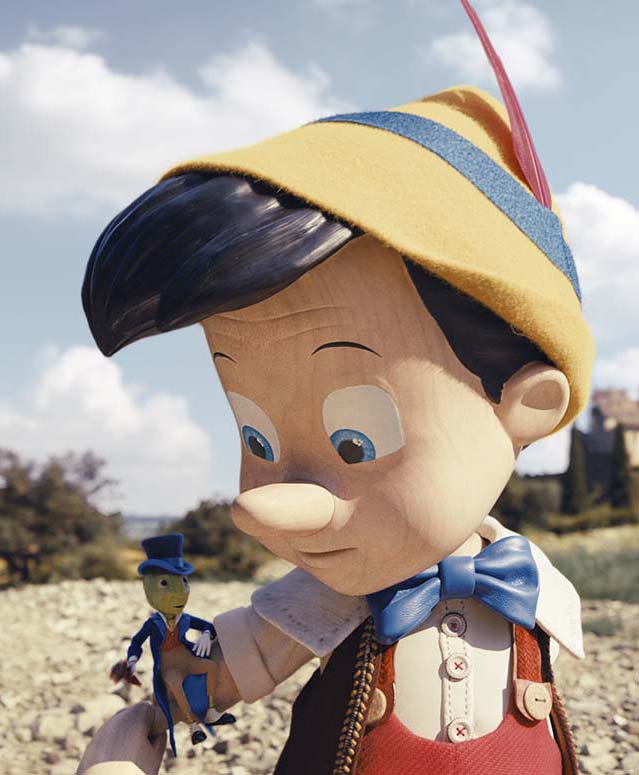
Pinocchio and Jiminy Cricket

And this being Disney, in the modern enlightened age of flagrant self-promotion, you’ll even get a wink-wink, yuk-yuk reference to actor Chris Pine (who’s starred in five Disney movie projects, including Into the Woods and A Wrinkle in Time), and a cuckoo display of characters from other classic Disney films, from Snow White to Roger Rabbit and Toy Story

Erivo, the Oscar-nominated British actress who’s played slave activist Harriet Tubman and musical legend Aretha Franklin, shines (literally) in her one scene as the Blue Fairy, a beacon of light belting out the memorable tune from Disney’s 1960 version that became a an Oscar winner—“When You Wish Upon a Star.” Another familiar song from the classic animated version is “High-Diddle-Dee-Dee (An Actor’s Life for Me),” and Pinocchio sings “I’ve Got No Strings” while he’s prancing on stage with a squad of can-can marionettes. But Jiminy Cricket is robbed of his signature song, “Give a Little Whistle,” which is a bit of a bummer.

Luke Evans—most recently starring in Hulu’s Nine Perfect Strangers—has an enhanced, singing/dancing role as the coachman, who drives kids to their fates on Pleasure Island, and Lorraine Bracco is the voice of Sofia, a helpful seagull.

Director Robert Zemeckis knows movie magic—he took us Back to the Future in two movie sequels, marooned Tom Hanks in Cast Away and gave the world Forrest Gump. His stylish new spin on Pinocchio is a dazzling display of filmmaking, a seamless integration of hyper-realistic FX and human actors. Appropriate, I’d say, for a story about a wooden boy who longs to become real.

An artful new spin on an old, old tale, it likely won’t become a new-age Disney classic—not so long as the 1940 original is around, anyway. But this solidly fanciful fable vibrantly, creatively dusts off the years from pop culture’s most famous puppet.

And I’m not just pulling your strings.

All the Small Things

The little yellow nubbins return for more squatty shenanigans

Minions: The Rise of Gru
With the voices of Steve Carell, Russell Brand, Taraji P. Henson, Michelle Yeoh & Alan Arkin
Directed by Kyle Balda
Rated PG

In theaters Friday, July 1

The fifth installment of the popular animated franchise featuring the small, scene-stealing yellow nubbins goes back to the ‘70s to uncover the riotously funny roots of its central character, the comedically earnest wannabe-villain, Gru. It’s both a sequel and prequel, connected to the preceding Despicable Me flicks and continuing the spotlight on the slapstick shenanigans of Gru’s mini army of squatty accomplices.  

We meet Gru (voiced again by Steve Carell) as a roly-poly schoolboy, where he’s mocked by his classmates for his career aspirations to be the best bad guy of all time. At home, he retreats to his basement—his lair—where dozens of chattering little Minions merrily do his pint-size bidding.  

A recent opening in the ranks of the Vicious Six, a cadre of supervillains, gives little Gru a possible entre to the bad-guy big leagues to earn his evil bona fides. What could possibly go wrong?

A lot—especially when Gru’s efforts to impress the Six with his stealthy thievery backfires and puts him in peril, spurring the Minions to come to his rescue.

Steve Carell provides the voice of 12-year-old Gru

Animator-turned-director Kyle Balda revives the lively, full-throttle comic-book style of the previous films (three Despicable Me flicks and their 2015 spinoff, Minions) with this rockin’ retro riff on the music, culture and movies of the mid-1970s as Gru and the Minions find themselves in the middle of a mighty—and mighty hilarious—misadventure.

Youngsters won’t get a lot of the references, but their parents—and grandparents—will dig the groovy sounds and sight gags, which place the story in San Francisco in 1976. There are nonstop in-jokes about the time and place, from rotary telephones to motorcycle daredevil Evil Knievel and kung-fu fighting. The city’s famous streetcars are used for comedic effect, and both Chinatown and the sea lions of Fisherman’s Wharf are incorporated into bits.

The funny flies fast and furious, equally applied to teeny tiny details and major story blocks—a mention of S&H Green Stamps, a cover of Mad magazine, an 8 track tape self-destructing (Mission: Impossible style) after playing its secret message, a sequence that pays homage to the tomb raiding of Indiana Jones. The funky, feisty bad-ass-ery of Bell Bottom (voiced by Taraji P. Henson), the motorcycle-mama leader of the Vicious Six, is a throwback to the “blaxploitation” movies of the era, like Foxy Brown, Cleopatra Jones and Coffy.

A massive music store—called Criminal Records—is a false front for the Vicious Six, where Gru is admitted by playing a record (appropriately enough, Linda Ronstadt’s “You’re No Good”) backwards in a listening booth. (And yes, kids, those used to be a thing.) The clerk at the store gives Gnu a super-handy smart-goo grabber he’s invented, one that he’s nicknamed “Sticky Fingers.” A torture device is a giant turntable and endless replay of The Tramps’ “Disco Inferno.”

Gru dances to a self-stylized version of Creedence Clearwater Revival’s “Bad Moon Rising,” and the familiar strains of “Funkytown,” The Carpenters’ “Goodbye to Love,” and Mott the Hoople’s “All the Young Dudes” all provide pop-cultural grounding as well as sonic hooks to whatever’s happening onscreen. You’ve never heard The Rolling Stones’ “You Can’t Always Get What You Want” until you hear it, and see it, performed in a cemetery by a choir of Minions. One particularly zany sequence, on a wild-ride commercial airline flight, is scored to Strauss’ graceful “Blue Danube” waltz—making an in-joke nod to the bedazzling sights of outer-space travel in 2001: A Space Odyssey.

That record store clerk (voiced by Russell Brand) will show up again—actually, he’s shown up before—in the Despicable Me-verse. Eagle-eye fans of the franchise will spot plenty of other details, and some characters, that they’ll recognize from previous films.

Other voices are provided by Jean-Claude Van Damme, who plays Jean Clawed, a baddie with massive lobster claws for hands. Lucy Lawless is Nunchuck, a nasty nun with awesome nunchuck skills. Master Chow (Michelle Yeoh) is a mild-mannered massage therapist who schools the Minions in the ancient art of combat. Alan Arkin has a sizeable presence as Wild Knuckles, an ousted member of the Six who becomes a reluctant mentor to young Gru. There’s also Danny Trejo and Dolph Lundgren, and Gnu’s mom certainly doesn’t look like Julie Andrews, but the iconic Mary Poppins and The Sound of Music star once more returns to the role. Rapper RZA is an Easy Rider-style biker.

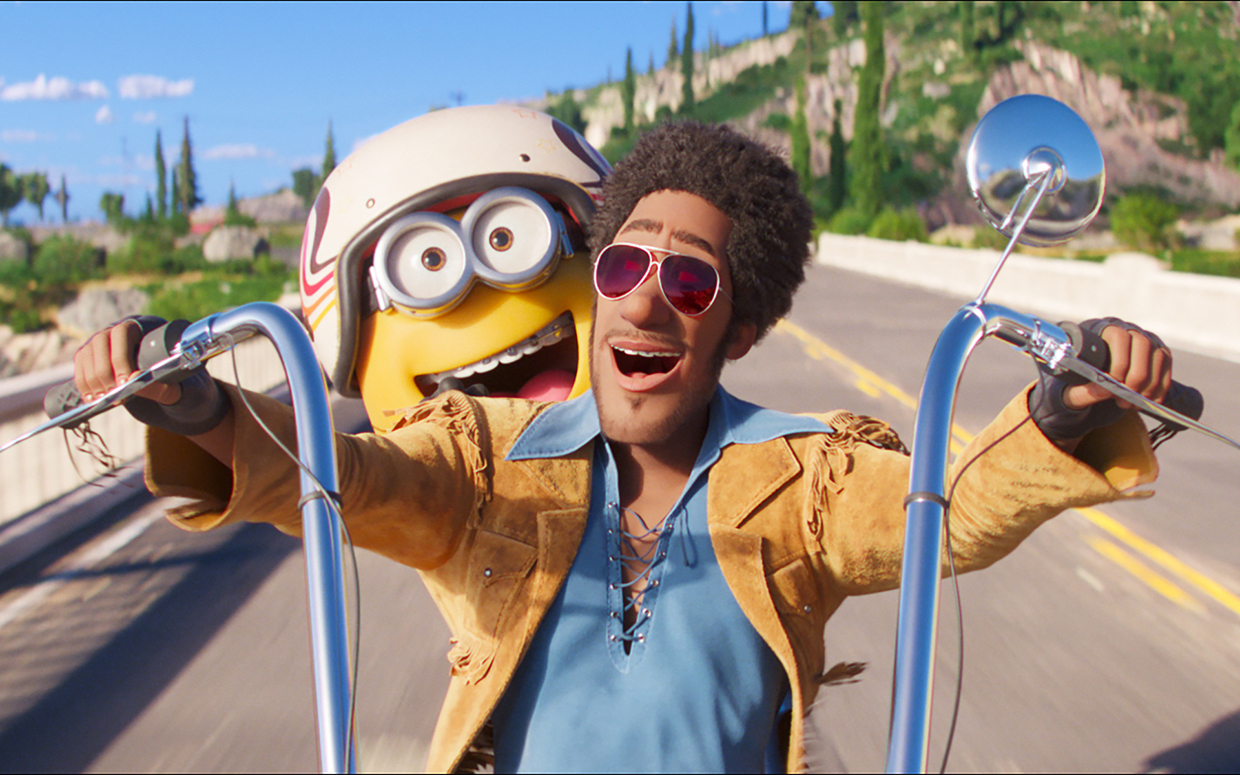
Rapper RZA provides the voice of a biker.

French animator Pierre Coffin (who directed three previous Despicable Me movies) again supplies all the hyper-expressive, yip-yappery gibberish of the Minions in a made-up mashup of childlike nonsense babble with occasional bursts of French, Spanish or English.

The younger set likely won’t catch the many flashback cues or be much interested in how much care, creativity, comedic precision and meticulous animation craftwork went into the filmmaking process; it all looks gorgeous, by the way, as its zooms through its brisk, 90-minute runtime. But I can guarantee little ones will tee-hee at the mild bathroom humor, get gob-smacked by the giddy, over-the-top onslaught of visual pop and pow, giggle at the crazy antics of the Minions and rev up to the gonzo-goofball pace of it all.

Another Minions movie? You might be tempted to say “Meh” and take a pass. But you’d miss the undeniable charms churned up by this zippy, laff-riot fun factory and these little banana-colored bumblers. In today’s darkening world of disease, war and division, the Minions again offer the opportunity to come together and bond in a bright yellow light of rampant imagination and unbridled silliness.

And well, yeah—the timeless amusements of butt cracks and fart noises.

The Boogieman’ll Get You

Ethan Hawk goes for real-life horrors as a neighborhood monster

The Black Phone
Starring Ethan Hawke, Mason Thames, Madeleine McGraw and Jeremy Davies
Directed by Scott Derrickson
Rated R

In theaters Friday, June 24

That old boogeyman, stranger danger, strikes again in this creepy, skin-crawlingly scary tale of abducted kids and a neighborhood monster who trolls for his victims in a van filled with black balloons.

Newspapers and news reporters, addressing the rising tide of missing children, refer to him as “The Grabber” for the way he seemingly snatches kids right off the streets, after which they are never seen or heard from again.

It’s a living nightmare for the residents of this community in North Denver, Colo., where the movie—set in 1978—begins with a closeup of a can of the local commodity, Coors beer, being popped open at a high school baseball game. Everyone’s watching the young pitcher, Finney (Mason Thames), hurling hit-resistant fastballs and curveballs out on the mound.

“Your arm is mint,” says an opposing player admiringly.

Finney’s a smart kid, into model rocketry, and he has a sweet, awkward crush on a pretty young classmate (Rebecca Clark). But he’s bullied at school, until his karate-kid friend (Miguel Cazarea Mora) comes to his aid, with a little bit of advice—namely, that he won’t always be around to protect him. “You’re going to  have to stand up for yourself one of these days,” he tells Finney.

Those days come soon enough, when Finney fatefully encounters the Grabber as he’s walking home from school one afternoon. Wearing ghostly white face paint and a top hat, the stranger stumbles and fumbles out of his van (painted with the word “Abracadabra”), claiming to be an illusionist. “Would you like to see a magic trick?” he asks, before engulfing Finney in a cloud of black balloons, drugging him and tossing him into the vehicle. Finney awakens to find himself locked in a stark, soundproofed basement. Will his affection for science and model rockets, or his “mint” pitching arm and his athleticism, do him any good now? Stay tuned!

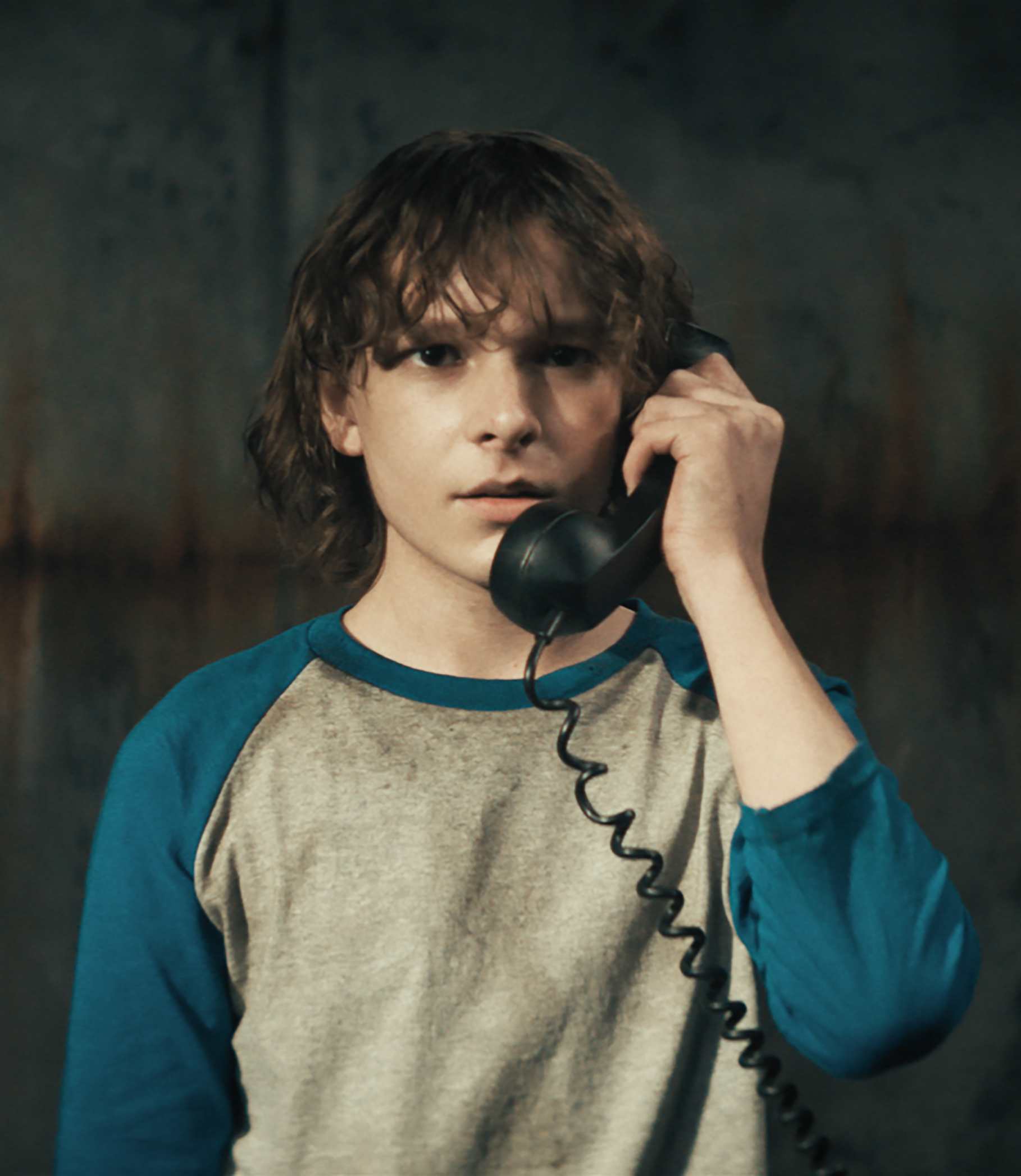
“Nothing bad is going to happen here,” the Grabber says while wearing a rubber mask of a grinning, leering devil, which doesn’t exactly reassure Finney—or us. The Grabber is a grotesque, unsettling sight, and he tells Finney to not get any hopeful ideas about the black rotary telephone mounted on the wall of the basement; that old thing hasn’t worked for years.

Finney’s situation seems dire indeed…until the phone starts ringing.

Mason Thames as Finney, who gets mysterious calls on an out-of-service phone

Telephones have an often-overlooked role in the pantheon of horror cinema, from the murder of a babysitter by a phone cord in Halloween (1978) to the sinister inside-the-house stalker of Scream (1979) and the dreaded you’re-about-to-die call in The Ring (2005). Some flicks have been even more on-the-nose, like When a Stranger Calls, Phone Booth and Murder by Phone.

This tale of telephone-connected unpleasantness is based on a story by Joe Hill, who happens to be the son of horror-fiction maestro Stephen King. It’s the second film built around one of Hill’s pieces (the first was Horns in 2013), and like his famous dad, he knows how to wrap a deeply disturbing yarn in the snug tentacles of the supernatural. The basement phone is a lifeline to an afterworld realm, where Finney is mysteriously—somehow—connected with the Grabber’s former young victims, who offer him advice on how he might avoid their terrible fates. And Finney’s spunky, potty-mouthed younger sister, Gwen (a terrific Madeleine McGraw), has troubling “weird” dreams that may be clue-filled portents pointing to the whereabouts of the Grabber and her missing brother. Are her nocturnal reveries rare psychic gifts brought by prayer-time invocations to Jesus, or merely the fruits of a wild imagination? Her volatile, alcoholic dad (Jeremy Davies) thinks her dreams are signs of genetic psychosis and thrashes her with his belt to drive the thoughts from her head. Under those circumstances, how can Gwen make her father, and the local police, understand?

Madeleine McGraw plays Finney’s sister, Gwen

Once again showing his versatility as an actor, Ethan Hawke dives deep into his deliciously deranged, big-bad-wolf role as the Grabber, drawing us in close to feel—and fear—his unhinged, unpredictable malevolence. Hawke has immersed himself in supernatural weirdness and wonders before, in films like First Reformed and Sinister; he brought home the reign of murder and mayhem in The Purge (the O.G of that franchise, back in 2013) and most recently had a brief but brutally pivotal role in the bloody Viking revenge epic The Northman. As the Grabber, he’s a real-world monster hiding in plain sight, which makes him even more bone-chilling. It’s impossible to miss the connections between the gruesome Grabber and actual mass murderers and serial killers, such as “killer clown” John Wayne Gacy, Ted Bundy and William Bonin, known as “the Freeway Killer,” who murdered 14 teenage boys between 1979 and 1980.

Director Scott Derrickson for sure knows how to get under your skin, as he did in his previous horror films The Exorcism of Emily Rose, Sinister (also with Hawke) and Deliver Us from Evil. (He also directed Doctor Strange.) He creates a stylishly creepy, eerily effective, tightly wound atmosphere of dread, tension and edgy, ever-present danger. The movie’s DNA shows strands of the killer clown in It, the flashback goosebumps of Stranger Things and hints of the “dissociative personality disorder” driving the central character in M. Night Shyamalans Split. Thinking all the way back to Carrie, the 1976 classic that became Stephen King’s first movie adaptation, there’s a similar thread of profane skepticism about the effectiveness of religion in the face of full-on, impenetrable evil. The strong bond between Finney and Gwen might make you recall the young vampire and her devoted childhood bestie in Let the Right One In.

There’s violence and a bit of blood, serious childhood shockwaves and a couple of “jump scares” that will give you genuine jolts. One breathless, bravura sequence in particular—involving booby traps, an axe, a telephone receiver and a snarling, vicious dog—will have you holding your breath.

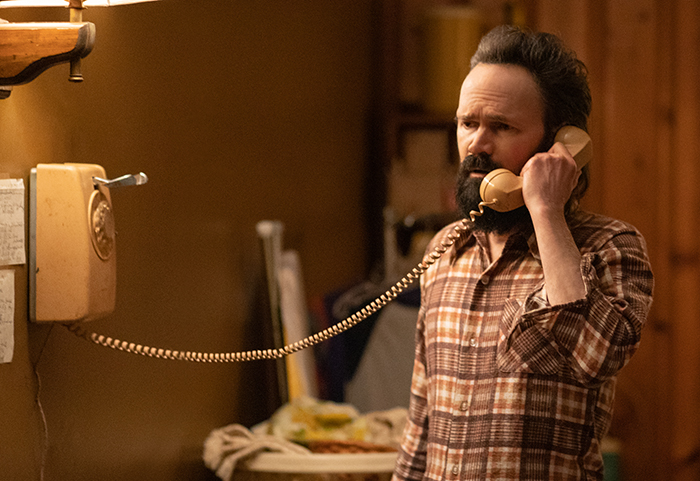
Jeremy Davies plays the dad of Finney and Gwen.

The attention to the detail of the late 1970s is impressive, from pinball and attire to chatter about TV’s Happy Days and The Partridge Family and kids riding their banana-seat Schwinns up and down the streets. Gwen’s dreams are depicted in sequences that look like grungy, grainy reel-to-reel home movies of the era (or the actual home movies that director Derrickson used to unravel Ethan Hawke in Sinister). Well-placed soundtrack tunes from the Edgar Winter Group, Pink Floyd and Sweet rock the retro vibe, which settles in like Licorice Pizza with a harrowing side serving of doom, fear and madness. It depicts a “simpler” time, before iPhones and internet, when entertainment was drive-in movies and late-night TV…and long-distance communication was done by rotary-dial telephones.

Like the black phone in the basement.

This nerve-jangling tale reminds us of both the tenderness and the toughness of childhood, how danger is always out there lurking and that some men can be monsters—and some monsters are men. It’s a ripping, vice-gripping procedural, a chilling dip into a horrific suburbia disturbia, and a heart-pounding slice of childhood trauma drama built on a troubling foundation of hometown terrors.

So, if you’re dialed into all that, well, The Black Telephone has your number.

All Teeth, No Bite

Dinos roar to close out the franchise, but the iconic ‘Jurassic’ movie series has almost overstayed its welcome

Chris Pratt races to outrun a velociraptor

Jurassic World: Dominion
Starring Chris Pratt, Bryce Dallas Howard, Jeff Goldblum, Laura Dern & Sam Neill
Directed by Colin Trevorrow
Rated PG-13

In theaters June 10, 2022

You want dinosaurs? Well, here you go!

The sixth and final installment of the dino-rama started by director Steven Spielberg in 1993 is chock full of roaring, rampaging reptiles. They rise like leviathans from the roiling sea; they gallop over the plains and swoop out of the sky; they cause highway accidents and accost campers in parks. And you thought mosquitos, sharks and bear attacks were anything to worry about?

In Jurassic World: Dominion, dinosaurs are no longer contained in exotic tropical-island zoos or research facilities. They’ve busted out of their once-experimental, bio-engineered bubbles and now live as “wild animals,” causing a ruckus across the globe. As the movie opens, a newscast notes “37 dinosaur-related deaths reported last year.”

Forget fossils. These living, breathing alpha predators have become a disruption, a new notch in the food chain, a black-market commodity and a global challenge to humankind’s abilities to coexist and adapt.  

But dinosaurs aren’t the biggest problem. Instead, it’s the shady company BioSyn, which has been genetically making and replicating them, and possibly planning something even darker and more diabolical.

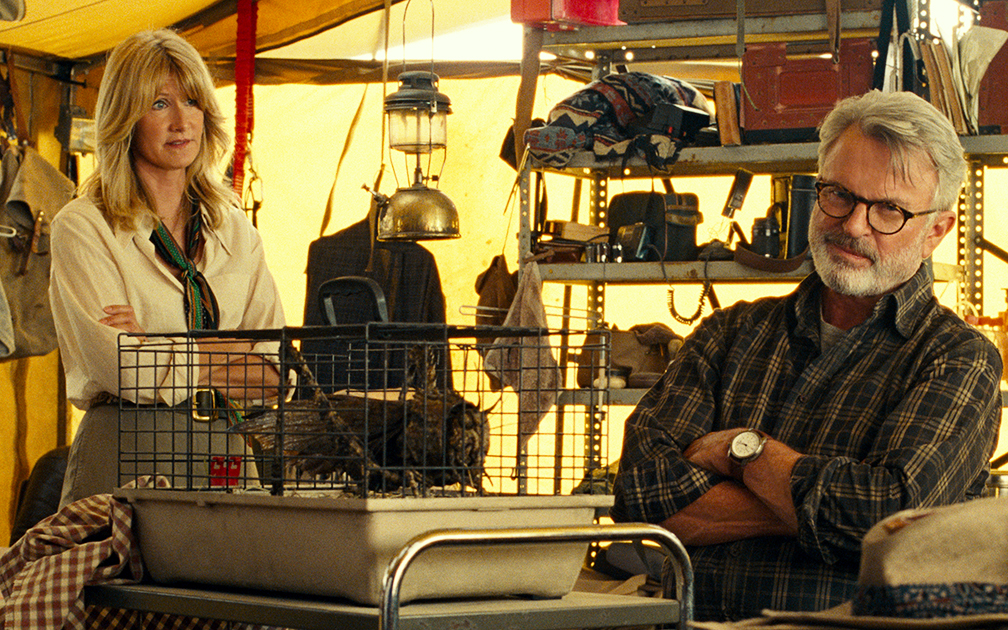
Dr. Ellie Sattler (Laura Dern) and Dr. Alan Grant (Sam Neill) reunite.

Who better to get in the dino drama than all the characters from all the Jurassic movies? It’s a reptile-romp reunion as Laura Dern and Sam Neill (who starred in the original Jurassic Park and its two follow-ups) re-enter the franchise, alongside Chris Pratt and Bryce Dallas Howard (from the two newer Jurassic World flicks). Jeff Goldblum, who straddles both the Park and the World, returns for more dry comic relief as chaos theorist/mathematician Dr. Ian Malcolm. Another familiar face: B.D. Wong’s pioneering dino scientist, who’s having second thoughts about the havoc he’s helped to unleash on the world.

Claire (Bryce Dallas Howard) is neck-deep in dino trouble.

Isabelle Sermon reprises her role from two previous films as Maise Lockwood, the now-teenage granddaughter of one of the engineers whose bold DNA breakthroughs helped create the the original dinosaurs of Jurassic Park. The fact that she is also a bio-engineered clone, like the dinosaurs, makes Maise immensely valuable for genetic research—and exploitation.

Colin Trevorrow (who directed 2018’s Jurassic World: Fallen Kingdom) returns to the director’s chair and throws even more characters into the mix. DeWanda Wise is a tough-cookie pilot who gets involved in the adventure when Maise is kidnapped. Campbell Scott is a hissable villain at the helm of BioSyn, and Mamoudou Athie has a key role as a young rising star there.

It’s a packed movie, with a lot going on and a lot on its mind—the dangers of cloning, the responsibilities of science, our fragile ecosystem, corporate avarice, animal abuse and human hubris. Do dinosaur moms love their dinosaur babies? Where can you buy dino kabobs? Some of those things are addressed, true, in previous Jurassic movies, but they’re really hammered home here. And it’s certainly not a coincidence when a conversation brings up the Greek god Prometheus, whose legend is a mythological caution about the perils of “playing god.”

Sometimes it works, and sometimes it doesn’t. It’s a kick to see all the cast members from previous films together. “Wow, this is so trippy,” says Goldblum’s character, and he’s right; it’s a trip, among other things, down memory lane. The movie is full of nods and throwbacks and strains of its own cinematic DNA, like a fateful salute to the greedy, bumbling programmer played by Wayne Knight in the original, and when a fearsome Giganotosaurus attack puts everyone through a scene almost identical to the classic, frightful T-Rex encounter from 1993.

But much of the time, it feels like it’s stuck in its own nostalgia loop, with scenes and setups that don’t break new ground as much as retread it. And it just doesn’t feel very awesome anymore. When Spielberg’s Jurassic Park hit the big screen nearly three decades ago, it was a groundbreaking movie milestone, a benchmark of technological advancement and a gob-smacking wellspring of awestruck wonder. No one had ever seen dinosaurs depicted so realistically. But that was 29 years ago, and we’ve been treated to five subsequent films, each reflecting the newest advances in combining actors with digital dino danger. There certainly are a lot of dinosaurs, more than ever (plus a bonus menace of giant flying locusts) in Dominion. But now, seeing them doesn’t seem like such a big deal. We’re kinda used to it.

It’s a fitting, flashy, action-packed finale for a franchise that introduced the world to a new era of dinosaur movies—and became a hot property entertainment franchise with sequels, spinoffs and even theme-park rides. Our fascination with dinosaurs may never become extinct, but most good things eventually come to an end, and even Jurassic Park couldn’t stay open forever.

“Let’s finish this,” says Laura Dern’s character at one point.

By the time Dominion stomped and romped across the finish line at a somewhat belabored two and a half hours, I pretty much felt the same way.

Still at the ‘Top’

Tom Cruise soars—older but wiser—in sequel to the iconic 1980s blockbuster

Top Gun: Maverick
Starring Tom Cruise, Jennifer Connelly & Miles Teller
Directed by Joseph Kosinski
Rated PG-13
In theaters Friday, May 27, 2022

Tom Cruise makes it all look so easy.

Scaling the glass of the world’s tallest skyscraper? Sure. Dangling from the outside of an airplane? Piece of cake. Leaping from the top of one building to another? All in a day’s work.

Yes, he did all those things, for real, for various Mission: Impossible movie adventures, often ignoring the advice of safety professionals and defying the film’s insurance protocols. (He famously broke his ankle on the skyscraper stunt—ouch—but hey, no big deal.)

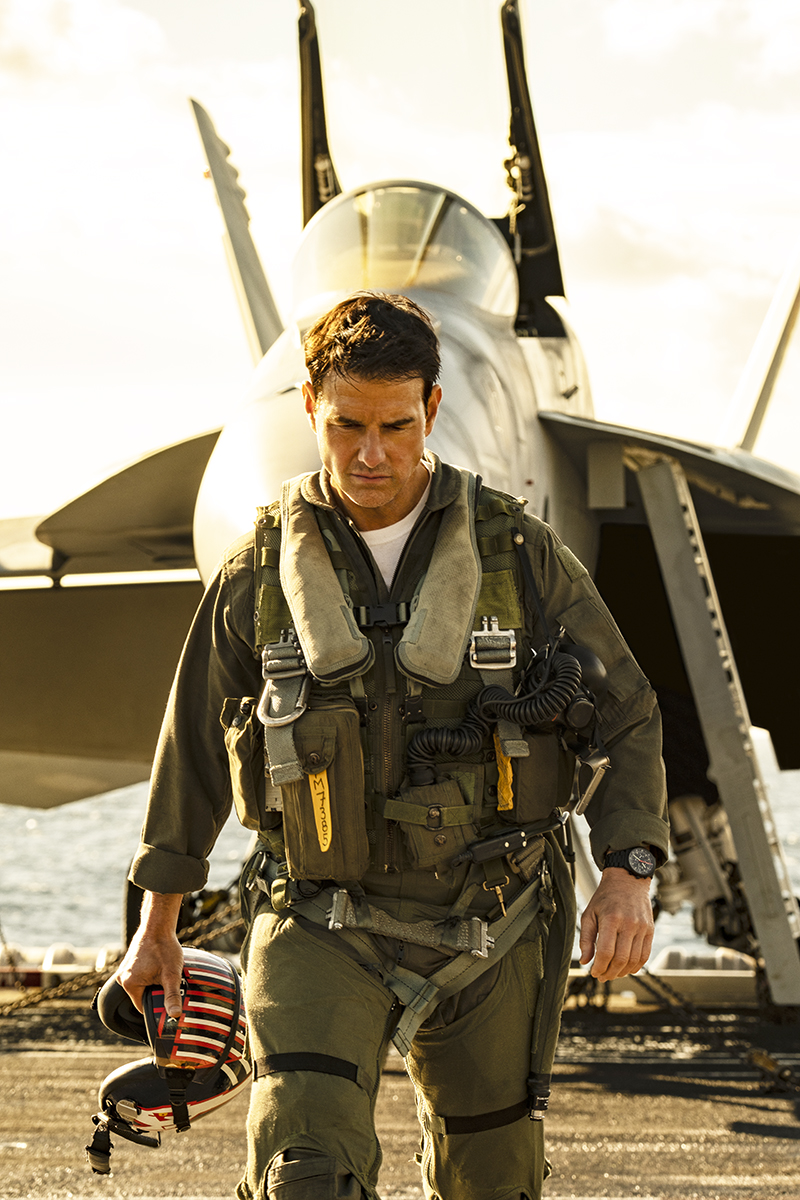
Cruise is up—and that’s truly the right word—to the job once again in this sky-high, much-anticipated sequel to the 1986 summer-movie smash. He returns to the role of U.S. Navy fighter pilot Pete “Maverick” Mitchell, whose cocky, risk-taking flyboy personality made him the standout superstar, almost four decades ago, at the elite Navy training program known as Top Gun.

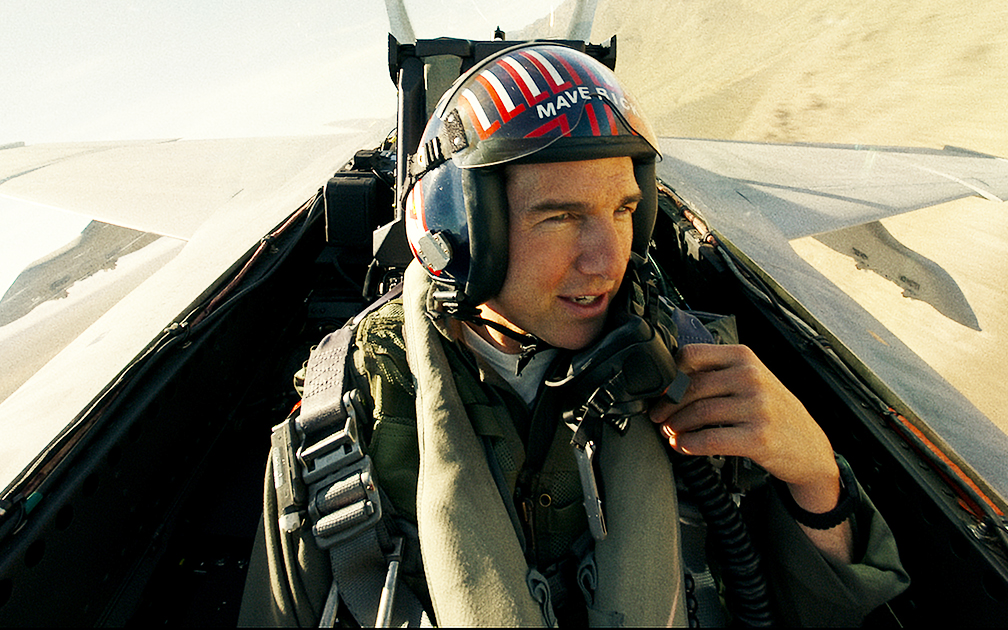
Now, Maverick is called back to Top Gun to train a new batch of elite younger pilots for a seemingly impossible mission. And in true Tom Cruise fashion, that’s really him in the cockpit, flying, soaring, zooming, sideways, straight up and upside-down at eyeball-popping supersonic speeds, pulling some serious G forces. No stunt pilot or special effects for him.

And those F/A-18 Hornets, F-14 Tomcats and “fifth-gen” fighters (the most advanced 21st century combat planes in the air), they’re all real, too. It’s like a military aviation museum roaring and soaring back life.

Cruise’s commitment to realism is only one of the factors that make Top Gun: Maverick such an exhilarating movie experience. It’s a fine-tuned, big-budget blockbuster, full of heart and soul, white-knuckle action and vertiginous excitement, swells of heartfelt emotion and jabs of joshing, mood-lightening laugh lines. It’s big, strutting, soaring, roaring, proudly pop-corny entertainment that begs to be seen on the big screen, like the blockbuster it was destined to be—which is why its release was delayed twice, over the past two years, by the COVID pandemic, until more people felt comfortable coming back to theaters.

Director Joseph Kosinski, whose other films include Tron: Legacy (2010) and the firefighter drama Only the Brave (2017), worked with Cruise previously, on the sci-fi adventure Oblivion (2013). He knows how to meld massive spectacle with strong story lines, and—in this case—how to make Cruise and his megawatt, big-screen charisma shine like the sun. When closeups fill the screen with his face, it’s a larger-than-life reminder that Cruise, now 60 years old, is much more than an actor, or a Hollywood veteran; he’s a bona fide movie star, an action icon who became one of moviedom’s most dashing leading men.

Miles Teller plays “Rooster,” the son of the late “Goose” (Anthony Edwards) in the original.

The new Top Gun has plenty of throwbacks to its 1980s roots, from a reprise of Kenny Loggins’ original signature song, Danger Zone, to character reappearances and nods to previous events. There’s Val Kilmer, who originally played Maverick’s stone-cold Top Gun competitor “Ice Man,” now a high-ranking Navy brass with serious health issues (mirroring Kilmer’s real-life situation after losing his voice due to throat cancer). Jennifer Connelly plays the bar proprietress Penny, a sideline character briefly noted in the first movie, now fully promoted to love interest. And Miles Teller comes aboard as the rookie pilot “Rooster,” the son of the late “Goose” (Anthony Edwards), whose tragic death in Top Gun has haunted Maverick all these years.

Cruise and Jennifer Connelly

The classic-rock tunes (T-Rex’s “Bang a Gong,” “Slow Ride” by Foghat, Jerry Lee Lewis’ piano-pounding “Great Balls of Fire,” David Bowie’s “Let’s Dance”) playing during an early scene in Penny’s bar, The Hard Deck, are affectionate musical acknowledgements of a story that began more than 35 years earlier, then zipped into the sunset as a pop-cultural touchstone. And the movie almost fetishizes certain “icons” from the first film—like Maverick in his signature shades or leaning into the wind on his Kawasaki GPZ motorcycle, flashing his pearly whites in a blissful grin. He may be flying “into the danger zone,” a place where people have been known to die and outcomes are rarely certain, but there’s something bad-ass retro cool and reassuring about seeing those cinematically comforting sights again. They’re reminding us to buckle up for another wildly entertaining ride, that it’s going to be full-scale fun, and Tom Cruise will make it all appear so natural, so effortless, so easy.  

A slo-mo beach football game has sun-drenched shades of the sweat-soaked volleyball match that steamed up the screen back in 1986 with its visual interlude of sexy, sculpted torsos. Lady Gaga sings the closing song, “Hold My Hand,” which has all the sonic soundtrack qualities of “Take My Breath Away,” the pop smash breakout by the new-wave band Berlin, which won an Oscar for the original film. And Maverick continues to break the rules and push the envelope, which is especially aggravating to the flinty, no-nonsense admiral now in charge of Top Gun (Jon Hamm).

Back in the mid 1980s, with global tensions ratcheting up in the Middle East and elsewhere, Top Gun—made with the full cooperation and partial funding of the U.S. Navy—was awash in flag-waving patriotism. It was a big-budget, all-star salute to fighter-pilot cowboys who put their lives on the line to defend America from the skies. The new movie is a bit less gung-ho about it, but Maverick does address the vital role of men (and women!) who put themselves into a cockpit and head into the front lines, especially in an era of combat technology that increasingly relies on drones and damage inflicted from afar.

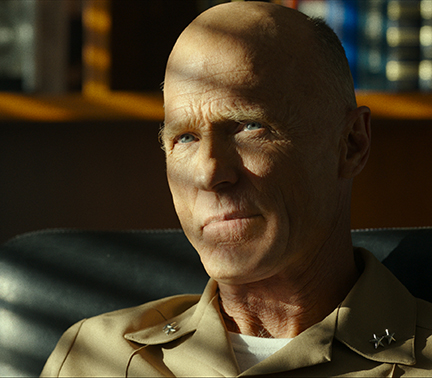
Ed Harris

“You’ve got some balls, stick jockey,” says a steely general (Ed Harris) of Maverick, before telling him his days—as well as the existence of the whole Top Gun fighter-pilot program—are numbered. “The future is coming, and you’re not in it.”

Can Maverick whip the young pilots into shape, make them a team and get them prepared for a daring, do-or-die mission (in this case, a blitz to destroy an enemy compound in an unnamed rouge nation)? Can he teach them to fly at a dangerously low altitude, through a twisty canyon, below radar level to avoid a stronghold defended by lethal batteries of surface-to-air missiles? Can he save the Top Gun operation and restore its relevance in an era of modern warfare? Can he salvage his fractured relationship with “Rooster,” who blames his father’s death on Maverick?

Will the flyboy get the bargirl?

C’mon, really? What do you think?

It’s Tom Cruise, and as always, he makes it all look so easy.

Oh, Man…

Jessie Buckley navigates a nightmare of toxic masculinity

Harper (Jessie Buckley) finds herself in a creepy tunnel in ‘Men.’

Men
Starring Jessie Buckley and Rory Kinnear
Directed by Alex Garland
Rated R
How to Watch: In theaters May 20, 2022

The so-called “battle of the sexes” takes a weird, wild turn in this smart, savage broadside about the abhorrent behaviors of men.

In this horrifically hallucinatory tale, a grieving young woman retreats to the English countryside after witnessing a terrible incident—she watches her husband plummet to his death from the top of their urban London high rise.

Harper (Jessie Buckley) is haunted by the memory of her husband hurtling to the ground, but also by her vivid recall of him screaming that life wasn’t worth living without her. He threatened to kill himself if she went through on her plans to divorce him.

Then she did, and he did. Was his death a suicide, an accident or a departing flourish of frustration about not getting what he wanted? And was Harper somehow responsible?

The troubled widow heads out of town to a quaint countryside village to clear her head. Maybe a week alone in a sprawling rental manor, far away from the city and its reminders of the trauma she’s just experienced, will help settle her jangled nerves.

But, oh, is she ever wrong.

Even though she’s alone in the manse, Harper is never truly alone, and her trauma continues to deepen, intruding into her consciousness with jarring flashbacks. Every man she encounters in the village unsettles her in some way, reconnecting her with the emotional shock of her husband’s violent death.

There’s the overly chatty, socially clumsy owner of the manor; then a scarred, naked man, who follows Harper home from a walk in the woods, appearing to stalk her. There’s a bratty, foul-mouthed teen; a lecherous vicar; a thug from the pub; and a boorish, smugly dismissive constable.

And the men all look the same; for one thing, they’re all played, in a brilliant—and, in one case, CGI-enhanced—multi-character performance by Rory Kinnear (who’ll be recognizable to James Bond fans for his recurring franchise role as the head of MI6). Is the movie suggesting that all men are really, down deep, just the same? That no matter how any man looks, behaves or appears, it’s only a superficial coating, a thin disguise over who he really is? Is Men saying that lust, the drive to procreate and an egotistic need to dominate are the hard-wired motivators of any man…or every man?

The woods around Harper’s manor are creepy. The village is creepy. The absence of other women is creepy; except for a lone policewoman, there aren’t any other females around, anywhere. And the men are all creepy, existing on a spectrum of micro-aggressions that will soon become major aggressions, and creating a rising tide of oppressive, noxious masculinity that seems to permeate the very air that Harper inhales.

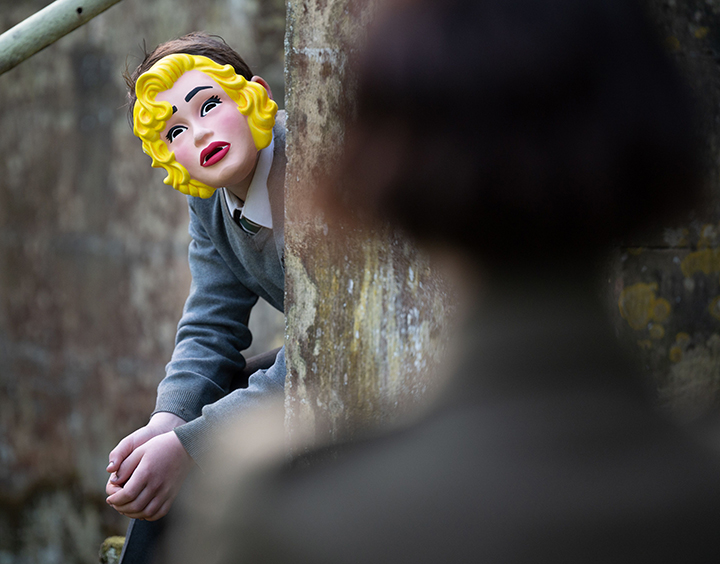
They invade the sanctity of her solitude, figuratively and then literally. They oppress her with their demanding haughtiness, insult her with their crude comments and threaten her with their primal yearnings. They intensify her crippling sense of guilt and deepen her psychic wounds. The teen, hiding behind a plastic trick-or-treat mask of Marilyn Monroe, insists to a disturbed Harper that she join him in playing a schoolyard game. The house owner chides her for eating an apple (“forbidden fruit”) off a tree in the yard. The vicar, who piously notes Harper’s culpability in her husband’s death, attempts to rape her.

Rory Kinnear as the vicar

It’s no wonder that her friend back in London (Gayle Rankin, who played the wrestler Sheila the She-Wolf on TV’s Glow) advises Harper on a FaceTime call that the only way to deal with these guys is take an axe from the woodpile and, well, hit ‘em where it hurts. Cut off the problem at its root, so to speak.

Buckley, the Irish actress most recently in The Lost Daughter, seems to relish playing characters who live beyond the surface of the mainstream, or inhabit its enigmatic, unfathomable underside—like the murderous nurse Odetta Mayflower in TV’s most recent season of Fargo, or the unnamed woman navigating the freakish, reality-shifting scenario of I’m Thinking of Ending Things. As Harper, she pilots a course teetering on madness, awash in wonder, awe and bewilderment…and ultimately, spiraling into a living nightmare.

Men is the third feature film from British director Alex Garland, whose two previous movies—Ex Machina and Annihilation—were trippy sci-fi hybrids exploring the terrors in the breached boundaries of the known and the unknowable.

And there’s certainly a lot of unknowable spread throughout this film, interwoven with elements of ancient folklore, religious allegory and dreamlike symbolism—and that’s before things erupt in a wild, galloping grand finale of all-out horror and the undercurrent of masculine menace becomes a flood of jaw-dropping WTFs. Men may be several things, but as Harper runs an obstacle course of toxic masculinity, it becomes a bizarro indictment of abhorrent behaviors, tapping into an ancient vein that’s been coursing through civilization since time began.

The naked bloke turns into an embodiment of the Green Man, a mythological figure whose representations appear around the world, representing nature’s eternal cycles of life, death and rebirth. (And ain’t it just like a man, to try to take credit for the work of “Mother” Nature?) When Harper inflicts a grievous wound on one of the men, the same wound appears on all of them. (You’ll never look at a front-door mail slot, or a butcher knife, the same way.) And finally, in a slimy, gross-out sequence during which the men suddenly have the, ahem, genitalia of women, they “birth,” well…different iterations of themselves. And the film’s central premise becomes clear: The unchanging, ever-repeating nature of men is to perpetuate their masculinity, to continually assert themselves in violent, assaultive ways, and to forever feel a pathetic need to control women, minimalize their roles and usurp them.

Maybe some viewers will be turned off by the movie’s sudden shift into goop and gore. Maybe you’ll interpret it all as a truly feminist horror fable. Maybe you’ll remember the 1990s best-seller, Men Are from Mars, Women Are from Venus, about the fundamental psychological differences between the genders. Maybe you’ll recognize the Elton John ballad, “Love Song,” which plays over both the beginning and the end of the movie. “Love  is the opening door,” he sings. “Love is what we came here for.”

Yeah, love may open the door. But if you’re on the other side, and especially if you’re a woman in the English countryside, in a creepy village where all the guys embody manhood’s worst, most loathsome attributes, it’s also probably a good idea to have a knife handy—or an axe.

Hop on Pop

Tough guy Robert De Niro shows his silly side in cross-generational comedy ‘The War with Grandpa’

The War with Grandpa
Starring Robert De Niro, Uma Thurman, Rob Riggle and Oakes Fegley
Directed by Tim Hill
PG
In theaters Oct. 9, 2020

Growing old is no joke, but it’s good for some laughs in this comedy about a 10-year-old boy forced to give up his bedroom when his grandfather moves in.

Based on an award-winning 1984 children’s book by Robert Kimmel Smith, The War with Grandpa begins when elderly widower Ed (Robert De Niro) causes a stir at a supermarket self-checkout, leading to an incident that results in his injury. That causes his adult daughter, Sally (Uma Thurman), to finally insist that he’s no longer capable of living alone.

Finding at spot for dear old dad at her home means her son, Peter (Oakes Fegley, who starred as Pete in Disney’s 2016 remake of Pete’s Dragon), gets booted from his bedroom and into the sparsely furnished attic.

Peter’s none too happy about the forced relocation, complaining both at home and at school, where his clique of buddies spurs on his beef. “The attic,” Pete huffs. “Where you put stuff and forget it.”

“I’d demand my room back,” counsels one of his friends. “Or it’s war.”

And war it is, as Peter launches a volley of outrageous pranks devised to get his grandpa to move out of his space—and his grandfather counterattacks with his own bag of devious dirty tricks.

Peter blasts Grandpa awake with a booming speaker on a remote-controlled car, changes out his shaving cream with cement-like self-adhering foam and glues down his keepsakes; Grandpa removes all the screws from Peter’s furniture, secretly rewrites his homework assignments and sabotages his favorite computer game.

Cheech Marin, De Niro, Jane Seymore & Christopher Walken

The comedic conflict escalates to a decisive dodgeball game between Peter’s perky schoolmates and gramp’s spry geriatric gang, Jerry (Christopher Walken), Danny (Cheech Marin) and Diane (Jane Seymour).   

Director Tim Hill wrote for TV’s Spongebob Squarepants and directed the 2020 movie The Spongebob Movie: Sponge on the Run, plus the family films Max Keeble’s Big Move, Muppets from Space, Alvin and The Chipmunks and Hop. So knows what’s funny and where to find it, in measures both big and small, whether it’s Thurman doing a spit take with a cup of coffee all over her car windshield, or De Niro fumbling and mumbling as Ed tries to figure out a new high-tech task, like how to open a digital version of his morning newspaper or use a new iPhone to get a ride on Lyft.  

But oh, does this movie have to repeatedly go so low—literally—for yuks? It repeatedly body-slams two Oscar winners (De Niro and Walken) and one nominee (Thurman) hard on the ground as visual punchlines—ouch! And maybe it’s OK to engineer a guffaw out of someone seeing Grandpa, ahem, sans trousers. But twice? C’mon—that’s not a running joke, it’s comedic elder abuse.

De Niro, who won his Oscar for The Godfather: Part II, is best known for playing gangsters and goombahs in movies like Casino, Cape Fear and last year’s The Irishman. He also has a sly, dry knack for the refreshing fizz of comedy, as demonstrated in Midnight Run, Meet the Parents and Analyze This. But even then, his movie-mobster reputation precedes him. When a black limo pulls up in front of Peter’s middle school, the rear window rolls down and Grandpa tells grandson to “get in the car,” it’s a bit worrisome, at least for a moment. Are they headed to pick up Joe Pesci?

Oakes Fegley, Uma Thurman, Laura Marano, Poppy Gagnon and Rob Riggle

Rob Riggle gets in some good chuckle-worthy moments as Ed’s son-in-law, and former Disney star Laura Marano (she was Ally on Austin & Ally, and also one of the original panelists on Are You Smarter Than a Fifth Grader?) plays Peter’s teenage sister, Mia. Young Poppy Gagnon is a petite scene-stealer as Jennifer, Peter’s Christmas-obsessed little sis.

Younger viewers won’t get the jokes, but eagle-eyed parents may smile with the movie’s knowing nods to its cast’s previous projects and its impressive movie DNA—a line of dialogue from Meet the Parents, a takeoff of an iconic scene from The Godfather, an interaction between De Niro and Walken that recalls their collaboration in The Deer Hunter, the 1978 movie for which Walken received his Oscar. And when Thurman’s character tells daughter Mia that “I was your age once,” we remember that yes, she was—and that she once played a character also named Mia, in Pulp Fiction. Wink, wink.

For all that subtlety, some of the gags are a bit over the top, the humor gets a tad slap-sticky, and the “battle” in a war like this one would not only leave bumps and bruises in real life, it would surely put most grandpas in in a body cast, if not a casket.

But hey, this fighting is all for fun. And if this mega-broad, generation-spanning movie comedy sometimes feels like watching a feature-length, superstar edition of America’s Funniest Home Videos, at least its cast of all-stars seems game to throw themselves—sometimes literally—into a setups that have something for just about for everyone.

Nobody’s going to add any Oscar gold to their mantle with The War with Grandpa. But there’s a genuine sweetness inside all the rampant silliness, a message about family and togetherness and the importance of building something that lasts, like a home, with a group of people who love you—instead of tearing things down, blowing them up or smashing them to pieces in a crazy war over a bedroom, or anything else.  

Witchy Woman

Unsettling tale of Old World witchery is sympathetic fable of assimilation

Noomi Rapace stars as in ‘You Won’t Be Alone.’

You Won’t Be Alone
Starring Noomi Rapice, Alice Englert and Sara Klimoska
Directed by Goran Stolevski
Rated R
How to Watch: In theaters April 1, 2022

Since prehistory, witches have been regarded, rebuffed and reviled as fearsomely mysterious, magical women whose powers made them a real threat to the order of the world.

And long before they were turned into Halloween costumes, sitcoms and cartoons,

witches and witchcraft were staples of lore and legend dating back into the B.C. era, even appearing in the Old Testament of the Bible. A trio of witches in Shakespeare’s MacBeth, written in the 1600s, famously warned that “something wicked that way comes.” In The Wizard of Oz, Dorothy encounters two wicked witches and one fairy-like “good” one. Cher, Michelle Pfeiffer and Susan Sarandon were The Witches of Eastwick; Better Midler, Sarah Jessica Parker and Kathy Najimy stirred up laughs in Hocus Pocus. Elizabeth Montgomery turned wizardry into twinkly weekly primetime pixie dust in TV’s Bewitched, and Melissa Joan Hart was Sabrina, the Teenage Witch.

The deep-rooted “sisterhood” of sorcery is at the tortured heart of this wild, devilishly mesmerizing tale of witchcraft set in the Balkans some five centuries ago. It follows one witch “spirit” as she passes through several human (and non-human) bodies.

And it for sure isn’t a sitcom. The story begins when a baby named Nivena is whisked away by her freaked-out mother to live out an extremely sheltered childhood: She’s imprisoned in a deep, dark rock abyss to hide her from Old Maria, the terrifying necromancer of local legend who visited the newborn soon after birth and chewed off the baby’s tongue for some black-magic mojo. Mom is obsessed about keeping her little girl secluded from the evil always lurking somewhere out there.

Sara Klimoska as Nevena and Anamaria Marinca as Old Maria

And it works for a while—until, 16 years later, Old Maria returns to claim Nivena, now grown into a young woman, and usher her into full-blown witch-hood.

You think you know a lot about witches? How they ride on brooms, keep black cats for companions and cackle as they stir boiling cauldrons? Well, not in this movie, where witches—all victims of some ancient, passed-on curse—must kill and drink blood to survive, a dietary requirement that doesn’t make them necessarily welcome, at least for long, around other people. They regenerate by taking the bodily forms of their victims, and a special two-step process (a searing rip into the chest by the black talons of a witch’s hand, followed by witch’s spit) mean you’re officially into the club. To hasten the transition from one body into a new victim’s body, witches remove their own innards, like unpacking an old suitcase once you’ve arrived at your destination. Being a witch involves a good bit of blood and guts, gristle and self-inflicted de-boweling.

You probably never imagined Sabrina, Samantha on Bewitched or Harry Potter’s Hermione Granger doing anything like that.  

Almost feral after spending her childhood in a hole, and not being able to talk, Nivena (Sara Klimoska, a young Macedonian actress) doesn’t realize, especially at first, that she’s a witch. She has no understanding of the rough life she’ll face on a hard road she didn’t choose; forever a social outcast and outsider, feared, persecuted and often burned alive unless she conceals her identity. But she’ll learn.

“Just you wait,” her witch-mother, Old Maria (British actress Anamaria Marinca), tells her. “Just you wait.”

One of the things she’ll learn is how she’s been bestowed with a cursed immortality; death may be perhaps unpleasant, but it’s not much of a deterrent. Incinerated in the flames of a pyre as a young woman, Old Maria became the stuff of hysteria and cautionary folktales—the child-plucking Wolf-Eatress—who continues to roam the Balkan countryside in her carcass of charred, scarred, ooey-gooey flesh. 

First-time feature writer/director Goran Stolevski was born in the Balkans himself (before relocating to Australia), and the film is steeped in the folktales, and the scenery, of the region during a rather dark and dismal time. It depicts a pastoral place that was especially rough for women, who mostly lived to serve their husbands, in every way—that is, if they weren’t getting raped, beaten or otherwise reminded of their lowly station in the social order. Maybe that’s why witches were such agitators: They were women with shadowy, secretive connections to the natural and supernatural world, and powerful enough to turn the tables and bring down almost anyone, even the strongest of men.

The dialogue is spoken entirely in the authentic “old” Macedonian language of its setting (subtitled into English for American audiences). We hear the inner thoughts of Nivena—who is unable to speak—as stream-of-consciousness bits of inner monologues, which are sometimes quite profound. As she explores everything around her, it’s all new—grass, trees, fields, sunlight, streams of water, tears and laughter. She marvels at every moment of discovery, struggling to figure out what’s what. “Are sparrows snakes? Women wasps? Kisses chains?” she wonders. “Me, devils?”

A lot of viewers will find all of it too challenging, too gory, too dreary, too artsy. Unsettling without being particularly scary, it’s not a spookfest meant to shock, but more an exploration, an existential expedition into what witch like might have been like. As the witch progresses through various incarnations, Nivena takes the form of a woman who’s just given birth (Noomi Rapace, the Swedish actress who starred in the original Girl with the Dragon Tattoo), a handsome farm boy, a cat, a dog, a donkey and finally a little girl, who grows up to become a young peasant woman (British actress Alice Englert), marrying and bringing her story full circle. Her witch mother, Maria, keeps popping in, mainly to tell her what a bad job she’s doing. Sometimes you wonder which witch is which.

Alice Englert as Biliana

And you gradually come to realize that You Won’t Be Alone isn’t just about witches. It’s a somewhat sympathetic tale of curiosity, enlightenment and exploration, a gritty parable about a woman who wants to be something else, something more, while being burdened less; a woman who became who (and what) she is because of something beyond her control, who wants most of all to be accepted. In an odd way, it’s about life and living and what it means to be fully alive, and the arc of reinvention. It’s a tale of assimilation and integration built around a most unlikely subject, but one with which many people can relate—certainly women everywhere, who’ve been treated as outliers throughout much of history.  

It’s a fright-fest fable with a uniquely feminist streak of scariness, an international cast, and a good bit of witchy weirdness. The world can be a harsh and unforgiving place, especially when you’re always outside looking in—or when your destiny takes a dark, unholy detour.

For anyone who’s grown up looking to witches for silly chills…well, just you wait: This hypnotic, horrific dive into the Old World disturbia is the stuff of nightmares. And if you it leaves you unsettled and a bit adrift in the terrors of something beyond the veil of modern comprehension, well, like the title says, you won’t be alone.

Far Out!

Michelle Yeoh skips across the ominverse in gonzo sci-fi action comedy

Everything Everywhere All at Once
Starring Michelle Yeoh, Ke Huy Quan, James Hong and Jamie Lee Curtis
Directed by Dan Kwan & Daniel Scheinert
Rated R

In theaters Friday, April 8, 2022

“Will it go round in circles?” asked singer Billy Preston in his hit song from the 1970s. Well, it will, indeed, and it does—in this gob-smacking gauntlet of action-packed, gonzo sci-fi fantasy about the loopy connectedness of all things.

The circle of Everything Everywhere All the Time surrounds Evelyn Wang (Michelle Yeoh), a Chinese immigrant in Southern California who’s become the exhausted, micro-managing proprietress of a laundromat business she inherited from her father (James Hong). Awash in business problems, she meets with a cantankerous IRS agent (Jamie Lee Curtis), who gives Evelyn a hard time…and a hard deadline for getting her affairs in order.

But an audit isn’t Evelyn’s biggest problem, by far, as she’s thrown into a sprawling, mind-blowing comedically cosmic adventure that plugs her into all the other parallel lives she’s ever lived, across the universe—and in other universes, too. And she learns she’s been chosen to lead the resistance against an omnipresent dark force threatening to destroy the entire omniverse, which links everything, everywhere, all the time.

You’ve probably seen Yeoh, who parlayed her success as a Hong Kong action star to noteworthy supporting roles in the Hollywood mainstream, in movies including Last Christmas and Crazy Rich Asians, and in TV’s Star Trek: Discovery franchise. But this marks her first leading role in an American film, and she totally rocks it, grounding the serio-comic shenanigans in a character who creates the zippy, zappy center of every scene. Evelyn is woman who’s told she’s been a failure, at least on the surface, at most everything she’s ever attempted or tried to do. Now she has an opportunity for success in a most spectacular fashion.

Staphanie Hsu

Stephanie Hsu, who played Mai on The Marvelous Ms. Maisel, is Evelyn’s daughter, Joy, whose sunny name belies an inner misery and some serious multi-dimensional clouds. You might recognize Ke Huy Quan, who does a bravura job as Waymand, Evelyn’s husband. (As a child actor, Quan played Short Round in Indiana Jones and the Temple of Doom, and Data in Goonies.) He may seem like a milquetoast, happy-go-lucky husband, but wait until you see Waymand’s parallel selves—as a multiverse warrior and strategist, or a debonair, handsome hunk—and how he can turn even an innocuous fanny pack into a fierce fighting tool.

Scream queen Jamie Lee Curtis—the veteran star of the original Halloween, plus more than 80 other movie and TV projects—camps it up as a frumpy government employee in one universe while pursuing a much more sinister agenda in another.

Jamie Lee Curtis

Worlds collide in a wild, frenetic, crossover mishmash as Evelyn finds herself morphing in and out of multiple versions of herself—as a chef, a prison con, a movie star and a singer, a kung-fu expert, a dominatrix and even a pinata and a sentient rock. The filmmaking team of directors Kwan and Scheinert, who collaborate as The Daniels, create a breathless explosion of riotous metaphysical mayhem as she zips and zaps her way across dozens of other parallel “existences” to fulfill her destiny.

The theme isn’t exactly a new one; other films have aggressively tweaked our perceptions of reality, like The Matrix, Inception, The Adventures of Buckaroo Bonzai and Time Bandits. But none of those films has as much unhinged, unruly playfulness as this one, with a racoon food maestro, a weaponized lap dog (within a frisky cameo by comedian Jenny Slate), people with hot dogs for fingers and a couple of outrageously salacious gags involving sex toys. Nor have other movies ever noted the multidimensional benefits of paper cuts, eating lip balm, sitting on the crack between couch cushions and reusing chewing gum.

This far-out film has all that, and much more.

All the chaos revolves around a soft, sentimental center grounded in marriage, mothers and daughters, kindness and the power of love, and pushing aggressively against the cultural bias of favoring boys over girls, men over women. (In a flashback scene to Eveyln’s birth in China, a nurse announces her arrival, knowing how deeply disappointed her father will be that his new child isn’t a male. “I’m so sorry,” he’s told.) But Evelyn busts that bias, smashes it to smithereens and drags it all over the omniverse, doing something that no one else—including men—could do, and doing it on a celestial scale.

And she learns that that every decision we make, anything we do or don’t do, creates new destiny pathways branching off from one life course and forging another. “Every rejection, every disappointment,” Evelyn is told, “has led you here.” Where you’ve been, in other words, determines where you are, repeatedly and symmetrically, like expanding rings of ripples in the expansive waters of an endless sea. Look closely and you’ll spot all the circles and round forms conspicuously sprinkled throughout the movie—mirrors, pots and pan lids, cookies, Chinese lanterns, stick-on goo-goo eyes, washing-machine windows, something on a piece of paper boldly, emphatically circled with dark ink.

And at the center of it all: a monstrously big bagel.

And like a bagel, yes, this gloriously bonkers blitzkrieg goes round and round, with a hole in the middle—a hole that Evelyn’s destined to fill. At the journey’s end, there she is, where she was at the beginning; she’s ’verse-hopped all around the cosmos, but her path brought her back around to her laundromat and left her with this blissful, all-encompassing thought.

“There is always something to love,” she says. “Even in a universe where we have hot dogs for fingers.”