Category Archives: Movie Reviews

Movie Review: “Unstoppable”

Inspiring true sports tale of the one-legged underdog who became a collegiate wrestling champ

Unstoppable
Starring Jharrel Jerome, Jennifer Lopez and Bobby Cannavale
Directed by William Goldenberg
Rated PG-13

Available on Amazon Prime Thursday, Jan. 16

You don’t have to be a sports fan to stand up and cheer for this rousing true story about Anthony Robles, who became a champion wrestler despite what was considered the significant handicap—to most everyone but him—of being born with only one leg. Based on Robles’ own 2012 autobiography, it’s an inspiring, heart-tugging tale about a teenage athlete determined to work his way to the top, despite a mountain of odds stacked against him.

Jennifer Lopez gives a solid performance as Robles’ mom, Judy, the emotional anchor in a domestic storm stirred by Robles’ bullying stepdad (Bobby Cannavale) while young Anthony is vying for a place on the Arizona State U wrestling squad and holding down a sideline job, scrubbing private planes at the local airport.

Jharrel Jerome, who stars as Robles, has both his legs, requiring some nifty digital effects to make him look like he doesn’t—and some seamless stunt doubling by Robles himself, who’s now in his mid-30s. It’s amazing to see just on a technical level, because you’ll absolutely be convinced you’re watching, well, a man with only one leg. And you are, except when you’re not. Ah, the magic of the movies.

According to one sideline commentator at a tournament, Robles wrestles “like a boa constrictor,” sliding, slithering, pouncing and squeezing his two-legged opponents. Even if you don’t know your pins from your takedowns, you’ll be amazing at the movie’s realistic depiction of the grappling, rough-and-tumble matches. And you can’t miss the overtones from another cinematic tale of an underdog when Robles’ visit for a match takes him up the steps of the Philadelphia Museum of Art and into the same exact spot as Sylvester Stallone’s Rocky Balboa in Rocky, nearly half a century ago.

The solid supporting cast also includes Don Cheadle and Michael Peña as coaches, and Shawn Hatosy as Roble’s most formidable rival, the intimidating Tom Brand from the wrestling powerhouse of Iowa State University.

“You make people believe in something,” Robles’ mom tells him as her son’s will to win and overcome creates a growing wave of support far and wide, fans of all ages who cheer him on. “You’re unstoppable.”

You’ll believe, too, in the message of this true-life sports drama with a smear or two of blood, copious amounts of sweat and even some tears. And if you really want your eyes to get moist, stay for the credits, where you’ll learn about Robles’ amazing achievements that continued after the events depicted in the film, as well his mother’s own triumphant, uplifting coda.

Neil Pond

Tagged , , ,

Movie Review: “Better Man”

Musical biopic puts a marvelous simian spin on Robbie Williams’ pop-stardom monkeyshines

Better Man
Starring Robbie Williams/Jonno Davies, Steve Pemberton & Rachel Banno
Directed by Michael Gracey
Rated R

In theaters Friday, Jan. 10

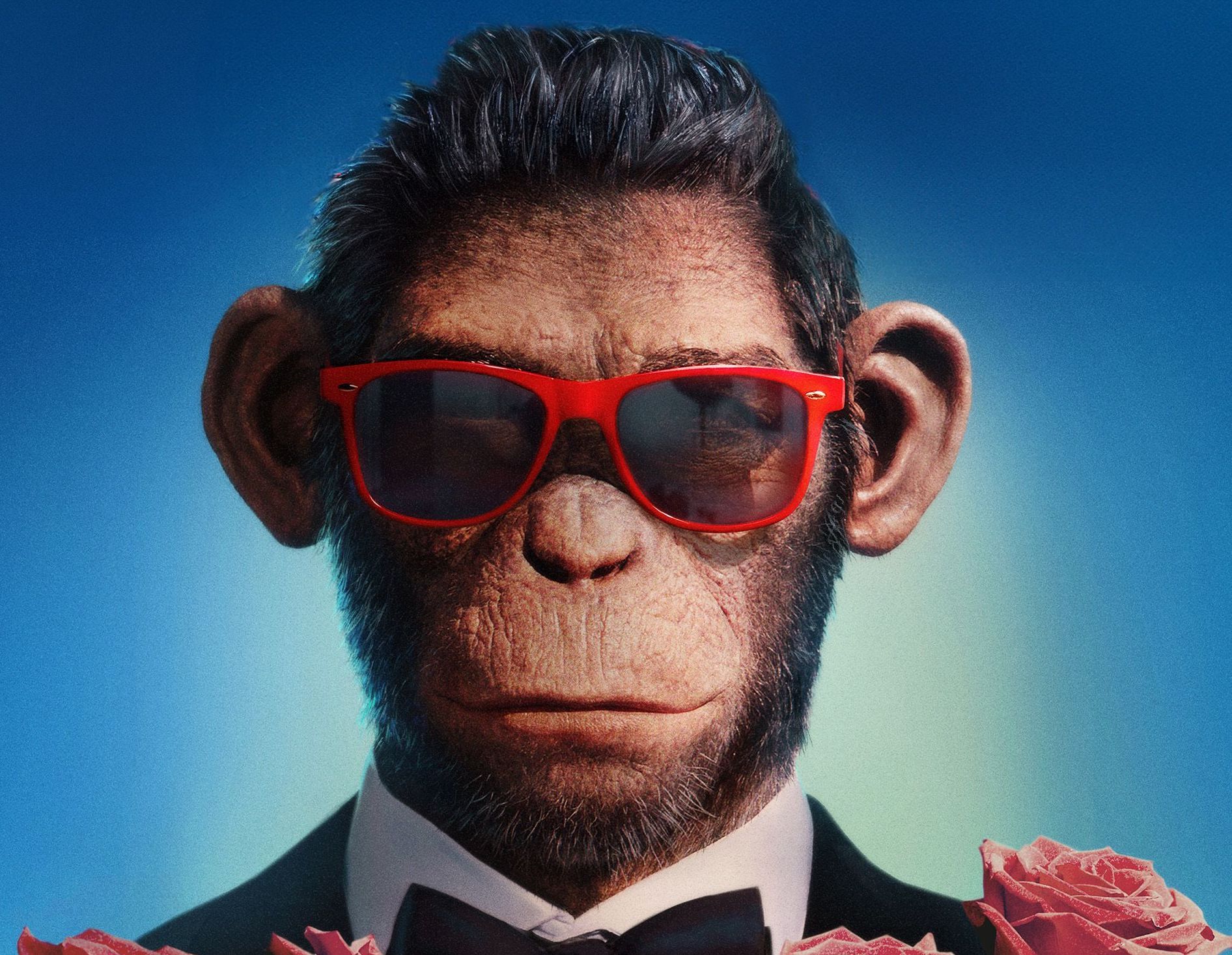
I’ll venture that you’ve never seen anything like this swinging, soaring, stirring music biopic about British pop star Robbie Williams. Because the star of the show is a monkey.

Throughout the film, Williams is portrayed as a chimpanzee, meant to represent the singer as he sees himself, “unevolved” and immature. “I’m ugly, stupid and untalented,” is young Robbie’s stinging self-assessment. Though what we hear is Williams’ own singing and speaking voice, British actor Jonno Davies portrays him—via some amazingly tactile high-tech motion-capture technology—as the monkey. It’s like one of the primates from Planet of the Apes became a Brit-pop singing star.

When he’s 16, Williams joins the startup “boy band” Take That—in the vein of Boys II Men or Backstreet Boys—that would notch nearly 30 Top 40 hits, a dozen of which went to No. 1 on the British charts. The movie is filled with music, often as springboards for movie-musical sequences, like when the group hits the streets for an poppin’ and boppin’ take of the song “Rock DJ.”      

It’s a bold choice to portray your movie’s star as a simian, surrounded by ordinary people who don’t seem to notice anything unusual. But it allows for some wildly provocative, surprisingly evocative moments as director Michael Gracey (The Greatest Showman) depicts just how maladjusted Williams feels, from growing up in working-class London to reaching the top of the pops as self-loathing singing star. The visual landscape is constantly moving and fluid, from “reality” to sweeping sequences of fantasy. When Williams crashes his car into a frozen lake, he’s swarmed by fans and paparazzi, pulling him deeper under. After he meets a cute girl at a party, the entire scene becomes a dazzling dance number orchestrated to the 1999 hit “She’s the One.” (And hey, this monkey’s got some smoooooth Fred Astaire moves!) When Williams is singing on stage and peers out into the audience, he sees troubling versions of himself, apes glaring back at him in scorn and disapproval. At one point, he dives into the crowd and fights them.

British actor Steve Pemberton plays Williams’ dad, an unabashed fan of classic crooners who abandoned his family to chase his own dreams of stardom. Rachel Banno is Nicole Appleton, the British pop star for whom Williams falls, hard, but eventually loses to another singing star, Liam Gallagher (Leo Harvey-Ellege) of Oasis. Alison Steadman (who played Mrs. Bennet in the mini-series Pride and Prejudice) is Robbie’s beloved grandmother, who gave him affection and support while munching on bags of crisps in front of the telly.

“I don’t want to be a nobody,” a sorrowful young Robbie tells his gram, recalling something hurtful and lingering that his father once told him. Robbie instead wants to be something that he would later express in his song “Better Man.”

That song, of course, becomes the title and the theme of this marvel of a movie, in which a CGI-motion-capture ape man makes us feel all kinds of human empathy for the real person he represents in some daringly creative cinematic monkeyshines.

—Neil Pond

Tagged , , ,

Movie Review: “Nosferatu”

New remake of the original vampire flick stirs up chills anew.

Nosferatu
Starring Lily-Rose Depp, Bill Skarsgård, Nicholas Hoult & Willem Dafoe
Directed by Robert Eggers
Rated R

In theaters Wednesday, Dec. 25

A beautiful bride becomes a ravenous obsession for a monstrous vampire in this spectacularly spooky spin on an old, oft-told tale.

How old, and how oft-told? Well, the original Nosferatu was a silent movie back in 1922, long regarded the first vampire film. It was based on the novel Dracula, by Bram Stoker, from the late 1800s. That story, and that movie, are both lauded as groundbreaking masterpieces, launching multitudes of other movie offshoots over the next century. Now this new, supremely crafted creepshow stirs up the terrifying roots of the classic story with chills anew, pouring on a moody megadose of gloomy Gothic doom, dark red blood and gasp-y (sometimes ghastly) arousal to offset all your cozy holiday feelings of comfort and joy.

Lily-Rose Depp (yep, Johnny’ Depp’s model-turned-actress daughter) is Ellen, the young newlywed suffering from unsettling nightmares and violent seizures. Her husband, Thomas (Nicholas Hoult) is a London real estate agent sent to faraway central Europe to arrange for a new home for the mysterious—and chilling—Count Orlock. (Though it’s never mentioned by name, a glimpse at an upside-down map notes the region as “Transylvania.”) And guess where Orlock wants to relocate? Yep, in London, just down the street from Ellen and Thomas.

Is Ellen sick with worry for her traveling husband? Or maybe distempered with melancholy, perhaps even possessed? Her friends (The Crown’s Emma Corwin, and Aaron Taylor-Johnson) are concerned, puzzled, and unsettled by her troubling spells. During Thomas’ absence, they summon the local doctor (Ralph Michael Ineson), who eventually calls on a scholarly professor of all things ancient and occult-y (Willem Dafoe, perfectly cast).

Soon enough, the prof gets a pungent whiff of what’s up. Turns out the count (Bill Skarsgård) is a vampire with an appetite for blood—and a beyond-the-grave crush on Ellen. But by then, the bodies are piling up, rats have infested the town, the count has arrived after a fateful shipboard journey, and some little girls discover, tragically, that imaginary monsters aren’t so imaginary.

Director Robert Eggers is a maestro of malevolence, as he demonstrated in his previous films The Witch, The Lighthouse and The Northman. He confidently paints this tale with all kinds of disturbia and draws out—sometimes graphically—the mythos of sexuality that’s often been sublimated in vampire stories. Ellen’s writhing agonies are close to ecstasies as Orlock seduces her from afar, causing blood-spurting, eyeball-bulging contortions—and orgasmic sighs. As different characters say throughout the film, “He is coming!” Uh, well, you could put it that way.  


Willem Dafoe is a vampire hunter.

The movie also explores the nature of evil in a world of yore where demons and curses and fairytales are real, science and religion powerless against unholy darkness, and death a fact of life. Orlock, who turns out to be the eternally unquenchable demon Nosferatu, is quite literally death itself. Can the “plague” he brings to London be stopped? Not just with a stake—or pickaxe—through the heart, I’m afraid.

Let’s talk a minute about actor Bill Skarsgård. He’s best known for playing another demonic character, the killer clown in two It horror flicks. Here’s he’s truly unrecognizable under layers of facial prosthetics and slinking around like a half-decomposed corpse. Cloaked in shadow for most of the movie, he’s a hideously ossified incubus, a profane beast for the ages. He is indeed the stuff of nightmares.

And so is this movie, now leading the pack as the best—and most lavishly unnerving—scary movie of the year. It’s a devilishly potent, magnificently orchestrated scare fest that’s intentionally unsettling, but also strangely comforting. Because it’s a dark, delicious reassurance that as long as Robert Eggers is making movies, horror is in good hands.

—Neil Pond

Tagged , , , ,

Movie Review: “A Complete Unknown”

Timothée Chalamet channels Bob Dylan in tune-filled biopic about the young troubadour.

A Complete Unknown
Starring Timothée Chalamet, Edward Norton, Elle Fanning and Monica Barbaro
Directed by James Mangold
Rated R

In theaters Wednesday, Dec. 25

He hitchhiked a ride, in the back of a station wagon, into New York City in 1961—as a complete unknown—with dreams of becoming a successful singer/songwriter. That’s how this vibrant biopic of Bob Dylan begins, setting up its intoxicating whirl through the turbulent first half of the decade as the former Robert Zimmerman becomes the new “youthful” voice and face of folk music, setting the foundation for all that would follow.

And just this time last year, Timothée Chalamet was singing a different tune, as the spry young chocolatier Willy Wonka. Now he’s kicked it up a few notches and dug down deeper, giving a much more matured, grounded and finely nuanced performance as the enigmatic, petulant, creatively restless and intriguingly shape-shifting writer of such classics as “Blowin’ in the Wind,” “The Times They Are A-Changing,” “It Ain’t Me Babe” and “A Hard Rain’s Gonna Fall.” He sings like Dylan, talks like Dylan, looks like Dylan and even nails Dylan’s tics and mannerisms. I’ll let true Bob Dylan scholars weigh in on the deep-dish accuracy, but to me, it sure feels like Chalamet could well be in the year-end Oscars race.

The movie introduces us to other real-life characters in Dylan’s early orbit. There’s banjo-playing elder statesman Pete Seeger (Edward Norton) and the legendary Woody “This Land is Your Land” Guthrie (Scoot McNairy), twin pillars of era’s folk scene. Monica Barbaro, from NBC’s Chicago franchise (Chicago Justice and Chicago P.D.), brings fire, spice and ice as folksinger Joan Baez; her complicated and testy relationship with Dylan—she calls him an “asshole,” he disses her songwriting as something like “an oil painting at a dentist’s office”—becomes one leg of a romantic triangle with Bob and New York artist Suze Rotolo (Elle Fanning). Ozark’s Charlie Tahan is Al Kooper—who’d later go on to found Blood, Sweat & Tears—as he scoots behind the Columbia studio’s Hammond B3 for a Dylan session and lays down the distinctive organ intro for “Like a Rolling Stone”  (a line from which the movie takes its title). And there’s country hitmaker Johnny Cash (Robert Holbrook), who becomes a pen pal and idol to young “Bobbie.”

Director James Mangold, whose wide-ranging movie and TV work also includes Walk the Line (2005), the Oscar-nominated biopic about Johnny Cash and wife June Carter, creates an authentic, almost encyclopedic milieu of the times, from music-makers in hippie-dippy clothes and smoky Greenwich Village coffeehouses to brow-creasing worries about Communists lurking everywhere, nuclear Armageddon and race riots in the aftermath of the assassinations of JFK and Martin Luther King. It shows how folk music became instrumental in the social activism of its times, its songs confronting and colliding with politics to create seismic pop-culture shifts and upheaval.

A Complete Unknown is really all about Dylan, how he became interwoven into the larger social fabric of the ‘60s, and how the success he wanted so badly also brought him a suffocating level of acclaim that he didn’t. And it’s about how he continually worked to create and re-create himself, twisting and retooling his musical identity in a stubborn refusal to conform to anyone’s expectations—and how even people close to him felt like they didn’t really know him, who he really was, or who he wanted to be.

Monica Barbaro plays Joan Baez.

Fittingly, the movie ends in 1965, just after Dylan goes “rogue” at the iconic Newport Folk Festival, causing a near riot by introducing a jangly bombast of electric instruments and drums for his three-song closing set—and then coming out, with just his acoustic guitar, to sing “It’s All Over Now Baby Blue.” It’s his final kiss-off to the folk darling he used to be, and how he started. Then he roars off on his motorcycle.

Music fans will dig it for sure, and everyone else—including those too young to “remember” Bob Dylan or the ‘60s—can certainly appreciate the care and attention that clearly went into depicting the events, and finally the pivotal moment when the young troubadour, only in his mid-20s, shook off folk music’s dusty past and headed down a highway into the future. Like a rolling stone, indeed.

Neil Pond

Tagged , ,

Movie Review: “Sonic the Hedgehog 3”

Jim Carrey all but steals the show from the little blue multimedia mammal

Sonic the Hedgehog 3
Starring Jim Carrey, James Marsden, Tika Sumpter and the voices of Keanu Reeves, Idris Elba, Ben Schwartz and others
Directed by Jeff Fowler
Rated PG

In theaters Friday, Dec. 20

Since 1993—and Super Mario Bros.—Hollywood has been capitalizing on videogames and their built-in fan base of passionate gamers. Sonic the Hedgehog, the Japanese-based Sega series of the early ‘90s, has been one of the most successful, and most prolific, spilling over into television, comics and related games and generating its own galaxy of characters.

This third big-screen movie in the Sonic franchise continues the adventures of the quippy little blue computer-generated anthropomorphic hedgehog who can run faster than the speed of sound. Ben Schwartz (from TV’s Parks and Recreation) returns as the voice of Sonic, who’s joined again by his teammates, the brawny anteater Knuckles (voiced by Idris Elba) and Tails (Colleen O’Shaughnessy), a gadget-guru fox.

It’s action-packed, zingy with wit and geared toward the generation-spanning audience the Sonic games and their multimedia spawn have been cultivating now for more than three decades. It’s a kid-friendly spy movie, a sci-fi tale, a meta heist comedy, a perilous adventure and a riff-tastic spin through time and space as Sonic faces off with another super-powered hedgehog named Shadow (voiced with just the right amount of angst by Keanu Reeves), discovering Shadow’s wrenching backstory and unraveling a sinister plot to, well, destroy the Earth.

There are shades of Mission Impossible, Raiders of the Lost Arc, Ocean’s 11, Armageddon, Austin Powers and James Bond, with nods to Godzilla and Casper the Friendly Ghost, loads of far-out gizmos and gimmicks and full-on montages orchestrated to the music of the Beach Boys and Jelly Roll. Even the Beatles’ “Abbey Road” album cover gets a nod. And the moon gets sliced in half, like it was indeed made of cheese, and Sonic gets sucked into a gaping black hole. This little hedgehog sure covers a lot of ground.

Other familiar faces get in on the zaniness, including James Marsden, Tika Sumpter, Krysten Ritter, Shemar Moore and Natasha Rothwell. And Alyna Brown, the young Australian actress who played young Furiosa in this year’s Furiosa: A Mad Max Saga, has a small part that resonates throughout the film.  

But the movie really belongs to Jim Carrey, who doubles down on his gonzo, over-the-top Jim Carrey-ness in a double role, returning as the rotund mad scientist Dr. Robotnik and also Robotnik’s mad-scientist grandfather. “It’s like we’re two characters, played by the same actor!” they both exclaim when they meet, looking into the camera for wink-wink emphasis. Carrey’s jokes fly fast and furious—even giving Sonic a run for his ha-ha’s—as he reflexively punches up nearly every scene with quips and puns and mannerisms and movie lines, from across the spectrum of his movie-comedy career, like he’s filling a carnival funhouse with his own greatest hits. If they handed out awards for best performance by Jim Carrey doing Jim Carrey alongside another Jim Carrey in a videogame franchise about a blue hedgehog, he’d be a solid shoo-in.

But for all its gung-ho go-for-it-ness, the movie has a soft, sensitive underbelly about friendship, family, making good choices, love and loss. It’s the awwwwwww at the center of all it all.

Fans of the franchise, of any age, will find a lot to like—especially in its end-scene hint of more to come. And everyone else, well, just sit back, buckle up and let Jim Carrey and Sonic take you on a way-out trip that suggests this speedy bright blue videogame breakout still has even more places for his blurry little legs to take him.

—Neil Pond

Movie Review: “The Brutalist”

Adrien Brody is an immigrant architect working to build an American dream in this sprawling post-Holocaust drama

The Brutalist
Starring Adrien Brody, Guy Pierce & Felicity Jones
Directed by Brady Corbet
Rated R

In limited release Friday, Dec. 20

Adrien Brody gives an impassioned starring performance as Lázló Tóth, a Jewish Holocaust survivor who emigrates to America in 1947 to build a new life, hoping to draw on his pre-wartime work as an architect back in Hungary.

Taking its name from a mid-century architectural style, The Brutalist is big and bold as it majestically sprawls across the years and Lázló meets a wealthy industrialist (Guy Pierce) who wants him to oversee a monumental legacy project on a hillside in Doylestown, outside Pittsburgh.

This is a large-scale, epic movie, the kind of serious, soulful drama that generates significant Oscar buzz. It’s gorgeous and enormous (three and a half hours long), filled with dramatic intensity, terrific acting, a multi-tiered plotline, complex characters and over-arching themes about the immigrant experience, antisemitism, homelessness, the downside of the American dream and the lofty aesthetics of design. Add opium addiction, lusty sex, a deadly train derailment and a shocking rape for spicy seasoning.

Felicity Jones plays Tóth’s wife, stricken with osteoporosis from wrenching malnutrition in a concentration camp, forcibly separated from her husband in the turmoil of the battle of Budapest at the close of the war—and now confined to a wheelchair. Their teenage niece (Raffey Cassidy) is an orphan, rendered mute by the traumas of what she’s endured. Joe Alwyn is a pompous, smarmy son of privilege; you’ll want to reach through the screen and give him a good, hard slap across his smug face. A Black U.S. Army veteran (Zachari Bankolé) that Lázló meets in a soup line becomes a close friend.

It all looks amazing, with elaborate period detail and impressive, sometimes jaw-dropping visuals, the kind of grandiose skyscraper of a movie—with an overture, intermission and an epilogue—that harkens back to Hollywood epics of yore. The soundtrack—with originals by composer Daniel Blumberg—is auditory magnificence. The movie towers over most others by its sheer scope, unbridled ambition and elegant artistic vision, like the massive, concrete, steel and granite construction project at its core—an achievement designed not just for the present, but a thing to be admired far into the future. The Brutalist isn’t a popcorn matinee movie. It’s a cinematic triumph, a thing of beauty constructed for the ages, and one I promise you’ll watch in awe.  

—Neil Pond

Tagged , , ,

Movie Review: “Maria”

Angelina Jolie is magnificent as the late, great grand dame of opera in her faltering later years

Maria
Starring Angelina Jolie
Directed by Pablo LarraÍn
Rated PG-13

In theaters Wednesday, Nov. 27 (and on Netflix Dec. 8)

Angelina Jolie gives a committed, center-stage, Oscar-bait performance as temperamental diva Maria Callas, a 20th century singing superstar who thrilled audiences all over the world. But by the 1970s, Callas’ voice and body were fading and faltering, and the distant applause of the opera houses—and the adulation in which she once basked—were becoming lost in a swirl of hallucinatory memories.

Jolie, whose multi-faceted career includes playing a rock-em, sock-em spy (Salt), a slam-bang videogame heroine (Lara Croft) and a regal Disney villainess (Maleficent), adds another bright plume to her cap as the once-heralded soprano, basking in glorious fantasy in the final weeks of her life in the 1970s. In the kind of sympathetic, deep-dish performance that tends to get awards attention, Jolie—as gorgeous as ever—reportedly prepared for the role for more than six months, learning the physicality and bold body mechanics of singing opera to realistically lip-sync to Callas’ actual vocals throughout the film. She gets a big bravo from me.

Kodi Smit-McPhee (The Power of the Dog, Let Me In) has a recurring role as a filmmaker—a figment of her imagination—interviewing Callas for a documentary about her. (Tellingly, the filmmaker’s name, Mandrax, comes from the sedative Callas has squirrelled away through her ornate Paris apartment.) The dreamscape documentary becomes central to the film, as it allows for numerous flashbacks illuminating Callas’ tumultuous life, including the traumas of her childhood (her mom, who told her she was “fat and unlovable,” and pimped her and her sister out to Nazis), her highly publicized affair with gazillionaire Greek tycoon Aristotle Onassis (Turkish actor Haluk Bilginer), and her encounters in the 1960s with a handsome young JFK (Caspar Phillipson). And how Callas found herself in the middle of a scandal when Onassis began having extramarital affairs with both Callas and JFK’s wife, Jackie; yes, he was a lecherous filthy-rich asshole who loved ancient art, his luxury yacht and leggy brunettes.

Callas’ housekeeper (Alba Rohrwacher) and manservant (Pierfrancesco Favino) are big parts of the story, trying to keep their boss grounded, anchored and safe as she drifts off, in more ways than one. “What’s real and unreal,” Callas says at one point, “is my business.”

Director Pablo LarraÍn utilizes a variety of techniques—mimicking cinéma verité, old newsreels and flights of sprawling psychological fantasy—to bring the story to immersive, vibrant life. Maria nowcompletes the Chilean director’s masterful trilogy of biopics about famous females, including Jackie (with Natalie Portman as Jacqueline Kennedy) and Spencer (Kristin Stewart played Princess Diana).  

It’s all a mad, magnificent swirl, with Jolie in the middle as the tragic diva whose escape—from harsh reality and the woes of her world—was her voice, her music…and then, her inner space. In a subtle grace-note touch, the film depicts Callas’ expired body, on the floor of her apartment filled with sculpted relics and fine art…where the whelps, whimpering and howls of her two little poodles become a sort of eulogy for the sublime high notes of her now-silent voice.

Fitting, that even dogs would want to continue her song, for a woman who once filled the cavernous spaces of the world with music. And Maria picks up her songful story again, hopefully for a new generation to discover one of the greatest, most acclaimed and sublimely troubled vocalists to ever grace an opera stage.

—Neil Pond

Movie Review: “Bonhoeffer”

Biopic about German minister who openly opposed Hitler reverberates anew today

Bonhoeffer
Starring Jonas Dassler, August Diehl and Flula Borg
Directed by Todd Komarnicki
Rated PG-13

In theaters Friday, Nov. 22

It’s impossible to miss the parallels to today’s fractured politics in the new biopic about the German theologian who stridently opposed the Nazi takeover of his country. The film’s warnings about fascism, dictatorship, authoritarianism, Christian nationalism and antisemitism are at the heart of the story, then, as now.

Dietrich Bonhoeffer was a pastor and author whose “radical” interpretations of Christianity became theological building blocks for generations to come. But his outspokenness about Hitler—and his association with a failed attempt on Dur Fuhrer’s life—sealed his fate.

There have been almost 10 movies already about Bonhoeffer, and this one mostly soft-pedals through its story about the firebrand man of the cloth who infiltrated the Nazis as a spy, became implicated in an assassination attempt, and spent the last days of his life as a prisoner of war. Bonhoeffer believed that his faith obligated him to take decisive action against Hitler and his genocidal movement against Jews, in the same way that he’d feel obligated to stop a madman driver intentionally trying to kill other motorists on the road. There’s a lot of “action” around the movie’s edges, but onscreen it’s largely a lot of talking—about what’s happening, what happened, what might happen, and what should happen as Germany slides into the dark abyss of the Third Reich. I wish the filmmakers had taken a cue from Elvis for “A Little Less Conversation” (and “a little more action, please.”)

It’s a modest production with no recognizable names attached, at least for American audiences.  Jonas Dassler, who plays Bonhoeffer as an adult, is a young German actor likely a bit better known in Deutschland, and maybe—maybe—you’ll recognize another German actor, August Diehl, from his role in Inglourious Basterds, as the Gestapo officer who horns himself into a tavern guessing game. Germany’s Fuela Borg was Javelin in The Suicide Squad, had a small role in one of the Pitch Perfect movies and appeared in an episode of TV’s Ghosts. Irish actor Muiris Crowley, who plays a sneering Nazi, popped up (as the “Third Saxon noble”) in a couple of episodes of Vikings.

The film shows Bonhoffer as a young lad frolicking in lederhosen, spending time in seminary, getting exposure to Black church services, jazz music and stinging American racism, and finally enduring his incarceration (where he serves communion to his fellow inmates—12 of them—in a scene obviously modeled on The Last Supper.) Winston Churchill (Tim Hudson) and Louis Armstrong (John Akunmu) get cameos. But I kept thinking the movie’s roving eye, hop-skipping across time and place and people, should settle down and sharpen its focus.

But it’s certainly a movie for thinkers, as well as doers, and it offers a lot to think about.

You might recall that a certain 2024 presidential candidate—now the president-elect—made no secret of his admiration for dictators and Hitler’s military prowess, and was supported by white nationalist extremists waving Nazi swastikas. Well, you don’t have to squint to see the movie’s connective tissue between past and present. (Not to mention the film’s pointed reference to Hitler replacing Holy Bibles in German churches with his own version, along with a copy of Mein Kompf—shades of the so-called Trump Bible, which contained copies of the Constitution, the Declaration of Independence, the Bill of Rights…and a snippet of Lee Greenwood’s song “God Bless the U.S.A.”) The movie’s an echo from the past with a resounding relevance today, about a man with bedrock beliefs remembered for taking on Nazi Germany, for confronting the menace and calling out its evil—and warning about the dangers of dragging the church into a political fray, kowtowing to government and getting trampled by jackboots. His life, and his words, ring true anew.

Neil Pond

Movie Review: “Gladiator II”

Rip-roaring sword-and-sandal sequel returns to the arena for more blood sport action in good ol’ ancient Rome

Gladiator II
Starring Paul Mescal, Pedro Pascal, Denzel Washington & Connie Nielsen
Directed by Ridley Scott
R

In theaters Friday, Nov. 22

Director Ridley Scott returns to the scene of the crime—the Roman Colosseum—in this big, brawny, blood-spattering, furiously entertaining sequel to his 2000 sword-and-sandal Oscar winner.

And the impressive shadow of Russell Crowe’s Maximus, the Roman slave who became a revered gladiatorial hero in the original Gladiator, looms large here, in more ways than one—in flashbacks, lines of dialog and visuals, woven into the movie’s very DNA. There’s even a hallowed, altar-like display in the catacombs of the arena, with Maximus’ armor and sword. Pretty impressive for a character who died, strolling off into the fields of Elysian afterlife nearly 25 years ago!

Paul Mescal plays Lucius, a farmer who becomes a slave forced into service as a gladiator (just like Maximus). Pedro Pascal is a lauded Roman general, increasingly conflicted about the part he’s playing in the empire’s ruthless quest for world domination. As a sly slave master plotting a bold power play, Denzel Washington chews the scenery like basilicas were made of beef jerky. Petulant, prissy twin-brother emperors (Joseph Quinn, and Fred Hechinger) rule like Romulus and Remus crossed with Beavis and Butthead, topped with a sneery dash of Caligula.

Denzel Washington

Danish actress Connie Nielsen reprises her role from the first film, as the daughter of Rome’s former emperor Marcus Aurelius. All the characters find themselves connected and drawn together in the drama swirling around the arena.

It’s a grand, gloriously rendered spectacle, just like events in the ancient Colosseum itself, where the citizenry of Rome cheered on hyper-violent blood sports. We see Lucius and his gladiator cohorts fighting in faux sea battles, the arena flooded with water churning with sharks waiting to chomp down on anyone who goes man-overboard. Warrior slaves defend themselves against the massive horn of a monstrous galloping rhino, and in another battle, face ferocious CGI baboons that look—curiously—like mutations from a mad scientist’s lab, or another planet. And, of course, they fight each other, often to the death.

It’s all supposedly mostly historically accurate—sea battle reenactments, wild animals against humans, all those togas and stewing senators. (But did so many Roman muckity-mucks wear eyeliner and rouge?? Really, now?)

The scenery and world-building are truly impressive, and the performances gritty and committed. Mescal—in quite a departure from his portrayal of a soft, sensitive gay man in All of Us Strangers—digs into the layered complexities of his character, hiding a big secret and channeling a fiery inner rage to become a crowd favorite down on the field… kinda like the A.D. equivalent of Patrick Mahomes.

There’s some deep-dish commotion—political intrigue, conspiratorial subterfuge and whispers of treachery—going on in the royal palace, the slave market and the side streets of the piazza, and a bit of recurring blather about the “dream of Rome.” But the movie’s real draw is its brawly, gut-punch wallop of its action scenes in the epicenter of ancient Roman life, where combatants often fought to the death.

Gladiator II is a movie that knows its place and hews to its mission, just like the Colosseum—to keep the crowd roaring, revved and ripped for the eye-popping, head-lopping, flesh-tearing show they’re watching.

Neil Pond

Tagged , , , , ,

Movie Review: “Wicked”

Cynthia Erivo & Ariana Grande rock the not-so-merry old land of Oz

Wicked
Starring Cynthia Erivo, Ariana Grande, Jeff Goldblum & Michelle Yeoh
Directed by Jon M. Chu
PG

In theaters Friday, Nov. 22

What’s the biggest, greenest, most Wicked-ly wondrous thing in the world?

Right now, it’s this dazzling new movie adaptation of the long-running Broadway blockbuster swooping onto the big screen with the fabled backstory of the witches from The Wizard of Oz. One the most hotly anticipated films of the year does not disappoint; it’s a visually stunning, fantabulously festooned song-and-dance extravaganza with magical moments and sweeping emotions, all built majestically around costars Cynthia Erivo and Ariana Grande as the young women who eventually become Oz’s polar-opposite sorceresses…and the premise that the green “Wicked Witch” didn’t start out wicked, the beautiful Good Witch wasn’t always so good, and “merry old land of Oz” holds, and hides, some not-so-merry secrets.

Fans of 1939 movie, and the Tony-winning musical it became more than 20 years ago, will delight in the sights (Extravagant costumes! Fantastical sets! Retro-riffic gizmo-trons!), the sounds (Toe-tappers! Showtunes! Big Broadway ballads!) and the movie’s meticulous attention to detail. (If you’re looking for ideas for a new pair of glasses, Wicked wire-rims rock.)

And if you’ve seen the musical, you probably know how Wicked foreshadows events and characters that would come later in the timeline of Oz, including the Cowardly Lion, the Tin Man and the Scarecrow…and the witch who gets smushed under Dorothy’s house. You’ll find out the origins of the Yellow Brick Road (and why it’s not some other color), get a quick glimpse of the Wizard’s real name (it’s Oscar Diggs), and learn the reason those flying monkeys got their wings. And you’ll understand how Erivo’s character, an “outsider” born with freakishly green skin, becomes shaped by fate and her own empathetic sense of right and wrong, only to become reviled and feared as evil, twisted and wicked.

Jeff Goldblum serves up a touch of seductive whimsy—and wily deception—as the Wizard. Michelle Yeoh (who also starred in director Jon M. Chu’s Crazy Rich Asians) is Madame Morrible, the head of sorcery at Shiz University (Oz’s version of Hogwarts), where Glinda (Grande) and the green-skinned Elphaba (Erivo) meet as young students. Peter Dinklage is the voice of a history teacher, who happens to be a goat. Jonathan Bailey, an award-winning British actor, steals his scenes (as well as hearts) as Prince Fiyero, a self-centered hunk of eye-candy charm.

It’s all a fab fantasy, for sure, but the musical also fleshes out allegorical undertones in the books by L. Frank Baum (on which the 1939 movie was based), about lies, politics, racism and the dangers of daring to different. When Elphaba arrives at the university to the gasps and giggles of her classmates reacting to her skin the shade of grass, it harkens back to the turmoil of racial integration in the 1950s—with Wicked green as the new black.

But you won’t get hung up and weighed down by the incidental heaviness as this jubilant musical soars and unfurls its heart-tugging, fiercely pro-feminist saga of two rivals who overcome their differences and become friends—and eventually diverge onto separate paths to their future. You may be moved to applause—or tears—by infectiously buoyant songs like “Dancing Through Life” and “Popular,” the melancholy “I’m Not That Girl” or “Defying Gravity,” the colossal closing number that reminds us that “everyone deserves a chance to fly,” to be who they are, and who they want to be. There’s a lot to make you smile, think, and even laugh.

And you’ll be wholly gob-smacked by the performances of Erivo—all but surely headed now to EGOT-ville with the growing buzz about an Oscar to round out her Tony, Emmy and Grammy—and Grande, a spectacularly gifted pop singer who absolutely crushes her first major film role, in a film that will certainly wear the crown as the movie musical event of the year, a grand-scale gollywhopper that will leave audiences wide-eyed…and hungrily waiting for its part two, set to arrive next November.

Until then, keep it green, keep flying—and don’t make any winged monkeys mad!

—Neil Pond

Tagged , , , ,