Jessie Buckley and Paul Mescal spin a tragic tale behind Shakespeare’s greatest play
Hamnet
Starring Jessie Buckley and Paul Mescal
Directed by Chloé Zhao
Rated PG-13
In select theaters Friday, Nov. 26 / Opening wide Friday, Dec. 5
This meticulously melancholic movie drama probes the origins of William Shakespeare’s Hamlet, widely regarded as one of the greatest plays of all time. It dramatically—and inventively—fills in gaps from the scant historical record about the life of the so-called Bard of Avon, his work, his wife Agnes and their three children, including a son who died when he was only 11.
The son’s name was Hamnet.
Based on a bestselling and award-winning 2020 novel of historical fiction by Maggie O’Farrell, it’s a story of love, anguish, grief and guilt, all ultimately channeled—plausibly—into a towering work of art, a tragedy that becomes a triumph.
Jessie Buckley has more than 40 acting credits, including acclaimed roles in movies including I’m Thinking of Ending Things, Men, Women Talking and Wild Rose, and TV’s Fargo and Chernobyl. But playing Agnes/Anne Shakespeare in Hamnet may very well bring her an Oscar. Agnes is a child of nature, a healer and a mystic (local townsfolk claim she’s “the child of a forest witch”) who tames wild birds, grows flowers, makes potions and poultices, and wails like a banshee during childbirth—or cradling her son as he breathes his last.
She also charms—or perhaps bewitches—the young “pasty faced scholar” of her village who’ll become her husband, and England’s most famous poet and playwright. William (an excellent Paul Mescal, from Gladiator II, All of Us Strangers and Aftersun) charms Agnes as well, captivating her with the Greek myth of the doomed lovers Orpheus and Eurydice.

Director Chloé Zhao, who already has a pair of Oscars (for 2020’s Nomadland) might want to be making a spot on her mantle for a third. She confidently steers Hamnet through an emotional, intensely intimate journey of highs and lows, and a time when life was hard, dirt and grime and disease were everywhere, and nature rich with signs and portents. Up there, in the sky—that’s not just a bird on the wing, it’s a spirit, a soul, a memory borne aloft.
And that clump of buzzing bees on a tree limb, well, they spell trouble, something bad, perhaps a plague or a pestilence. To quote one of Shakespeare’s other works, “Something wicked this way comes.” Indeed, it does. And it hits hard.
Appropriately enough, the movie begins with a shot of the massive roots of a tree. Listen and watch, and you’ll catch glimpses of the roots of Shakespeare’s success, laboring by candlelight over what will become Romeo and Juliet or laughing with Agnes as their children playfully recreate a scene with three witches from Macbeth.
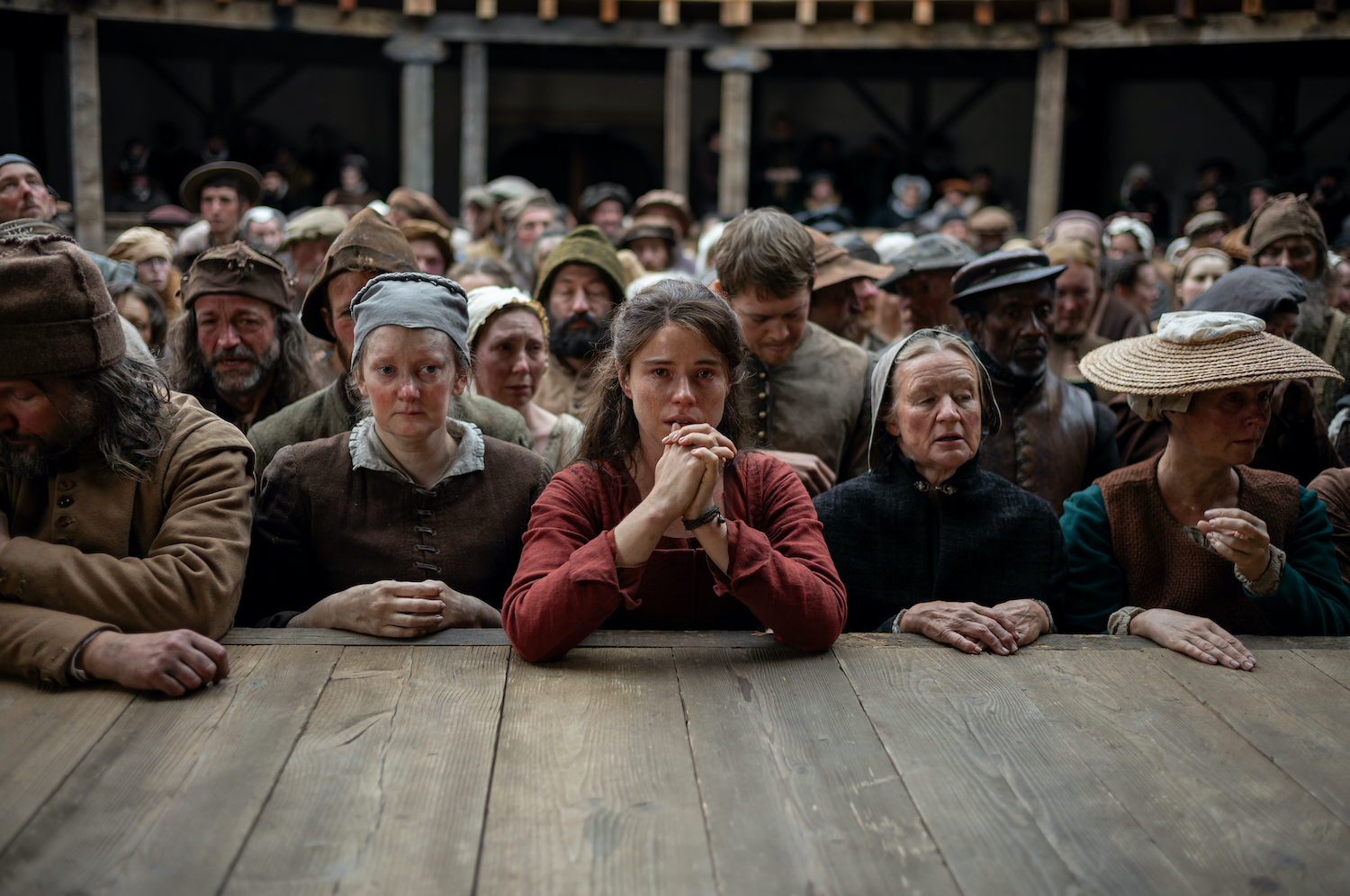
The scene when little Hamnet dies, crosses to the other side, is devastating. But it’s virtuoso filmmaking as we watch him entering the afterlife, then disappearing into a stage setting—the very stage setting from which we’ll eventually see him “re-emerge.” The movie’s real emotional wallop—and its ultimately uplift—comes at the end, when Agnes attends a cathartic performance of her husband’s play about a son, a ghost and death.
This isn’t a story you’ll read in a history book, at least not quite. But it’s one rooted in real people, a real place and time, and a real tragedy—and the play that’s speculated to be rooted in it all. “Get thee to a nunnery,” we hear as actors rehearse for Hamlet. Forget the nunnery. Get thee to a theater to see Hamnet and find out what the Oscar buzz is all about.
—Neil Pond


 The Media Tourist