Category Archives: Movie Reviews

Is There Life Out There?

George Clooney looks at the end of the world in Netflix’s cautionary Armageddon tale

The Midnight Sky
Starring George Clooney, Caoilinn Springall, Felicity Jones, David Oyelowo, Tiffany Boone and Kyle Chandler
Directed by George Clooney
PG-13
Available on Netflix Dec. 23, 2020

George Clooney shoots for the stars in this ambitious, sprawling post-apocalyptic saga about a dying planet, a search for habitable life elsewhere, and a lonely scientist desperately trying to send a warning to a group of NASA explorers.

The dying planet is Earth, the scientist is 70-something Augustine Lofthouse (Clooney), and the warning to the astronauts is to keep them from coming home—since things have changed a lot in the two years since they left, in 2047. We’re never told what happened, exactly, but ever-expanding, big red circles on the digital displays of Augustine’s computers let us know it’s not good: Something has toxified the whole world.

Climate change? Global warming? Depleted ozone? Nuclear armageddon? All of the above? Whatever. Everything, everywhere is toast, and the dwindling pockets of still-breathable air anywhere are where nobody can live, not for long—in the inhospitably frigid Arctic Circle. That’s where Augustine has opted to remain, holed up alone at a remote observatory, while the planet’s decimated surviving population has been evacuated deep underground to live out the rest of their pitiful days.

Augustine is trying—in vain—to ping the spaceshift Aether, already zipping along at 30,000 miles an hour on its way back home from its mission to set up an experimental colony on one of the moons of Jupiter. But his messages aren’t getting through; the observatory’s signal is too weak. And he knows his days are numbered, too, one way or another. Augustine is dying of something, likely cancer, that requires regular blood transfusions. But can he live long enough to at least keep those astronauts alive, and diverted away from their suicidal course?

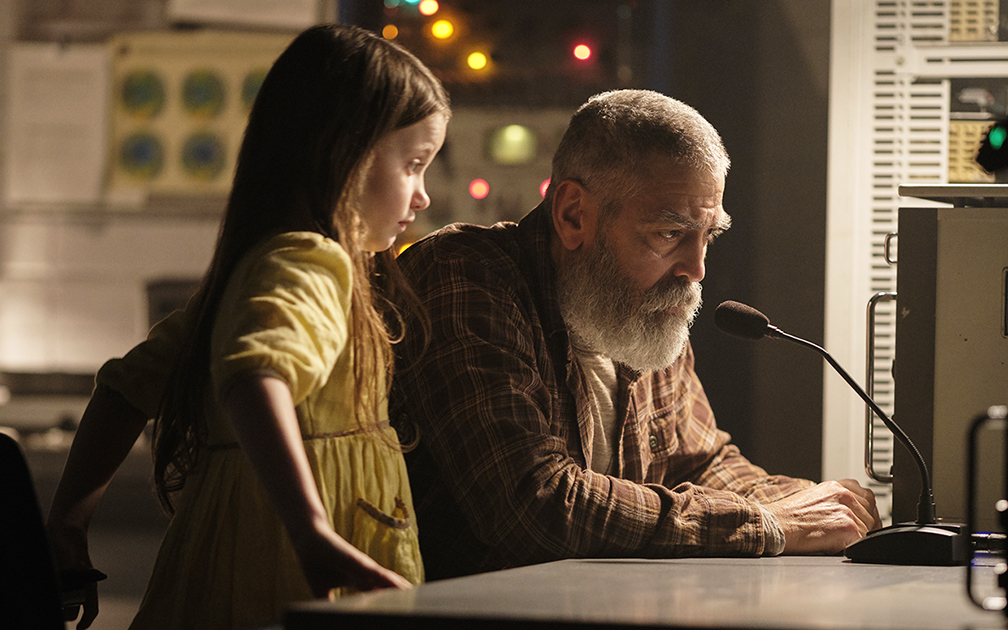
Augustine thinks he’s alone at the observatory, and maybe even in the world—until he’s shocked to come across a tiny stowaway child (newcomer Caoilinn Springall), three weeks after the evacuations.

The tiny-tot newcomer doesn’t talk—is she mute, shell-shocked, or just shy? But Augustine is able to determine from a picture she draws that her name is Iris, like the flower. He warns her away from the all the high-tech equipment, gets her to giggle (once) in a mini food fight, and points out the most important star, up in the midnight sky—Polaris, the North Star, the one that remains fixed in place while the others circle around it. “If you ever get lost,” he tells Iris, “it will help you find your way.”

In order to reach the astronauts, Augustine and the young foundling must venture outside into the brutal, sub-freezing cold and undertake a treacherous journey, trekking to another abandoned but hopefully-still-operational observatory, many miles distant. It might have enough power to communicate with the spaceship and shoo it away, back to Jupiter, back to where its astronauts can possibly start life anew.

Clooney, who hasn’t made a movie appearance in three years (since Money Monster and Hail Caesar!, both in 2016), comes roaring back in The Midnight Sky, not only anchoring in a starring role but also directing and producing. With one foot in space and the other on bleak, toxified terra firma, he unifies the two stories in a way he’s described as Gravity meets The Revenant. He’s already won two Oscars (Best Actor, for Syrianna, and Best Picture, as one of the producers of Argo), and he could well be in the running again with this entry’s high-pedigree, Academy Award-caliber music, effects and storytelling, and its super-solid supporting cast.

Augustine and Iris must content with ravenous Arctic wolves, blinding snowstorms and melting glaciers. High above them, the Aether is dangerously off-course, damaged from a run-in with meteoric space ice. It’s also flying blind, unable to receive any signals from Earth, where all the communications centers are kaput; no one up there knows that everything down there is gone.

Clooney grizzlies out, “ages up” and goes full geezer for the role, with a supersized grey beard that makes him look like an Arctic explorer of yore, a severe self-inflicted buzz haircut and a slow amble that fits the advanced years and high mileage of a weary, terminally ill loner hermit. This cheerless, ice-caked performance isn’t his most robust—not anywhere near it—but it may be one of his most poignantly personal, as one of Hollywood’s most renowned environmental advocates. The movie walks a razor’s edge of topicality about what’s happening already on our planet; one shot of Earth, as seen by the astronauts from space as a darkened, smoldering, burned-out orb, doesn’t look much different from real-life satellite photos of this year’s California wildfires, writ large. This tale may be futuristic science fiction, but it feels not so fictional, and not so futuristic…

Felicity Jones spacewalks.

And there’s plenty of drama up above, too. Aether’s mission specialist (Felicty Jones) is a few months pregnant with a baby on board; the father is flight commander Tom (David Oyelowo), who ponders finding a name for the child, and finding a quick shortcut home; the veteran pilot (Kyle Chandler) frets about the wife and kids he’s left behind; aerodynamicist Sanchez (Demián Bichir) hides a personal heartbreak that he salves through the holigraphic memories of the young flight engineer (Tiffany Boone), who’s queasy about making her first spacewalk to make some emergency repairs.

The film is technically, visually wondrous, especially the space segments, inside and outside the Aether; depictions of space, spaceships and space travel have become fairly common territory for movies for decades. But The Midnight Sky stakes its own claim, especially on one particular effect, and sequence, that I suspect might help get it a technical-category Oscar: a pristine white airlock filling with red bursts of zero-G blood droplets, signaling life floating away, one crimson globule at a time.

The movie has life on its mind, in every way—old life ending, new life beginning. Why, one character asks, do some people die so young, and others live so long? What happens if, and when, an entire planet perishes? Is there more life out there, among the stars? Or is it too late for any of that?

It’s a lot, sometimes, to cram into a crowded spacepod—flashbacks (in which a younger actor, Ethan Peck, plays a younger Augustine) and fever dreams; a dying old man and a wide-eyed little girl; seeds and flowers; a Neil Diamond classic and a George Jones drinking song; a clip from a 1959 movie (about the end of the world) starring Ethan Peck’s grandfather, Gregory Peck, and Ava Garner. But director Clooney ropes it all together, somehow, up there and down here, into a big, bold fable about an expired globe of poisoned air, unliveable earth and undrinkable water, and the possibilities of the vast, unfathomable, unknowable future of space.

“I’m afraid we didn’t do a very good job of looking after the place,” Augustine laments.

As the movie builds toward something you might not see coming, it ends with something you won’t be surprised to see—a look upward, into a majestic nighttime canopy of the cosmos.

It’s Clooney’s way of suggesting that perhaps The Midnight Sky, like the North Star, can point everyone toward doing a little better job—before it really is too late.

Pistol Packin’ Mama

Rachel Brosnahan breaks out on big screen as mob wife on the run

I’m Your Woman
Starring Rachel Brosnahan
Directed by Julia Hart
R
Dec. 11, 2020 on Prime Video

Since 2017, Rachel Brosanhan has been churning out laughs as a stand-up comedian on the Emmy-winning Amazon series The Marvelous Mrs. Maisel.

But she swaps comedy for crime in this dapper, danger-spiked 1970’s-set character drama about a career thief’s wife who has to go on the run with a baby after her life takes a screeching turn for the worse.

Brosnahan is Jean, the bored suburban spouse of a slick hustler named Eddie (Bill Heck), who keeps her supplied with groovy stolen clothes and doesn’t care that she can’t cook. When Eddie walks through the front door one day with an infant, she of course wonders what’s up, asking if it’s a joke. “It’s all worked out,” Eddie assures her. “He’s our baby. It’s your baby.”

Then he lets a group of his gangster friends into the house, grins and winks at Jean, and closes the door behind him as he leaves her, baby on her hip, in the kitchen.

Most wives would have questions—a lot of questions. But when you’re the kind of wife married to a guy like Eddie, you don’t ask a lot of questions, because there aren’t a lot of answers. And there’s not a lot of time for questions. That night, while she’s sleeping, there’s an urgent knock on her door—it’s one of Eddie’s “associates,” who tells Jean that Eddie has disappeared, she’s in serious danger, and she’s got to get out of town—really, really fast.

Eddie’s friend gives her a satchel full of money, says there’s no time to pack and puts her and the baby, whom Jean has named Harry, into a car with a hulking driver named Cal (Nigerian-British actor Arinzé Kene). And they hit the road.

We can certainly relate to Jean’s nervousness, fear and sense of confusion; she tells Cal that she’s never been on her own. She knew her husband was shady, but doesn’t understand anything about what’s going on, or why she can’t get any information from the tight-lipped Cal, who turns out to be as good with calming a crying baby as he is with a gun. But where’s Eddy? Is he OK? Is anyone looking for him? “Everyone’s looking,” Cal tells her. “And they’re looking for you, too.”

Some answers—about what happened to Eddie, where’d the baby come from, and Cal—do come, in dribs and drabs. But the important thing is following Jean’s odyssey, and her evolution as she learns to live on the lam with baby Henry in tow.

Director Julia Hart, working once again with her husband-collaborator Justin Horowitz (the producer of La La Land) on the script, spins a tight, terrific, fem-centric tale of lower-tier mob life from the mob-wife perspective, balancing soft, tender, wistfully contemplative moments with ripples of explosive violence. An extremely tense scene involving a too-friendly, nosy new-neighbor lady (Marceline Hugot) reminds us—and Jean—that she’s dealing with some very tough, rough characters, baby or not.

As Jean and Cal try to stay one step ahead of goons and goombahs trying to close the messy loop Jean’s husband opened and set into lethal motion, it’s clear that I’m Your Woman isn’t just a crime story with a unique perspective. It’s a self-actualization, women’s-lib tale with a twist—about Jean’s “liberation” from her pampered, blinkered cocoon as a moll-doll accessory.

In a parallel of how many women of the ‘70s asserted their independence, Jean also proves that she can “do it all,” stepping into a new world, a man’s world—her man’s world—to care for a child, live on her own and build a life with a newly acquired skillset.

“Fuh, fuh, fire,” she enunciates to Henry, who’s watching her do something she’s never done—start a fire—in the fireplace of the cabin in which they’re hiding out. “Fire—I did that.”

Jean’s skills also expand as movie dips its toe into race relations of the era, when she and Cal get pulled over by a state trooper and she has to think fast to explain why she’s traveling with a Black man. (“I didn’t know I could lie like that,” she marvels afterward.) Later, she learns about a Black-owned hotel catering to Black families—especially ones that need a safe place to lay low for awhile. Her little white, suburban cocoon starts feeling farther and farther away.

In addition to her starring role The Marvelous Mrs. Maisel, for which she’s received an Emmy and two Golden Globes, Brosnahan has appeared in numerous other TV series (including nearly 20 episodes of House of Cards), and she’s had small roles in more than a dozen movies. But this is her breakout film in every way, proving she’s so much more than a “TV actress,” and showing she can do so much more than Midge Maisel. I’m Your Woman puts her through a gauntlet, emotionally as well physically, from a hood’s pampered princess to a scrappy, survival-focused, pistol-packin’ mama.

And most mob movies don’t offer this kind of empathetic examination of motherhood. In a poignant scene in a diner, Jean explains to Cal her difficulty in conceiving a child—and her deep, long-unfulfilled yearning to have one. “And then in walked Eddie with a baby,” she says. Jean’s ongoing difficulty in cooking an egg—an ancient symbol of life and regeneration—also hints at her long struggle with fertility.  

Jean tells Cal how she soothes Little Henry by cooing Aretha’s Franklin’s “Natural Woman.” She may not realize it, in that movie moment, but we do—that the 1967 Top 10 hit addresses how baby Henry has touched her life in a profound way, re-awakened her maternal instincts and kicked something into gear that had been dormant for years.   

Marsh Stephanie Blake plays Terry

We meet several other characters, including Cal’s wife, Terry (Marsh Stephanie Blake, who played Berdie on Orange is the New Black and Vivian Maddow on How to Get Away with Murder), who has a surprising connection to Jean. Cal’s kindly father, Art (Frankie Faision, whom The Wire fans will remember as Commissioner Burrell), gives Jean an important introduction to using a firearm.

“Get used to the weight,” he says, pulling a sizeable revolver out of his pouch, and we understand the implication—it’s not just the heft, it’s dealing with the responsibility, the potentially heavy life-ending aftershocks of what you might do when you pick it up, point it and pull the trigger.  

I’m Your Woman is smart, stylish and saturated with the look and feel of the ’70s, popping with period detail—a freezer packed with TV dinners, a pink bedroom telephone, a pedestal ashtray in a hospital waiting room. It’s a parade of fab fashions in a palette of pastels and creamsicle hues; Jean may be on the run, but her wardrobe for herself and little Henry is never less than smashing. (Were there off-the-grid Baby Gaps back in the early 1970s? Just asking.) Big steel sedans prowl the streets like predatory sharks cruising for a meal. It’s a treacherous world, but it’s dreamy to sit back and watch it turn.

How fitting that another song from Aretha, her soulful cover of The Band’s “The Weight,” closes out the movie. Putting a finer point on Art’s earlier advice, it suggests that Jean can indeed handle the weight, the responsibilities of her new life, her new role, and whatever becomes the aftermath of whatever she’s got to do.

And so, too, can Brosnahan, in a rousing performance that proves that she can handle it, too, on TV or now in the movies. Got a gig? A comedy, a drama? She’s good with a pistol or a punchline. Give it to her. She’s your woman.

Call of the Wild

Aubrey Plaza plays ferociously disorienting mind games in this wildly original genre-defying indie

Black Bear
Starring Audrey Plaza, Sarah Gadon & Christopher Abbott
Directed by Lawrence Michael Levine
R
Available on demand and in select theaters Dec. 4, 2020

Parks and Recreation’s Aubrey Plaza breaks out of almost everything she’s been in before for this ferociously disorienting meta-drama designed to muck with your head.

And muck it does.

It ends the same way it begins, makes you question pretty much everything about what you see, and really does feature a bear.

The movie opens with Plaza’s character at the edge of the dock at a lakeside house, gazing into the mist with an inscrutable look on her face. Then she gets up, goes inside and starts to write in a journal. This she does three times, the exact same thing, throughout the film; each journal entry is about “the bear.” The music over these scenes begins with Eastern, Zen-like, meditative tones, but then takes on a darker, more ominous feel.

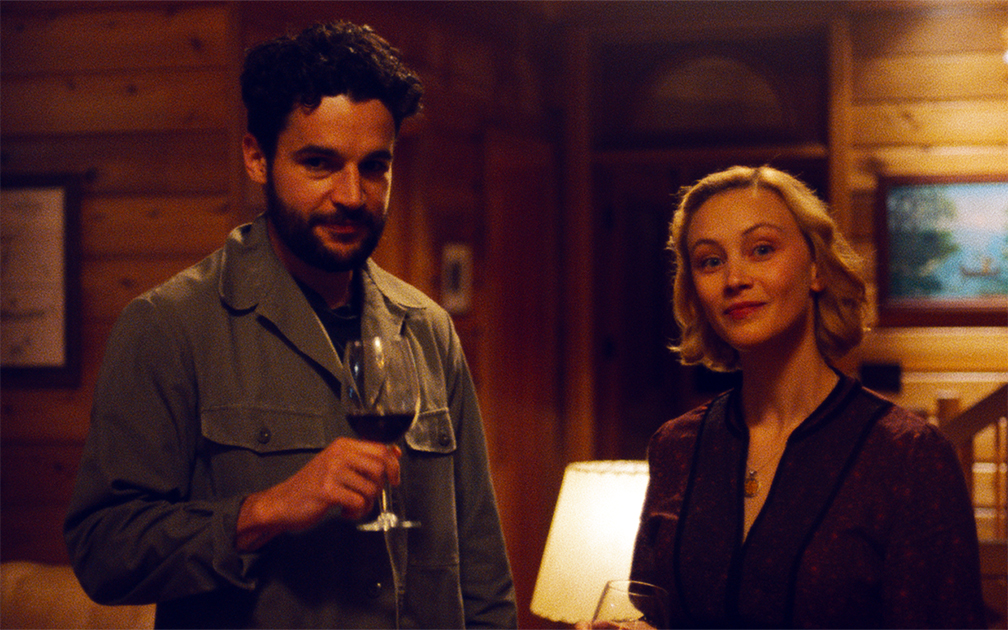
Then the film backs up, or flashes forward, or otherwise plops us inside a car to watch the arrival of Plaza’s character, Abbie, at the house, a gorgeous, retreat-like abode of Gabe (Christopher Abbott), a musician, and his pregnant girlfriend, Blair (Sarah Gadon). Abbie says she’s an actor-turned-director looking for some kind of recharge, inspiration—perhaps—for her next project. Over copious amounts of wine, she shares various tidbits of personal information; how she hates getting compliments, she never learned how to cook, her mother’s dead, she doesn’t have a husband.

Christopher Abbott and Sarah Gadon

As it’s quite obvious Blair and Gabe’s relationship is a bit rocky, it doesn’t take much for Abbie and Gabe to end up together for a late-night splash in the lake. And just moments later, Abbie confesses that she made up all those things she said earlier. “I’ve been lying from the minute I got here,” she tells him.

Then things heat up to a boil with all three characters, a bear appears, and boom—everything fades to black. And just like that, the first part of the movie is over.

When it comes back and we get our bear-ings (pun kinda intended), the actors, character names and setting haven’t changed. But the situation is jarringly different, a kind of movie Mobius strip of everything we’ve just seen—everything looks the same, but twisted, turned over and inside-out.

This jarring, surreal shift introduces additional characters to the lakeside house, where they’re wrapping up a movie—also called Black Bear. And it’s not going well.

This audaciously original, wildly creative indie makes a provocative commentary on the creative process, about how every idea begins in a void, on a virtual blank page, and bringing a concept to completion can be a wrenching, pained process. It’s a tale of tortured artistry taken to new, inter-dimensional intensity, the primordial process of destruction as a part of regeneration, a snake turning on itself to eat its own tail.  

Writer-director Lawrence Michael Levine, whose previous films include Wild Canaries (2014) and Always Shine (2016), also probes and pokes gender roles, ideas about feminism, relationships and abusive power dynamics. (It’s interesting that Plaza and writer/director Levine are both married to their moviemaking partners, with whom they have frequently collaborated.) And he’s challenging his audience to ponder what’s real and what might instead only be imagined, and how permeable the membrane may be separating the two. When the psyche does rip into reality, morphing into the physical world, could it be like a bear that’s been rummaging through the mind’s trash bin, now going on a rampage?

And if that bear gets riled up…watch out.

Plaza and Abbott

Plaza, best known for playing the deliciously deadpan April Ludgate on Parks and Recreation, has also been impressive in a variety of films, mostly kooky comedies (Mike and Dave Need Wedding Dates, Dirty Grandpa) and offbeat indies (Ingrid Goes West, Safety Not Guaranteed). But she breaks new ground in Black Bear by cannily chiseling a sizzling fissure that eventually erupts in a spectacular spew of razor-sharp, red-hot lava. You dare not take your eyes off her, and you’re constantly trying to figure her out. What’s her deal?  

Abbott, who starred as John Yossarian in Hulu’s recrafting of Catch-22, is also strong in the dual roles of Gabe, as both a flirty spouse and a devious director. And Gadon—who appeared in season three of HBO’s True Detective—gives a fiery, multi-faceted performance that stokes the mysteries hidden inside this meticulously layered puzzle box.

Is Black Bear a dark comedy? A fever-dream relationship drama? An artsy cinéma vérité movie metaphor? A psychological horror show? All of the above? Yes…maybe!

“That was some game we played,” says Blair at one point.

Some game, I’ll say! I’m not exactly sure who won, who lost, or even what the game was. But the next time Aubrey Plaza want to play—anything—count me in.

Nowhere to Run

Sarah Paulson is a monster mom in this wickedly inventive, twisty-turny horror thriller

Run
Starring Sarah Paulson & Kiera Allen
Directed by Aneesh Chaganty
PG-13
Nov. 20 on Hulu

Sarah Paulson has carved quite a niche for herself as a scream queen on the dark underside of nine seasons of the FX anthology franchise American Horror Story, and then, more recently, in Netflix’s Ratched, the backstory of the sadistic nurse who’d years later torment the psychiatric patients in One Flew Over the Cuckoo’s Nest.

Now she’s pitch-perfectly cast as a most malicious mother in this taut, terrifying little gem of a horror-thriller about a homeschooled teen and her helicopter mom from hell.

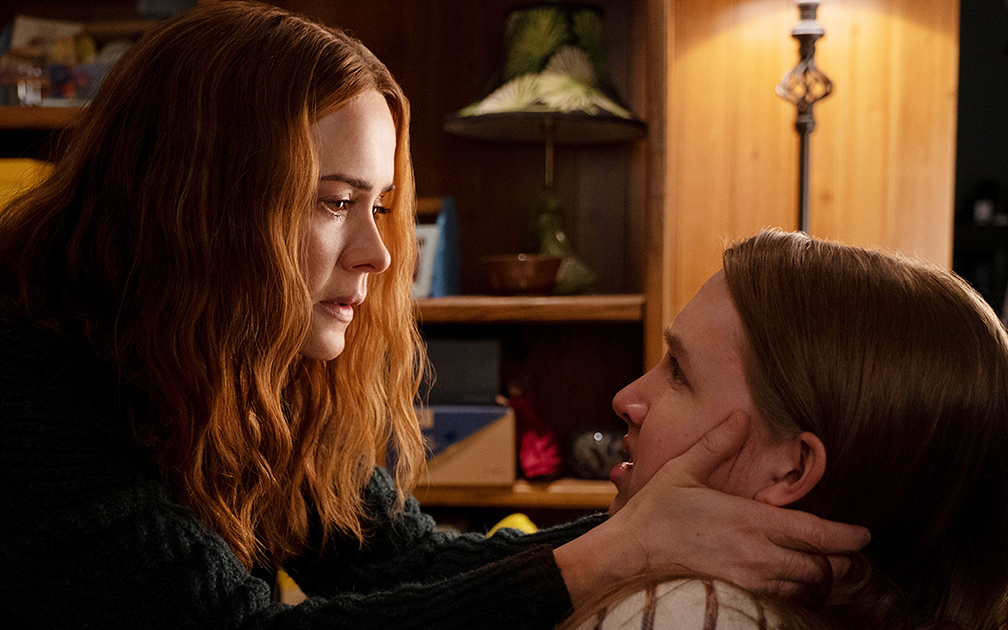
Run pairs Paulson with newcomer Kiera Allen as her daughter, Chloe, who figures out just how dire and dangerous things are, but then finds it hard to get away—because she’s in a wheelchair.

Kiera Allen makes her feature debut as Chloe.

The movie opens with Paulson’s character, Diane, at a hospital, eyeing her newborn baby. Then it zooms ahead 17 years, introducing us to now-teenage Chloe, and her routine of daily injections, meds and inhalers to treat her asthma, diabetes, arrhythmic heart, paralyzed legs and other conditions.

Chloe’s been raised in almost total isolation by Diane, who smothers her with attention, watches her like a hawk, prepares all her meals, administers her therapy and maintains her strict homeschooling schedule.

But Diane’s been doing other things, too, secretive things, unnatural things—sinister things. 

Chloe is spunky, bright and smart—and she’s waiting anxiously to hear back from Seattle’s University of Washington, where she’s applied for admission after she completes her senior coursework. Hopeful for a new chapter in her life, she perks up every day when she hears the mailman pull up in their driveway.

Diane, however, never lets Chloe check the mail—or have a computer in her room or get an iPhone. And when Chloe begins to suspect her mom has been giving her medicine that isn’t what her doctor prescribed, it worries—then later terrifies—her.

“I’ve got you,” Diane tells Chloe, burying her in a hug that gives us the creeps—and makes Chloe want to flee.

But, of course, that’s something not so easy for someone in a wheelchair.

Director Aneesh Chaganty’s only previous feature, Searching, was another modest but extremely effective thriller, about a father who breaks into his daughter’s laptop when she goes missing, desperately looking for clues in her online footprints. He’s an impressively economical filmmaker who’s all about streamlining; he knows how to make every shot, every scene, every edit and every second of screen time count. In Run, everything clicks and ticks like devilish clockwork to draw the knot of suspense and dread tighter and tighter as it goes.

Paulson is frightfully fit for the part as Diane, a mother whose “love” has clearly crossed the line from protective to possessive and poisonous. Her dark eyes are perfect for hiding an abyss of ill intentions, and there’s a disturbing, dark void behind Diane’s wan smile. There’s never any specific mention of Munchausen by proxy, a psychological disorder that involves the abuse of someone by their caregiver. But the condition has repeatedly made for a juicy pop-cultural cocktail of crime, medical mystery and genuine horror, as depicted recently on TV in HBO’s Sharp Objects and Hulu’s The Act.   

As Chloe, Allen makes a powerful debut in her first feature film. She more than holds her own with Paulson, a veteran of nearly 70 TV and movie roles. The young actress—who was studying creative writing at Columbia University when she got the part—uses a wheelchair in real life, giving Chloe a calm, resourceful authenticity that makes it easy to root for her in her ever-deepening dilemma, sometimes inch by excruciating inch.

Wheelchairs are confining, by their very nature. Setting Run inside a house, for most of the film, adds to the aura of confinement, claustrophobia and challenging spatial parameters; to Chloe, looking down a narrow staircase from the second floor can like peering into a chasm of the Grand Canyon. Chaganty, who also co-wrote the original screenplay, creates a pressure-cooker atmosphere, a sense that something has to eventually bust loose, blow up—or break out.

The movie is full of edge-of-your-seat, wickedly inventive, twisty-turn, shock-ya surprises, compounded by the irony of a protagonist not being able to do what the title suggests—and the situation clearly warrants. One scene features Chloe McGyver-ing her way across a frozen rooftop with extension cords, a blanket and a screwdriver. Another involves her sneaking out of a movie theater outing with her mom to attempt a frantic, furtive trip to the local pharmacy, across the street.

Run may make you recall a couple of famous films and actors, notably Jimmy Stewart in Hitchcock’s Rear Window and James Caan in Misery. Stewart’s character witnesses and then solves a murder, all while recovering from a broken leg in his wheelchair. And Caan, as a famous novelist, escapes from the clutches of a psycho fan, turning the tables on her—also from his wheelchair. (A minor character is Run is even named “Kathy Bates,” a wink-wink nod to the actress who won an Oscar for playing Caan’s tormentor.)

Those guys didn’t let wheelchairs keep them from doing what they had to do, and neither does Chloe.

The wheelchair element makes Run even more breathless fun as a fright-night delight, but its real fear factor comes from the powerhouse female duo that duels it out in its house of horrors. Paulson is a formidable, five-star scream queen, now as a monster masquerading as a mom. But young Allen proves herself a most capable co-star—and a sensational opponent.  

Jimmy Stewart and James Caan would be proud.

Love is a Battlefield

Carrie Coon & Jude Law star in searing domestic drama

The Nest
Starring Jude Law & Carrie Coon
Directed by Sean Dirkin
Rated R
On Demand Nov. 17, 2020

What’s something that couples argue about?

If you said “money,” you’d assuredly have the No.1 answer on Family Feud—and you’d also hit the bullseye for this searing domestic drama, about a marriage that begins to fall apart when the husband’s dreams of financial wealth fail to match his reality.

Set in the apex of the go-go 1980s, Jude Law is Rory O’Hara, a dashing London entrepreneur who came to America and made a million dollars trading commodities. His wife, Allison, (Carrie Coon), trains horses and gives riding lessons. Rory has a 10-year-old son (Charlie Shotwell), and he dotes on Allison’s teenage daughter (Oona Roche) like she’s his own.

Everything seems like a picture-perfect snapshot of an upper-middle-class blended American family—until Rory abruptly tells Allison one morning, “I think we need to move. There’s an opportunity.”

We can sense that Allison has heard this before—and we also sense the trouble that might be brewing in paradise. “This will be our fourth move in ten years,” she reminds him. “The money’s fine—right? Right???

The family packs up—Allison’s favorite horse and all—and follows Rory, again, this time back to the United Kingdom. He’s already gone before them, with a get-rich scheme that he’s confident will make him a fortune. When they arrive, he greets them at the gateway of their new home, a sprawling country manor with cavernous wings and entire floors of empty rooms that they’ll never use, a massive table so huge and heavy it can’t even be moved, secret doors and passageways, and a scandalous superstar history.

“Led Zeppelin stayed here!” Rory excitedly tells his kids.

But Allison isn’t so excited, especially when she finds out that bills aren’t getting paid, Rory hasn’t been truthful about his new job and there’s a lot more money going out than coming in. There’s not near enough to feather this nest. Plus, their daughter starts rebelling, and their son is being bullied at school.

Director and writer Sean Dirkin, whose previous film was the marvelously twisty Martha Martha May Marlene (2011), creates a handsome, super-stylish portrait of a malignant marriage and its descent onto a battlefield of scorching verbal warfare, bitterness, resentment, scorn and emotional volatility. Ugly rarely looks so elegant.  

Law makes everything he does imminently more watchable, from movies (The Talented Mr. Ripley, King Arthur: The Legend of the Sword, Vox Lux and the Sherlock Holmes franchise) to TV (The Young Pope, The Third Day). His Rory is superb, a consummate B.S. artist who became addicted to easy wealth and fast money and now can’t let it go—even after his wife, his boss (Michael Culkin), an old buddy (Adeel Akhtar) and even a cabdriver all call his bluff. Coon builds on her notable appearances on TV’s Fargo and The Leftovers and in movies, including Widows and Gone Girl, to score an absolute knockout as Allison, her meatiest role yet. Just seeing her face, as she listens at a ritzy party to what she now realizes are Rory’s lies, is like watching a master class in acting; you can practically feel the life draining from her, behind her smile, with every breath.

And the story is very much a product of its time and place. Rory, a native Englishman, wants to come “home” a conquering hero, having learned the ropes of rampant American capitalism in the era of wildcat, corporate-raiding deregulations and free-market Reaganonomics. “You know you’ve succeeded when you get tired of America,” marvels a London coworker. Now Rory wants to show his fellow Brits some good ol’ slick American king-making.

But this emperor has no clothes.

As the power dynamic in their relationship surely shifts, Allison becomes more assertive, more emboldened, more assuredly in charge. The “crap” she’s been shoveling, dealing with Rory’s lies and his non-starter enterprises, becomes more than a metaphor when she takes a job offered by a local farmer, just as another scene puts her, literally, in the driver’s seat while her husband has to hoof it home.  

And their house becomes a character itself, a symbol of the big empty shell of the high life that Rory and Allison have bought into but can’t afford to actually buy. Its massive Kubrickian hallways seem to swallow the family into its bottomless maw, losing them in its shadows, its secrets and its echoes of the past. In another movie, it could very well be haunted. When Allison discovers her beautiful, beloved horse, Richmond, has taken ill, it parallels the state of her ailing marriage.  

A richly detailed, slow-burn churn, with tension and turbulence always just below its surface, The Nest seems like it could have been a devilishly good miniseries, like Ozark, its characters and storylines longing to be stretched and extended—because it feels more like a sweeping, tragic, trans-American saga than a quick, over-and-out snapshot.

“You’re embarrassing,” Rory tells Allison.

“You’re exhausting,” she spits back.

And Law and Coon are both exceptional, as a couple whose caustic love curdles before our eyes in the year’s most majestically cinematic family feud.

Head for the Hills

Glenn Close & Amy Adams pan for Oscar gold in edgy ‘Hillbilly Elegy’

Hillbilly Elegy
Starring Amy Adams, Glenn Close & Gabriel Basso
Directed by Ron Howard
R
Available Nov. 24 on Netflix

Hollywood’s year-end awards race heads for the hills with director Ron Howard’s gritty adaptation of author J.D. Vance’s 2016 best-seller, featuring two top actresses digging deep for Oscar gold.

Vance’s Hillbilly Elegy: A Memoir: A Memoir of a Family and a Culture in Crisis recounted his hardscrabble youth in the Ohio Rust Belt and his family’s roots in rural Kentucky, where he’d often return for childhood visits. More than just a tad controversial, it drew fire from some critics, who lambasted Vance for his moralizing and his broad stereotyping of the region.

Howard sidesteps most of Vance’s musings on socioeconomics, politics and the mire of systemic working-class poverty, focusing instead on the “memoir” of the story—a powerfully personally odyssey of how Vance overcame the odds, in a world of brawling, abusive, working-class kin, and got out, got an education and earned a law degree from Yale. And Howard also focuses—wisely—on the substantial talents of his all-star leads, Amy Adams as Vance’s drug-addled mom, Bev, and Glenn Close as his flinty, defiant grandmother, Mamaw.

It’s a wild, wooly, clan-takerous melodrama with a high-class Hollywood pedigree. 

With a total 13 total Oscar nominations (but no wins) between them, Adams and Close claw ferociously into their roles, as if nominations 14 and 15 may be in there somewhere—in the trashy trail of Bev’s needles and pills, Mamaw’s puffs of cigarette smoke, and the constant din of almost everyone yelling, screaming and scolding.  

“Perch…and swivel!” says Mamaw, giving her upturned middle finger to someone as a parting gesture.

The movie whipsaws, in flashbacks and flash-forwards, between J.D. as a child and young teen (played by Owen Asztalos) and now-young-adult J.D. (Gabriel Basso)returning to Ohio from Yale, years later, to help clean up a mess with his druggie mom, who’s graduated from opiates to heroin.

Owen Asztalos as young J.D. Vance with Amy Adams as his mom, Bev

As the two women who shaped him, Mamaw and Bev are J.D.’s hillbilly yin and yang, practically elemental forces of creation as well as destruction. They’re nurturers, but also capable of catastrophic wrath and ruin—as in one memorable scene when Bev, in a fit of fury, threatens to crash the vehicle she’s driving, with young J.D. in it, ending both of their lives.

The film suggests that both Bev and Mamaw are broken—crushed—because the American dream that once cradled them has instead crumbled around them, leaving them frustrated, cheated, angry and foraging for shards of hope.

J.D. finally goes to live with his Mamaw after Bev’s spiral of self-destruction hits rock bottom. Life with his grandmother isn’t exactly a breeze, but Mamaw shapes up J.D. with strict rules, tough love and a work ethic that points the way to his high school education and beyond.

Bev and Mamaw aren’t glamorous roles—indeed, you’ll have to search hard to find movies where Close or Adams look scragglier or act scrappier than they do here. Close (who disguised herself as a man for Albert Knobbs and vamped it up as a Disney villainesses in Cruella) disappears almost completely into her character, close to being unrecognizable beneath a tent of baggy clothing and matronly makeup. Adams has played a princess, a scientist, a scam artist, Lois Lane, a Julia Child wannabe and a number of other wide-ranging roles, but this is her first full-on junkie, digging in a motel toilet for a flushed-away needle.  

Haley Bennett as Lindsay, Gabriel Basso as J.D. Vance, and Amy Adams

And both actresses dominate the movie so completely with their ferocious performances that they eclipse Vance—and almost everything else—in his own story. Bennett (a young standout in The Girl on the Train, Thank You for Your Service and Swallow), however, makes a nice, soft counter impression as J.D.’s sister, Lindsey, giving a natural, nuanced performance as she goes about holding down a job, raising her kids and trying to hold her life together.

But the movie can be a bumpy, unpleasant ride. Watching the toxic malfunctions of J.D.’s situation, a parade of Southern culture on the skids, often just isn’t very pretty, or very enjoyable. And the theatrics of Adams and Close are sometimes so hyper-dramatic, they underline in bold type what we already can clearly see: a mountainous ash heap of awful parenting, a megadose of painful addiction and a tawdry, torn backdrop for a wrenching coming-of-age survivor’s tale.  

What made Vance’s book such a hot—and hotly debated—topic was how he melded his personal story to a bold manifesto about America itself, and raised some hard questions about some complex issues. Howard—who shot for the moon in Apollo 13, reached for the stars in Solo: A Star Wars Story and won a directing Oscar for A Beautiful Mind—sticks to a much more straight-line tale about Vance, his scruffy family and his tumultuous tug of war with himself about how to reconcile who he is with how he got there—and the two women who formed the pillars of his life, for better and for worse.

It’s not the Hatfields and the McCoys, but this feisty, all-star family feud sets its own brawling benchmark for hillbillies in Hollywood, especially as it barrels into this year’s gold-plated Oscars season like a backfiring truckload of rowdy, backwoods relatives.

“Family is the only thing that means a godd*mn,” proclaims Mamaw.

If you say so, Mamaw—but it certainly doesn’t hurt to pack the truck with a best-selling book, Ron Howard, Amy Adams and Glenn Close!

Witchy Women

Young necromancers make new sparks fly in Gen-X update of ‘The Craft: Legacy’

Lovie Simone, Zoey Luna, Cailee Spaeny and Gideon Adlon star in ‘The Craft: Legacy’

The Craft: Legacy
Starring Cailee Spaeny, Gideon Adlon, Lovie Simon & Zoey Luna
Directed by Zoe Lister-Jones
Not Rated

Available Oct. 28 Amazon Prime and other digital retail platforms

“Raven hair and ruby lips, sparks fly from her fingertips,” sang the Eagles in their Top 10 hit “Witchy Woman,” back in 1972. “Woo-hoo, witchy woman, see how high she flies.”

Sparks do indeed fly from the fingertips of the witches in The Craft: Legacy, but these teen sorceresses don’t fly—they float, or at least levitate, and they can slam a high school bully up against a locker just by thinking about it.

You don’t have to be a fan of the 1996 cult hit The Craft to pick up and go with this lively and likeable “continuation” story, but there are several throwbacks to the original movie in this one, including a sock-o surprise cameo and a couple of quips too good to leave behind.

Like, “We are the weirdos, mister.”

And the basic premise is still much the same. Teenager Hannah (Cailee Spaney) relocates across country to a new town with her mom (Michelle Monaghan) to move in with mom’s long-distance bf (David Duchovny) and his three teenage sons. But Hannah feels like an outsider, both in her new blended family and at her high school—until she finds a connection with a trio of fellow-misfit girls (Gideon Adlon, Lovie Simone and Zoey Luna), who happen to be a coven of young wannabe witches.

And the neophyte necromancers were just waiting for the right newbie to complete their “craft,” to be a fourth element in their mystic ceremonies summoning the spirits of air, fire, water and earth.

Zoe Lister-Jones, best known for playing Jen in the Colin Hanks sitcom Life in Pieces, is also a budding filmmaker; not near enough people, alas, saw her charming 2017 romcom Band Aid, in which she also starred with Fred Armisen. Here, completely behind the scenes as writer and director, she leans into the fem-centric elements of the tale, as Hannah asserts herself against toxic masculinity at school and at home, and the girls of the “craft” grow in their bonds of sisterhood and the rituals of their shared spirituality.

Things start out light, lively, fun and frisky, as the girls discover the power that is, quite literally, at their fingertips; it’s pretty cool for blasting away defamatory locker graffiti or freeze-framing lunchroom pranks just for yuks. But the movie takes a more serious turn when it dives into some darker emotional issues, including a character’s difficulty dealing with gender identity, and Hannah’s search for answers about her past.

And sometimes spells, the craft discovers, can spell trouble.

The young cast is solid, smart and spunky, with built-in Gen X appeal. Spaeny rocked her roles in the movies Bad Times at the El Royale and On the Basis of Sex; Adlon was great in The Mustang and Blockers; Simone is a breakout on the Amazon series Selah & the Spades; and newcomer Luna played Lacy in Pose.

Witches have, of course, been a part of legend, folklore and literature practically forever—they’re mentioned in the Bible, they stir up double-double-toil-and-trouble in one of Shakespeare’s most famous plays, and Hollywood loves them.

But witchcraft has a much more troubling side, historically, particularly in how it’s been used to label anyone, particularly women, whose behavior did not conform to local norms—with often terrible consequences. Pop culture, from Bewitched and Hocus Pocus to Sabrina, the Teenage Witch, puts a happy face on a tragic past whenever it gets playful with modern-day witches. At least The Craft: Legacy holds a dark mirror to its ancient roots. Lister-Jones depicts a “society” aggressively intent on keeping its male-dominated heirarchy intact—and marginalizing, or eliminating, the young women of the craft.

The soundtrack snaps with tasty hip-hop and pop from a playlist that includes snippets from such contemporary acts as Sa-fire, Litty Kitty, Nadia Rose, Kikbak and Bette Lemme. At a house party, everyone’s excited to hear a tune by Princess Noika. In a musical nod to its predecessor, the movie opens with Alanis Morrissette’s “You Oughta Know,” a No. 1 flashback hit from late 1995 that would have still been on the radio when the first Craft movie hit theaters in May the following year.

More “seasoned” viewers will enjoy seeing Monaghan, recognizable from nearly 50 TV and movie appearances over the past two decades, including memorable roles in the Mission: Impossible franchise, Patriot’s Day, Gone Baby Gone, Kiss Kiss Bang Bang, 2014’s True Detective and Hulu’s The Path. Duchovny, who starred as Mulder in The X-Files, its reboot and a spinoff movie, looks a bit bored and worn down; maybe after the mind-bending, paranormal threats he faced as Mulder, these teenage-hoodoo hijinks don’t faze him much.

Occasionally tense but never really scary, certainly not gory, and sometimes even quite sensitive and sensual, The Craft: Legacy is a magic-sprinkled Halloween trick-or-treat mainly for girls who’ll harken to its timely theme of youthful female outsiders finding each other, bonding together and harnessing their strengths to confront a world trying to quash them. The movie also presents positive, timely messages of inclusion, anti-bullying, LGBT acceptance and the responsible use of power—and how those who abuse and misuse their positions of dominance don’t deserve to have them.

The Craft: Legacy may be Hollywood’s latest check-in with teenage witches, but it’s clearly got something bigger than bedknobs and broomsticks on its mind.

At one point, the young women of the craft fear they’ve gone too far, that their magic has careened dangerously out of control. Hannah’s friends want to “unbind” themselves from their sorcery. She urges them to instead reconsider—to realign, refocus and regroup.

“You shouldn’t run from your power,” Hannah tells them. “None of us should.”

In a world that just celebrated the 100th anniversary of women’s voting rights, and a recent Pew research poll in which 61 percent of American women identified themselves as “feminists,” women everywhere continue to push—to march, mobilize and work—for advancement. Like Hannah, none of them want to run from their power.

Sparks fly from her fingertips, indeed.

Without a Hitch

Specter of Alfred Hitchcock lingers of Lily James and Armie Hammer in Netflix’s new version of classic ‘Rebecca’

Rebecca
Starring Lily James, Armie Hammer & Kristin Scott Thomas
Directed by Ben Wheatley
PG-13
Oct. 21 on Netflix

First of all, Lily James isn’t Rebecca.

There isn’t actually a Rebecca in Rebecca, not in the sense, at least, that you expect in movies with someone’s name in the title.

Based on the classic 1938 novel by British writer Daphne du Maurier, this twisty psychodrama is about a pair of young newlyweds who can’t get escape the memory of his former wife, whose toxic presence continues to dominate him—and almost everyone else.

The story has been adapted numerous times over the years for stage, television and screen, most famously by Alfred Hitchcock in 1940. Hitch’s film, his first American project after more than 15 years of making movies in his native England, won him an Oscar for Best Picture, the only Academy Award he’d ever receive. (It received an additional Oscar, for its cinematography, and was nominated for nine others.)

Du Maurier’s tale certainly makes for fertile storytelling fodder: It’s got love and romance, mystery, crime and misdemeanor, and hints of some things so spicy they landed Hitchcock in hot water with the Hollywood morality police.

James, the British actress appeared as Lady Rose MacClare in Downton Abbey and then starred as Disney’s most famous fairytale princess, Cinderella, also takes center stage in this new version. She’s the main character, and also provides the film’s narration, which opens the movie (and the book).

Lily James

“Last night I dreamt I went to Manderley again.”

Manderley is the ancestral home of Maxim de Winter (Armie Hammer), the aristocratic widower that James’ character meets on the French Rivera, where the story begins in the mid 1930s. He’s recovering from the untimely death of his young wife; she’s the paid traveling companion of a haughty American tourist (Ann Dowd, of The Handmaid’s Tale).

After a breezy, breathless courtship—with Maxim whisking her up and down the sun-dappled coast of the Mediterranean—he marries her and brings her back to England, to his sprawling countryside estate.

Situated high on a windswept seaside cliff, Manderley is staffed with servants who run the massive manor, supervised by the icy Mrs. Danvers (Kristin Scott Thomas). It’s filled with pricey treasures dating back to Henry VIII and the Tudors, and with precious keepsakes of Maxim’s marriage to Rebecca, his former wife, from her handwritten notes and her clothes, to the dark hairs in her hairbrush, still on her nightstand.

It’s impossible for Mrs. de Winter No. 2 to escape the feeling that she’s always being compared to Rebecca, always hearing about how beautiful she was, how perfect she was. She begins to question herself, her looks and her marriage—how can she ever measure up? She starts having nightmares about this woman she’s never seen; Maxim is so troubled, he sleepwalks through his massive house, and around the grounds of his estate.

And what exactly happened to Rebecca? That’s at the dark heart of the story, and anyone who’s read the novel—or seen Hitchcock’s movie—will of course know. But everyone else, well, you’ll have to find out, along with the new Mrs. de Winter, as she explores the shadowy, Gothic hallways and forbidden rooms of Manderley, catches shade from the creepy staff and gradually gets a fuller, more troubling picture about the power that Rebecca continues to wield from beyond the grave.

Hammer and James make an eye-candy couple, but they never generate any sweet heat; it’s hard to understand why they fall in love, much less why they remain that way as the dramatic vice tightens in the movie’s second half. Kristin Scott Thomas, however, is absolutely galvanizing as the devious, duplicitous Mrs. Danvers; she’s a matronly movie monster, and the veteran actress seems to relish the devilish delight of biting into this juicy rotten apple of a role.

Director Ben Wheatley—known for his violent 2016 action flick Free Fire (also with Hammer) and the dystopian drama High Rise, with Tom Hiddleston—seems a bit out of his league here, even while dressing up the screen with gorgeous on-location scenery, lots of dandy-looking Brits with dapper haircuts, and a parade of sumptuous fashion getups.

Kristin Scott Thomas plays Mrs. Danvers

But something is missing, something that a more masterful director could have brought to a tale brimming with sexy subtext and wicked, deep-dish character nuance—a director like, say, Alfred Hitchcock.

Hitchcock, for instance, knew how to orchestrate Rebecca’s buildup of tension, dread and criminal collusion with consummate craftsmanship and finesse; how to navigate the tale’s simmering undercurrents of twisted, psychosexual manipulation; and just how important it was to build upon its beguiling ambiguity about the shifting sands of good and evil. Stronger direction, especially in a contemporary remake, could have fleshed out the dueling feminist dynamics of its two pivotal characters, Mrs. de Winter No. 1 and No. 2, one of which never seen, but all-powerful, even in death; the other as the star of the story, but invisible in another way—unnamed, other than in relation to the man she marries.  

To get around censors 80 years ago, Hitchcock had to alter some of his movie—specifically its hints of lesbianism, and one character’s “morally objectionable” actions—before it could be released. Hitch certainly knew the dark, subversive power of Rebecca. He’d make two more movies based on books by du Maurier, including The Birds.

This Rebecca too often feels like a pleasant-enough cross between a posh, British period drama and a primetime network crime procedural, maybe like a special episode of CSI: Downton Abbey. It’s pretty, but it plays too polite to have very much punch.

“She’s still here,” Mrs. Danvers says, sadistically taunting the new Mrs. de Winter about the ever-present specter of Rebecca at Manderley. “Do you feel her?”

Ah, the poisonous power of the invisible Rebecca: She’s still here, and so is he—Hitchcock, whose impressive shadow continues to loom over this classic tale, 80 years later, in a movie version he didn’t even make.

Riding With Bill

Bill Murray drives the smooth comedy of director Sofia Coppola’s new Big Apple tonic for our troubled times

On the Rocks
Bill Murray, Rashida Jones and Marlon Wayans
Directed by Sofia Coppola
R
In select theaters Oct. 2 (Available Oct. 23 on Apple + TV)

In trying to find out if her marriage really might be falling apart, a young New York woman reconnects with her father—who certainly has some experience in that area.

Director Sofia Coppola’s sparkling, stylish, smart new Big Apple comedy reunites her with Bill Murray, 17 years after their collaboration in Lost in Translation won her an Oscar (for writing) and him an acting nomination.

In On the Rocks, Rashida Jones plays Laura, a harried, 38-year-old mom and freelance writer raising her two young kids in a trendy SoHo apartment with hubby Dean (Marlon Wayans). Only Laura is doing most of the raising, while Dean spends days—and often nights—at his new start-up company, flying to meetings in far-off places, wooing new investors, going to dinners, celebrating at parties…and maybe doing something else.

She gets a bit suspicious when she finds a women’s toiletry kit in his open suitcase. Dean has a ready excuse, and it’s believable enough…

Felix (Bill Murray), Laura’s ne’er-do-well, bon vivant dad, offers to take her to lunch. He breezes up to her apartment door in a chauffeured sedan, rolls down the back window, and grins.

“Feel like hoppin’ in?” he asks.

Felix knows all about cheating husbands; his serial infidelities broke up his own marriage to Laura’s mother. He’s a world-traveling, roguish flirt, an irrepressible cad, a prankish playboy who loves women—and loves to be loved. And he’s convinced that Dean is cheating on Laura.

Can Felix and Laura catch him in the act?

Murray, who’s played almost everything in a career that began four decades ago, has nonetheless never before played a movie father, much less a grandfather. On the Rocks is somewhat new comedic ground for him, but he makes Felix feel like a natural progression, all the way back to the goofballs of Saturday Night Live, Stripes and Caddyshack, now just a bit older, a lot more worldly, certainly more wealthy, but just as incorrigibly puckish.

As Laura, Jones is terrific, with most of her performance funneled into her expressive face—as when we watch her elation subtly turn to deflation at a botched birthday surprise. Wayans, usually cast in broader comedic roles, shrewdly plays Dean as a straight-up, nice-guy, hard-working dad—to keep us, as well as Laura, guessing.

Felix obviously loves his daughter, and he also loves a good caper. Which is why they end up all over Manhattan, and later beyond, on their rolling surveillance mission—where, in slack moments, Felix imparts to Laura some of his not-so-enlightened observations on mating rituals, marriage, monogamy and the biology of attraction.

“The bangle is a reminder,” he says, admiring Laura’s bracelet, “that women were once men’s property.”

Felix’s property includes a collection of fine art and a bunch of celebrity friends—his mantle has photos of him playing golf with President Obama and chumming with Andy Warhol. He picks Laura up one evening in a vintage cherry-red Alfa Romeo convertible, which he stocks with champagne and caviar for a late-night reconnaissance mission as they race across the city to keep up with a taxi carrying Dean and his leggy assistant (Jessica Henwick). Felix seems to know everyone in New York—doormen, waitresses, maître d’s, even the cop who pulls them over for running a red light.

He charms the policeman and his partner into giving the convertible a push to get it re-started.

Filmed pre-pandemic on location in New York, On the Rocks—its title a double entendre to the fragile state of Laura’s marriage, as well as the copious drinks she and Felix consume in a variety of iconic nightspots—is also a paeon to the grandeur of Manhattan. (At one point, Felix treats Laura to ice cream at a restaurant “at Bogart’s table—where he proposed to Bacall.”) Coppola treats the city almost as a character itself, its buildings standing tall and proud, its profile majestic and sprawling, its lights twinkling like a panoply of urban fantasia.

Most of us can’t directly relate to Felix’s globetrotting world of fine art, celebrity pals and pricey Italian sports cars. But everyone can probably connect, in some way, when Laura tells him that her “life could just be falling apart.”

Especially right now.

A smooth comic elixir for our very troubled times, On the Rocks basically comes down to Bill Murray—aged like a fine wine—pulling up in a red sports car, asking you a simple question.

“Feel like hoppin’ in?”

Yes, yes, yes, we do!  

Ain’t Misbehavin’

Keira Knightley, Jessie Buckley, Gugu Mbatha-Raw headline cast of feisty flick about worlds-collide moment in British women’s-lib history

Gugu Mbatha-Raw (center) and Loreece Harrison (right) portray contestants in the 1970 Miss World competition in ‘Misbehavior.’

Misbehaviour
Starring Keira Knightley, Gugu Mbatha-Raw and Jessie Buckley
Directed by Philippa Lowthorpe
Unrated
In select theaters and on VOD Sept. 25, 2020

A lot was going on back in 1970.

The Beatles broke up. Janis Joplin and Jimi Hendrix died. The astronauts of Apollo 13 gave everyone a scare when their spacecraft glitched two days into the mission, nearly stranding them between the Earth and the moon. The Ohio National Guard opened fire on unarmed students protesting the Vietnam War at Kent State University in Ohio, killing four and wounding nine others.

It was a turbulent time. And over in England, some women were shaking things up too.

This British true-life character drama is based on the true story of a group of “mischief makers” who disrupted the 1970 Miss World competition in London—a major TV event—with a message that resonated far beyond that raucous November evening at tony Royal Albert Hall.

Claiming that beauty competitions were demeaning to women, the newly formed Women’s Liberation Movement gave the growing grassroots crusade a bracing jolt of international publicity at something the whole world was watching.

Misbehaviour crafts its feisty, worlds-collide story of female activism, women’s rights and an era locked down in a cocky, casual grip of patronizing patriarchy through converging storylines about a cast of real-life characters who all come together at the pageant.

Keira Knightley

There’s Sally Alexander (Keira Knightly) and Jo Robinson (Jessie Buckley), vastly different but aligned in rallying for a common cause—planning a demonstration against an event they liken to a world-stage “cattle market,” where women are measured, weighed and displayed for mass-market consumption.

Jessie Buckley

The Miss World contestants arrive in London by the busload from the airport, and we get to know them—and they get to know each other—as they’re put through their rehearsal paces and prep under the tutelage of pageant founder Eric Morley (Rhys Ifans) and his wife (Keeley Hawes).

Cool and cocky Miss Sweden (Clara Rosager), the odds-on international favorite, acts bored by the whole shebang. Shy, wide-eyed Miss Africa South (Loreece Harrison) admits that she’s never been on an airplane, or anywhere outside of her own repressive country. If either she or Miss Grenada (Gugu Mbatha-Raw) wins, it will make history as the first time for a Black woman, representing any country, to take home a Miss World trophy.

Meanwhile, American stateside superstar comedian Bob Hope (Greg Kinnear) is preparing to make a return Over There to provide some Yankee-Doodle yuks at the event. But his jaded, longsuffering wife (Lesley Manville) isn’t so hyped about the trip, remembering how badly her infamously flirtatious husband behaved the last time he was in merry old England.

Greg Kinnear

When Morley, the Miss World owner, hears of the planned demonstration by the Women’s Libbers, he dismisses it as just a bunch of “anti-establishment mischief makers.”

But when the big night arrives, the demonstration becomes a sneak-attack invasion and there’s a boisterous break-out of total disorder in the middle of Hope’s mid-show comedic monologue. Chaos reigns when the feminist infiltrators unleash an arsenal of anarchy inside the auditorium—unfurling banners, waving signs, tossing leaflets, hurling bags of flour onto the stage, rattling rattles, shouting and squirting ink-filled water pistols. The fracas shuts the telecast down. Alexander, Robinson and the other agitators are hauled off to jail, but they know they’ve done what they intended to do, and they’ve scored a media victory.

The (mostly British) cast is great, filled with familiar actors and fresh faces. Busy-bee Buckley is on fire as the radicalized Jo; this is her fifth project this year, including a significant role in this season’s Fargo and starring in director Charlie Kaufman’s recent Netflix adaption of the trippy novel I’m Thinking of Ending Things. Mbatha-Raw, a standout on Apple TV+’s The Morning Show, is equally impressive as Miss Grenada, Jennifer Hosten, whose calm demeanor conceals passion, ambition and dreams far beyond Miss World. Knightley, of course, has been in everything from high-toned dramas (Pride and Prejudice and Atonement) to blockbusters (the Pirates of the Caribbean franchise) and larky romcoms (Love Actually). She’s perfect here as a proper young British mom and wife who knows just how much she has to lose by throwing in with a commune of ragtag anarchists—but weighing how much she’ll throw away if she doesn’t. Manville (she was Princess Margaret in The Crown, among her 100-plus TV and movie roles) is superb as Delores Hope, who literally gets the last laugh at her philandering, floundering spouse. And speaking of The Crown, maybe you’ll recognize Miss South Africa—she’s played by Emma Corrin, who portrayed Lady Diana Spencer in 2019’s season four of the Netflix series.

British director Philippa Lowthorpe, who’s steered several episodes of Call the Midwife and The Crown, keeps things brisk and lively, with distinct dashes of British whimsy even when dealing with weighty issues like apartheid, sexism, misogyny and oppressive international politics.    

Misbehaviour gives a sense of the complex, complicated web from which the tapestry of women’s rights was woven. The Women’s Liberation Movement was made of many threads, in many places, some far apart and wildly different, like rabble-rousing activists and beauty pageant contestants. But the movie suggests there’s a common thread that connects all women, and it reaches around the globe.

There’s a subtle scene where several of the women in the pageant catch a BBC appearance by Alexander on TV; she’s on a local talk show presenting the view of the Women’s Libbers and why they’re against the idea of beauty pageants, but not against the contestants themselves. We watch the contestants as they watch Alexander, and we can see the conflict seeping into them as she makes her points, giving them pause as they try on their gowns in their hotel rooms or practice their pageant-perfect smiles.  

And the movie leaves us with a lesson, about how most things worth having are worth standing up for—and sometimes that might mean standing up with a banner, or a bag of flour, or squirt gun pointed at Bob Hope.

“You get the world you deserve,” Jo tells Sally. “And if you don’t fight, you deserve the world you f—’in get.”

The women in Misbehaviour believed in fighting, or at least in misbehaving for a cause. And it’s a cause not only timely, but very much with us; as everyone is well aware, all-too-real battles continue over women’s rights, and women’s bodies, today. But 50 years after Miss World 1970, this bright little charmer of a British micro-moment history lesson is a macro reminder of how much impact the events of one night, or anything, can have on everything and everywhere—and how little threads can connect to become something bigger, bolder and so much stronger.