Julia Roberts and Andrew Garfield star in this heady sexual-accusation psychodrama set in the world of academia
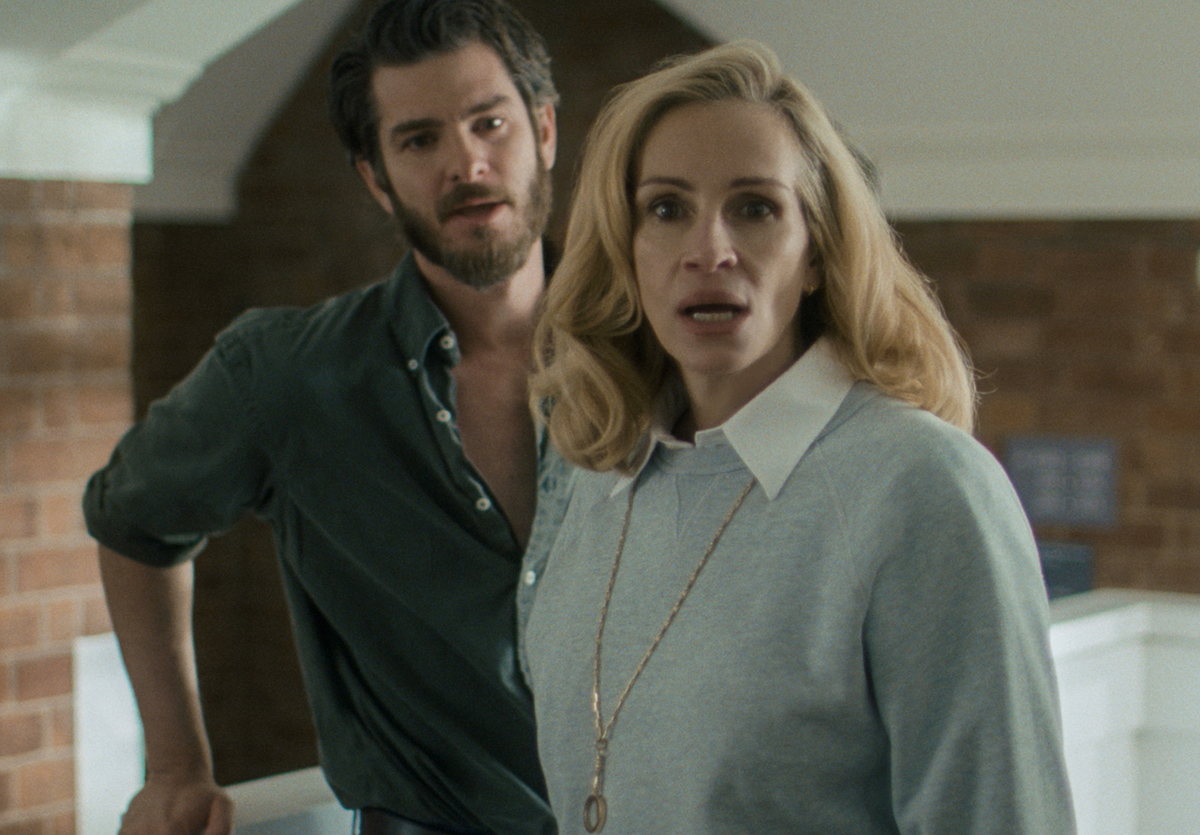
After the Hunt
Starring Julia Roberts, Andrew Garfield, Ayo Edebirl, Michael Stuhlbarg & Chloë Sevigny
Directed by Luca Guadagnino
Rated R
In theaters Friday, Oct. 17
When a Yale doctoral student accuses one of her professors of sexual assault, it sets off a chain reaction of consequences in this provocative psychodrama set in the heady world of academia.
Julia Roberts leads the stacked, all-star cast as Alma Imhoff, an adjunct psychology prof suffering from some internal mystery malady (she heaves over the toilet a lot). Maybe it’s stress related, since she’s certainly anxious about getting tenure—and mired in conflict when one of her students, Maggie (The Bear’s Ayo Edebirl), claims she was raped by one of Alma’s professorial colleagues, Hank (Andrew Garfield).
The situation is further complicated by the fact that Alma really likes both Maggie and Hank. Maggie insists she was raped. Hank proclaims his innocence. Who does Alma believe? Who do you believe?
Another professor (Chloë Sevigny) sniffs about Yale’s “entitled” student body, and how they’re quick to claim victimization of any kind. Michael Stuhlbarg plays Frederick, Alma’s doting psychiatrist husband.
After the Hunt is a-swirl with recriminations, he-said/she-said ambiguity, long-buried secrets, career-altering revelations and smoldering sexual tension. It’s about a “hunt” for truth, and assigning blame. It’s interwoven with talk about white male patriarchy, female solidarity, #MeToo, sexual misconduct, morality, restorative justice and racial inequality. There are conversations dense with banter about Aristotle, Freud, Arendt, Nietzsche and Kierkegaard. Sometimes it feels like a philosophy crash course.

It’s a knotty, complex story, largely told through Alma’s perspective as she reacts to what’s going on all around her—and realizes the need to reconcile her own past with her present. Roberts and the rest of the cast are terrific. The soundtrack (by the three-time Oscar-winning duo of Trent Reznor and Atticus Ross) scores what we’re seeing onscreen with a sometimes-unconventional sonic undercurrent effectively conveying the sense of creeping uncertainty and growing dread. Director Luca Guadagnino continues his interest in exploring the many ways passion, sexuality and amour can be twisted into dysfunction and dysphoria; After the Hunt certainly slices into a thematic vein shared with the Italian director’s previous films Challengers, Queer, Call Me by Your Name, Bones and All and Suspira.
It’s all very handsome, tony, provocative and well-crafted, but it asks a lot from the audience—including, with a running time of over two hours, more than a bit of patience. And it presents some truly thorny ideas and issues without really resolving or wrapping them up in the end—even though a hospital scene in the final stretch offers some insight, if not a tidy little bow. A “five years later” coda adds to the sense that time may not, in fact, heal all wounds. It’s not a feel-good movie, by any means. It challenges you to watch, listen, think and stew along with its characters.
As Alma snaps to Maggie in a heated up-close encounter, “Not everything is supposed to make you feel comfortable.” That obviously includes After the Hunt.
—Neil Pond




 The Media Tourist