The acclaimed director tackles a dark chapter of American history, and makes another movie masterpiece
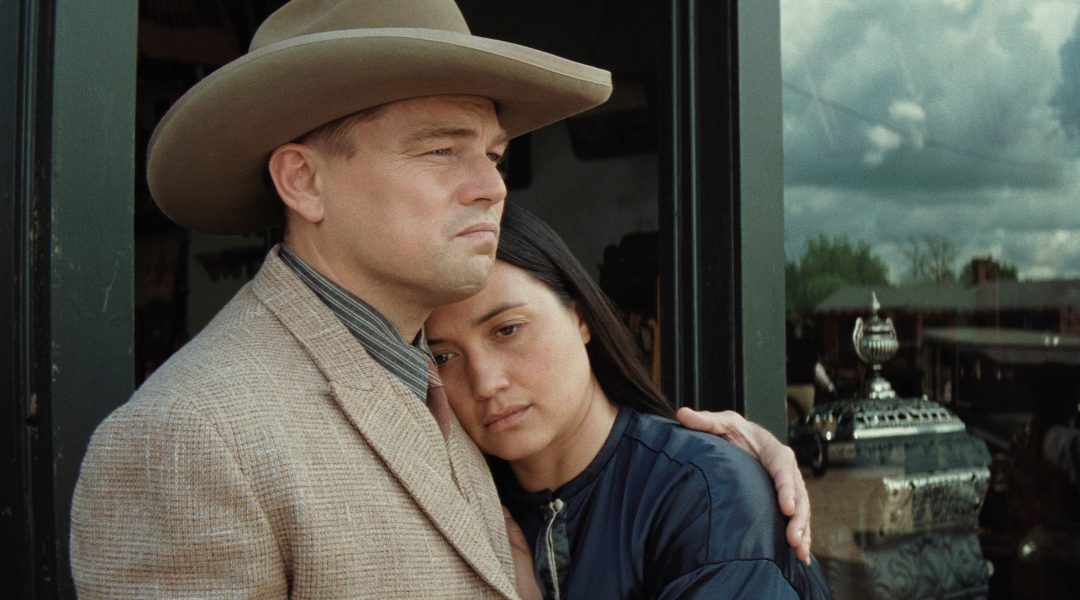
Killers of the Flower Moon
Starring Leonardo DiCaprio, Robert De Niro & Lily Gladstone
Directed by Martin Scorsese
Rated R
In theaters Friday, Oct. 20
“If you’re gonna make trouble, make it big.”
That’s what big-deal bigshot William Hale (Robert De Niro) tells his neophyte nephew (Leonardo DiCaprio) early in director Martin Scorsese’s sprawling, slow-burn neo-Western epic about a grim and horrific chapter of American history in the expanding frontier of the 1920s.
And indeed, there’s some very big trouble in this very big big-message movie, which clocks in at nearly three and a half hours.
DiCaprio’s character, Ernest Burkhart, is a young WWI veteran who returns from the battlefield to stake out a new life “out West” on the Great Plains of Oklahoma, where oil has been discovered on land settled and owned by the Native Americans of the Osage Nation. Ernest freely admits—a couple of times—that he “loves money,” and there’s certainly plenty of it here, bubbling and spewing in geysers from the ground…and making the Osage some of the most fabulously wealthy people on the planet.
And it’s also made a boomtown for carpetbaggers, non-indigenous “white” opportunists like Ernest’s uncle, thirsty for some of that black gold—or all of it. So, what will money-loving Ernest do to get filthy rich, far beyond what he can rake in playing poker or even pulling highway-robbery holdups?

Scorsese is probably best known for his crime sagas—Goodfellas, Casino, Gangs of New York, The Irishman, The Departed. This isn’t a “gangster” movie, as such, but it certainly has the feel of the director’s familiar wheelhouse, with a core group (yes, a gang) of bad men doing bad things. In the Osage Nation, they’re robbing the natives of their wealth by almost every means possible, including murder.
Ernest falls in love and marries an Osage woman, Molly (Lily Gladstone), and then, one by one, all Molly’s sisters and other family members start dying. Who’ll be next? Maybe even Molly? Who blew up that house? Or left that dead body out in the woods? And what’s Ernest got to do with it? As the death toll rises into double digits, J. Edgar Hoover sends a federal agent (Jesse Plemons) from the Bureau of Investigation—which would later become the FBI—to nose around.
Based on the bestselling 2017 novel by David Grann, it’s a complex, complicated tale of systemic racism, white nationalism, greedy imperialism, income disparity, ethnic genocide and a conspiracy of silence and coverup, all folded into a love story that takes a wrenching wrong turn. DiCaprio has rarely been better, playing a scowling, morally compromised yahoo in an oversized Stetson, and Gladstone (who grew up in the Blackfeet Nation) has an almost Mona Lisa-like serenity, anchoring the story with a radiance and grace that will doubtlessly be recognized by the Oscars and other year-end awards. Their chemistry is lusty and palpable.

It’s all massive, majestically moving and monumental, but also intimate, richly detailed and finely tooled, full of authentic “period” touches—and enough violence, including an ad hoc autopsy with a handsaw, to meet minimum requirements for a Martin Scorsese movie.
DeNiro—who, like DiCaprio, is one of Scorsese’s favorite go-to actors—is great, as usual, craftily playing “King” Bill Hale, a dapper Osage benefactor and community builder whose smile masks a much more sinister side. There are dozens of other characters too, many played by authentically indigenous Osage actors, and small-part cameos by musicians Jack White, Sturgill Simpson, Pete Yorn and Jason Isbell, plus Brendon Frasier and John Lithgow.
But appropriately enough, it’s Scorsese, the virtuoso filmmaker who’s crafted yet another cinematic masterpiece of movie storytelling, who gets the last word, quite literally, in a final wrap-up epilogue that show how true crime became entertainment for the masses—like this all-star opus about “big trouble” that the modern-day Osage still refer to as their nation’s Reign of Terror.
—Neil Pond
 The Media Tourist